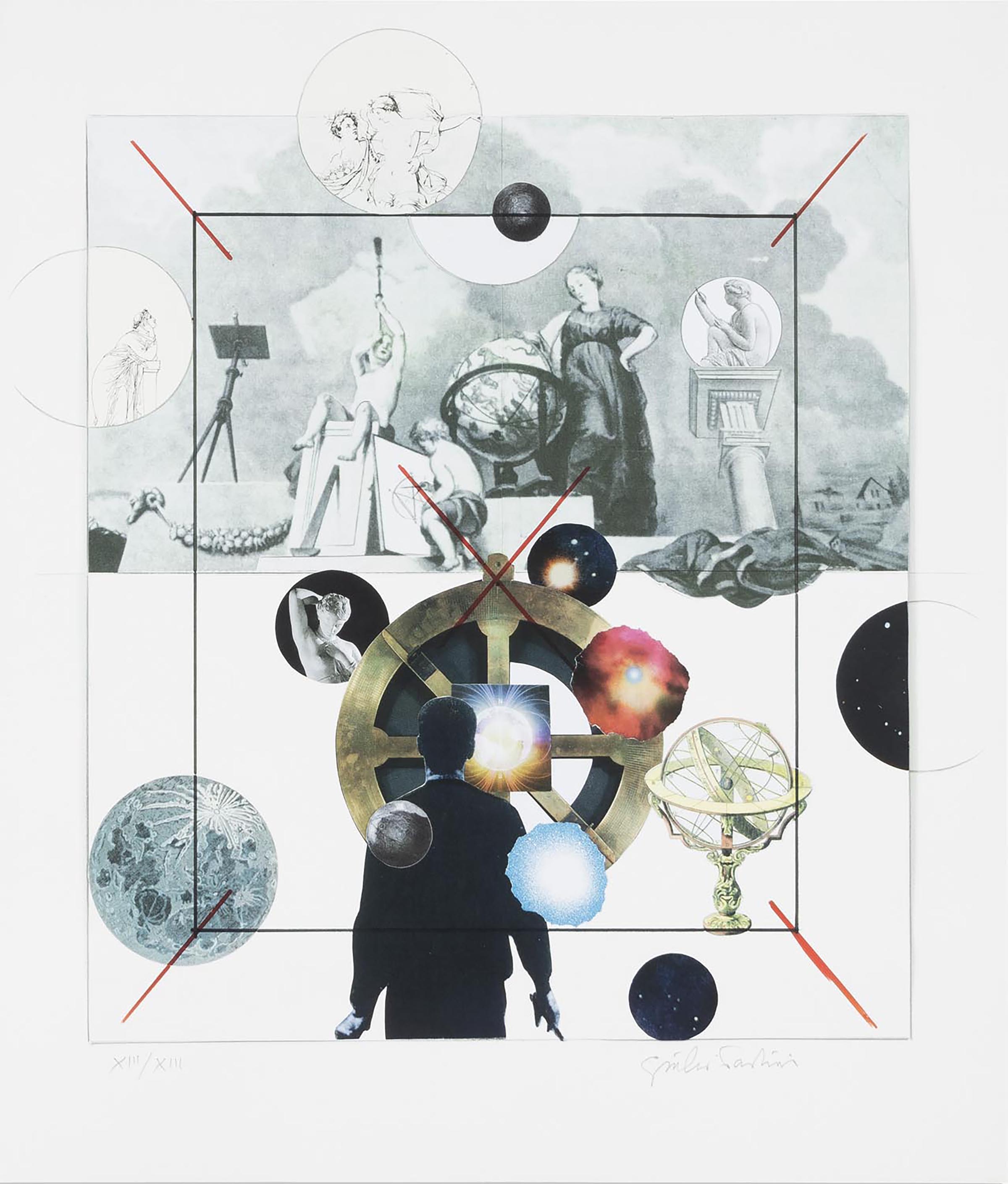
L’arte “a consulto”, 2017
GPE-0139
Asking Art for Guidance
Fine Art print
60 x 50 cm
Signed on the recto, bottom right: “Giulio Paolini”
Autograph numbering on the recto, bottom left
40 in Arabic numerals from 1/40 to 40/40
13 in Roman numerals from I/XIII to XIII/XIII
Consulta per la Valorizzazione dei Beni Artistici e Culturali di Torino, Turin
Marco Noire Editore, Turin
The print was produced by the artist for the Consulta per la Valorizzazione dei Beni Artistici e Culturali di Torino, Turin, on the occasion of the association's thirtieth anniversary. During the same year the Consulta had commissioned the artist to make Pietre preziose for the Giardini dei Musei Reali, Turin, inaugurated on 26 October 2017. The Consulta was born in 1987 at the behest of the Aziende piemontesi to safeguard the heritage of the City of Turin.
Double-sided grey full-cloth folder, with three white ribbon ties, closed format 62 x 51.5 cm; cover with titles in black (author, title, printer). Contains the plate, inserted in a bi-folio with title-page (first side), a list of the companies and the member institutes, and at the bottom information concerning the context of the production of the print (second side), a text by the artist (third side), and the colophon (fourth side).
Includes the title with a typo (”L’Arte ‘A Consulta’”) and information regarding the edition size, printer, publisher, and date of printing (December 2017).
Text by the artist, L’arte a “consulto”, on his thoughts about art.
A rectangle, whose diagonals are marked in red in the area corresponding to the centre and to the four vertices so that they coincide with the diagonals of the sheet, overlaps a composite image, divided horizontally. In the lower half a male figure viewed from behind, holding a pencil in his right hand, is intent on observing a varied ensemble of round shapes and spheres, characterized by a cosmic subject, integrated by an antique spherical astrolabe.1 The upper half of the plate, in black and white, with the sky in the background and in a perspective from below, instead features a banquet of mythological and allegorical figures, some of which inscribed inside a circle: visible to the left, in a contemplative demeanour, is Clio, Muse of History; at the centre one of two putti is busy using a telescope to observe the sky, while the other is drawing; next to them a female figure with a globe recalls an allegory of astronomy; to the right a crouching figure is painting; soaring above are a faun and a nymph with their heads encircled with a diadem of laurel leaves.
The figure viewed from the back (a stand-in for the author) turns its gaze towards an absolute dimension – represented by cosmic motifs and by the detail of a Neoclassical sculpture – which is impossible to gaze at without flinching, as suggested by the blinding globe at the figure's eye level. The allegorical Olympus of the arts, represented in the upper half of the plate, celebrates the very mystery of Art, which is always renewed from scratch in the framing of a painting.
The title implies a play on words that alludes to the patron, the Consulta of Turin. In the text that accompanies the edition, Paolini declares that art itself "must capture and translate the inspiration that allows it to surrender itself body and soul, assume its own image and take the great step: consult with the vast panorama of History and offer itself to our interpretation without uttering out loud its undisputable truth".
The print is based on the central collage of the triptych documented in the online Catalogue Raisonné of the works on paper at number GPC-1985.
1 The composition of the circular elements hinges on the great structure of an antique astrolabe, in a central position, around which nine circular images revolve – equal to the number of planets and Muses – which represent details of the starry sky, a nebula, the terrestrial globe, as well as the detail from Phryné (1845) by James Pradier. The motif of the figure seen from behind holding a pencil, turned towards a movement of circular elements, has a significant precedent in the print Santa Croce 2073 from 2010 (GPE-0124).
• Couple of figures in the tondo at the upper centre from L’Italia descritta e dipinta con le sue isole di Sicilia, Sardegna, Elba, Malta, Eolie, di Calipso, ecc. 2 (Turin: Giuseppe Pomba e C., 1837-38), plate 14 (“Pitture antiche. Affreschi di Pompei”).
• Figure in the tondo at the upper left from Thomas Hope, Costumes of the Greeks and Romans (New York: Dover Publications, 1962), plate 109 (“Clio from a statue in the Villa Borghese”).
• Figure in the tondo at the upper right: female nude with pen, Neoclassical period.
• Figure in the tondo at the center: Jean-Jacques Pradier, Phryné, 1845, marble, 183 x 40 x 47 cm, Musée de Grenoble, Grenoble.
• Figure viewed from behind at the lower centre: portrait of Giulio Paolini taken by Salvatore Mazza, 1993.

