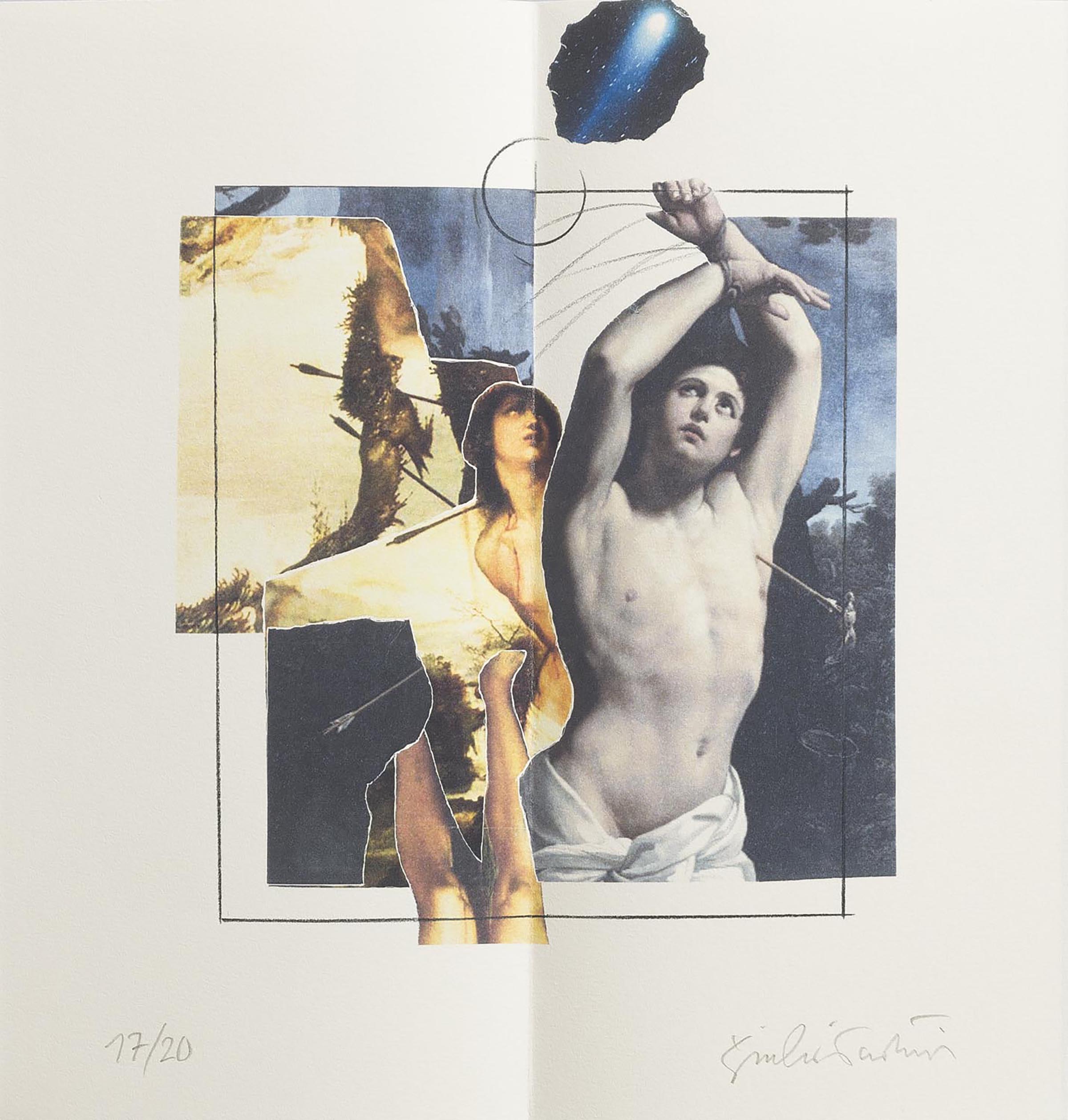
Estasi di San Sebastiano, 2020
GPE-0144
Ecstasy of Saint Sebastian
Lithograph and original pencil drawing by the artist
Plate 25 x 12 cm folded, 25 x 24 cm open
Signed on the recto, bottom right: “Giulio Paolini”
Autograph numbering on the recto, bottom left
20 in Arabic numerals from 1/20 to 20/20
4 unnumbered artist’s proofs
From one copy to another the freehand drawing made above the right arm of Guido Reni's Saint Sebastian varies just slightly.
Alberto Tallone Editore, Alpignano (Turin)
The print was commissioned from the artist by the publishing house Alberto Tallone Editore, Alpignano (Turin) – directed by Aldo and Enrico Tallone – on the occasion of the publication of the volume by Pietro Verri titled Sull’Indole del piacere e del dolore. The publisher's catalogue includes deluxe books of past and contemporary prose and poetry, created and produced entirely by hand.
Pietro Verri, Sull’Indole del piacere e del dolore (Alpignano: Alberto Tallone Editore, 2020). 25.5 x 12.6 cm, 105 pages, bound with soft cover, double hard casing. Introduction by Stefano Zecchi, essay by the author, text by Silvia Contarini, no illustrations. Limited edition of 160 numbered copies (on different types of paper), of which 20 (of the print run on Magnani pure cotton tissue paper) include the folded print edition, inserted in a white sleeve with flaps.
The book includes a colophon for the print with information about the original pencil drawing and numbering, and a colophon for the book with information about the print run, type of paper, font, place and date of printing (Alpignano, October 2020).
The print reproduces two pictorial representations of the martyrdom of Saint Sebastian, divided up into several parts and juxtaposed incongruously: in the left half of the plate the fragments of Sodoma's Martyrdom of Saint Sebastian (1527) prevail, while in the right half Guido Reni's Saint Sebastian (c. 1615) is dominant. The gazes of the two figures turned skywards are arranged in relation to the streak of sidereal light located at the top centre. A linear square, staggered with respect to the image, further reveals the discontinuity of the ensemble that seems to be held in precarious equilibrium by the circle outlined above, similar to the face of a clock.
The choice of the theme of the martyrdom and ecstasy of Saint Sebastian harkens back, figuratively, to the contents of Pietro Verri's eighteenth-century text for which the print was commissioned. The iconography of the saint pierced by arrows is, among other things, a recurring theme in Paolini's work since 1999 (cf. among the large-scale works GPO-0868, GPO-0978, GPO-1064, among the works on paper in particular GPC-0939, GPC-1538, GPC-1630, GPC-1632, GPC-2154, GPC-2155, GPC-2154). In the ecstasy of the martyrdom Paolini finds an allegory of the contrast between pleasure and pain that connotes the author's own condition, forever oriented towards an absolute dimension (represented in the print by the cosmic light and the perfect shape of the circle), albeit aware of its unattainability (as suggested by the incongruence between the parts making up the lithographic image).
The original collage on which the print is based is documented in the online Catalogue Raisonné of the works on paper at number GPC-2096.
• Figure on the left: Giovanni Antonio Bazzi known as Sodoma, Martirio di San Sebastiano, 1527, 206 x 154 cm, processional gonfalon, Galleria Palatina, Palazzo Pitti, Florence.
• Figure on the right: Guido Reni, San Sebastiano, c. 1615, oil on canvas, 127 x 92 cm, Musei di Strada Nuova, Palazzo Rosso, Genoa.

