L’exil du cygne, 1984
GPE-0046
Collotype
Plate 50 x 40 cm folded, 50 x 80 cm open
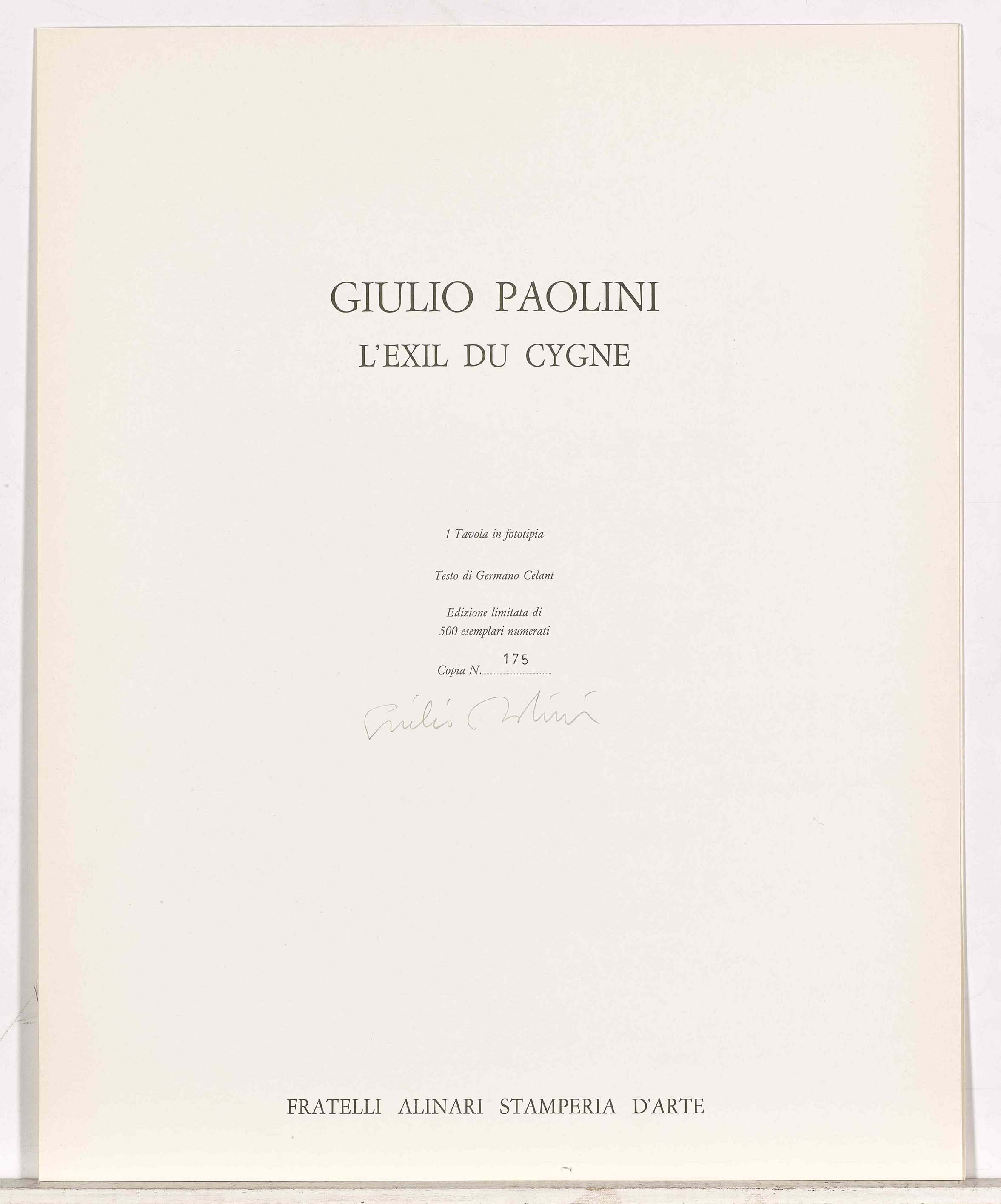
Signed on the colophon of the portfolio: “Giulio Paolini”
Stamp numbering on the colophon of the portfolio
500 in Arabic numerals from 1/500 to 500/500
Fratelli Alinari Stamperia d’Arte, Florence
The portfolio is part of the series Collection curated by Maria Gloria Bicocchi for the publisher Fratelli Alinari Stamperia d’Arte, Florence. The series of graphic editions by artists and architects, which began in 1983, was promoted by a Select Committee that included Maria Gloria Bicocchi, Germano Celant, Nicola Gandini, Vittorio Gregotti, and Pontus Hulten. The publishing plan for the years 1983-84 included for the visual arts editions by Michelangelo Pistoletto, Alberto Burri, Enzo Cucchi, Nicola De Maria, Jannis Kounellis, Sol LeWitt, and Giulio Paolini, and for architecture works by Lapo Binazzi, Superstudio, Andrea Branzi, and Hans Hollein.
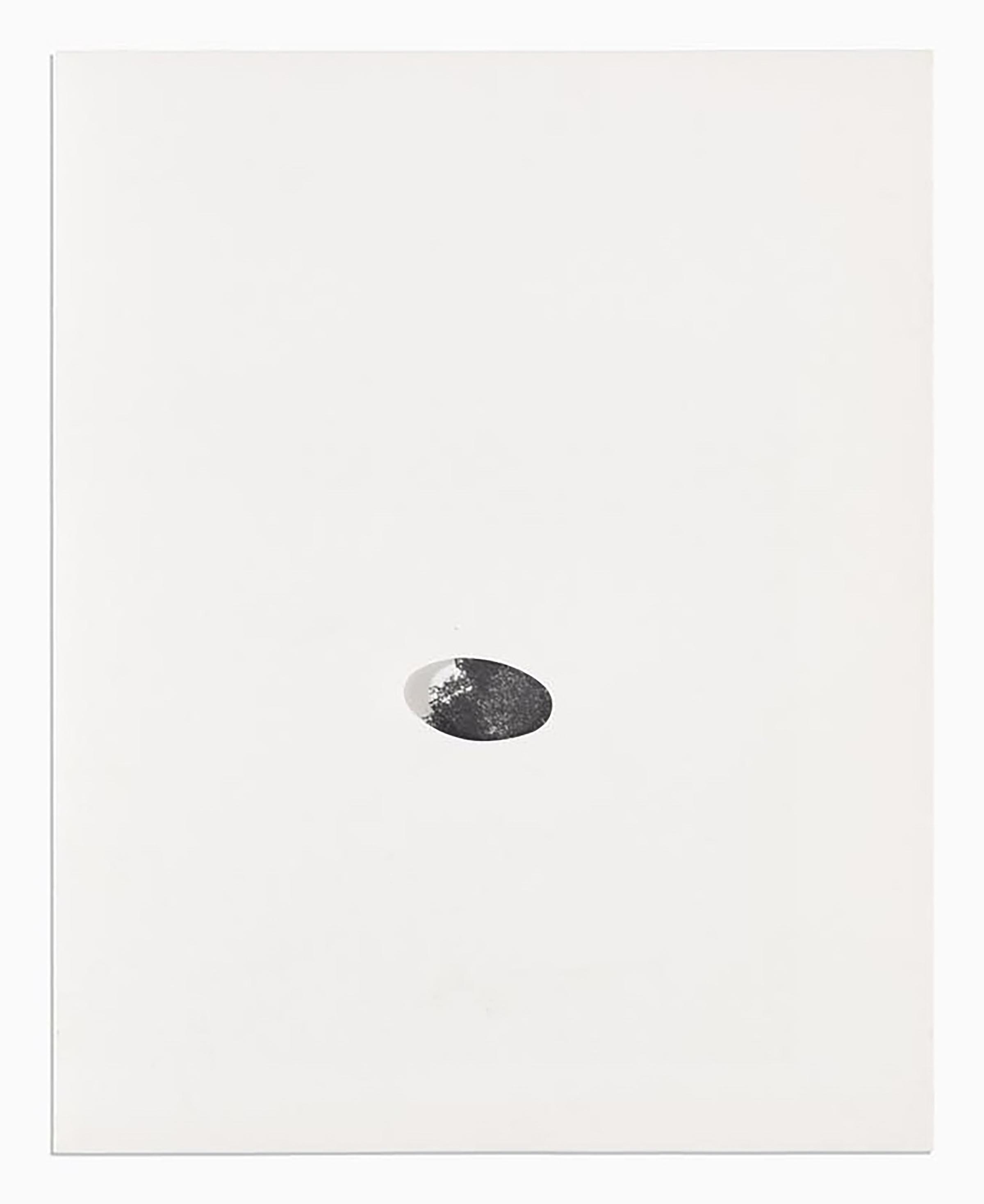
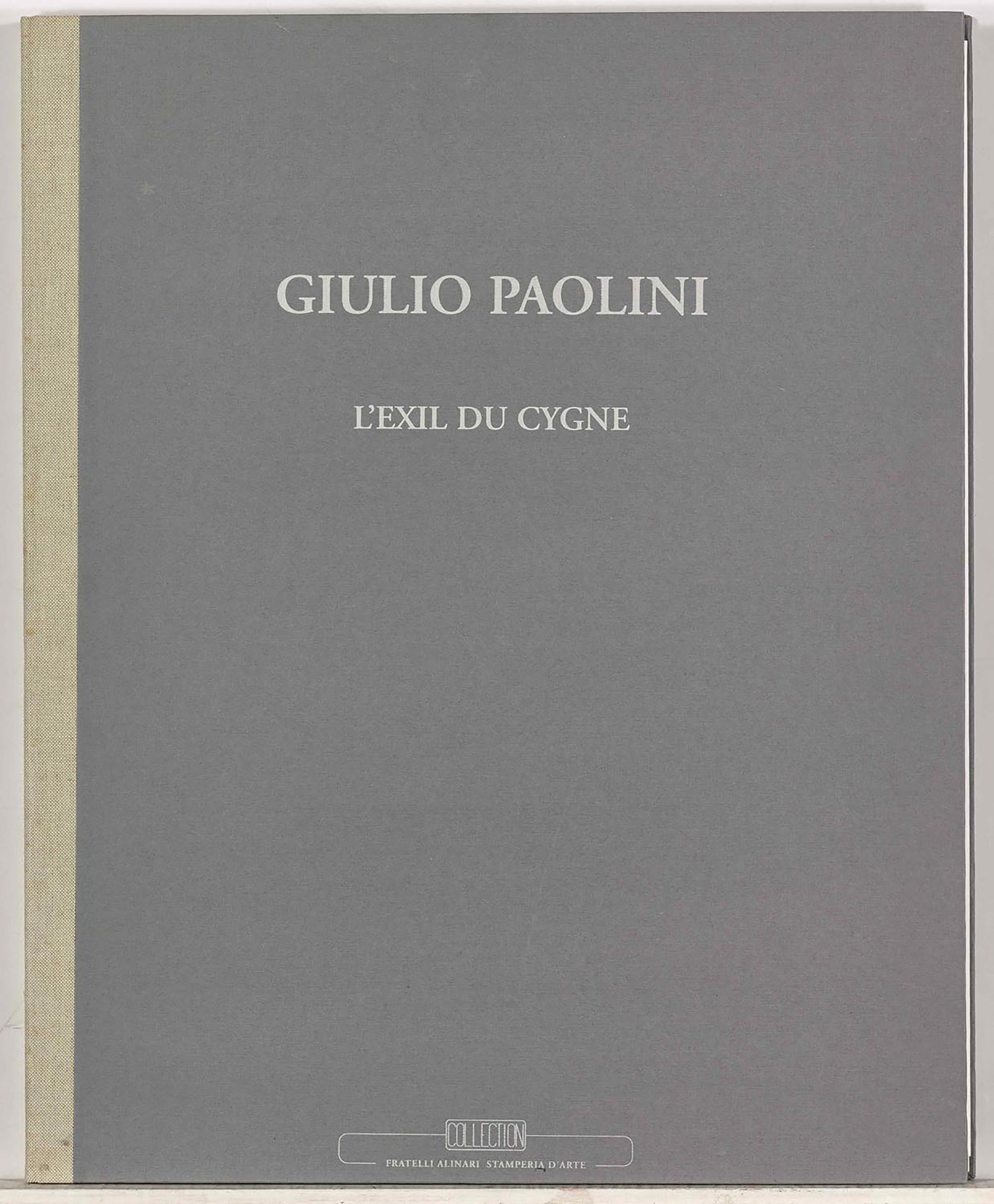
Double-sided grey cardboard folder, light cloth spine, with three glued flaps, closed format 52 x 42 cm; on the front board titles in grey (author, title, publisher). Contains a white sleeve with flap: the first side serves as a title-page and colophon, the fourth one provides information on the series that the work is a part of and on the related Consultant Committee; the folded plate is inserted in the sleeve along with a bi-folio including a text by Germano Celant (in Italian on the first and second sides, in English on the third and fourth sides) and a dark grey sheet with an explanatory note about the collotype, in Italian and in English.
Includes information regarding contents, printing technique, and edition size. Numbering and signature bottom centre.
• Text by Germano Celant, untitled; expanded republication of the essay “Del bello intelligibile”: l’architettura paoliniana, 1981 (in Il limite svelato. Artista Cornice Pubblico, exhibition catalogue, Turin, Mole Antonelliana [Milan: Electa, 1981], pp. 17-18), also corresponding to the original version of the text Giulio Paolini et la cité de l’art, 1983 (in Art press 76 [Paris], December 1983, pp. 28-31), with a never-before-published final paragraph. Presentation of the artist's research, in closing reference to the iconographic motifs of the print edition.
• Anonymous note, The Collotype Technique, with explanation of the photomechanical process of the collotype.
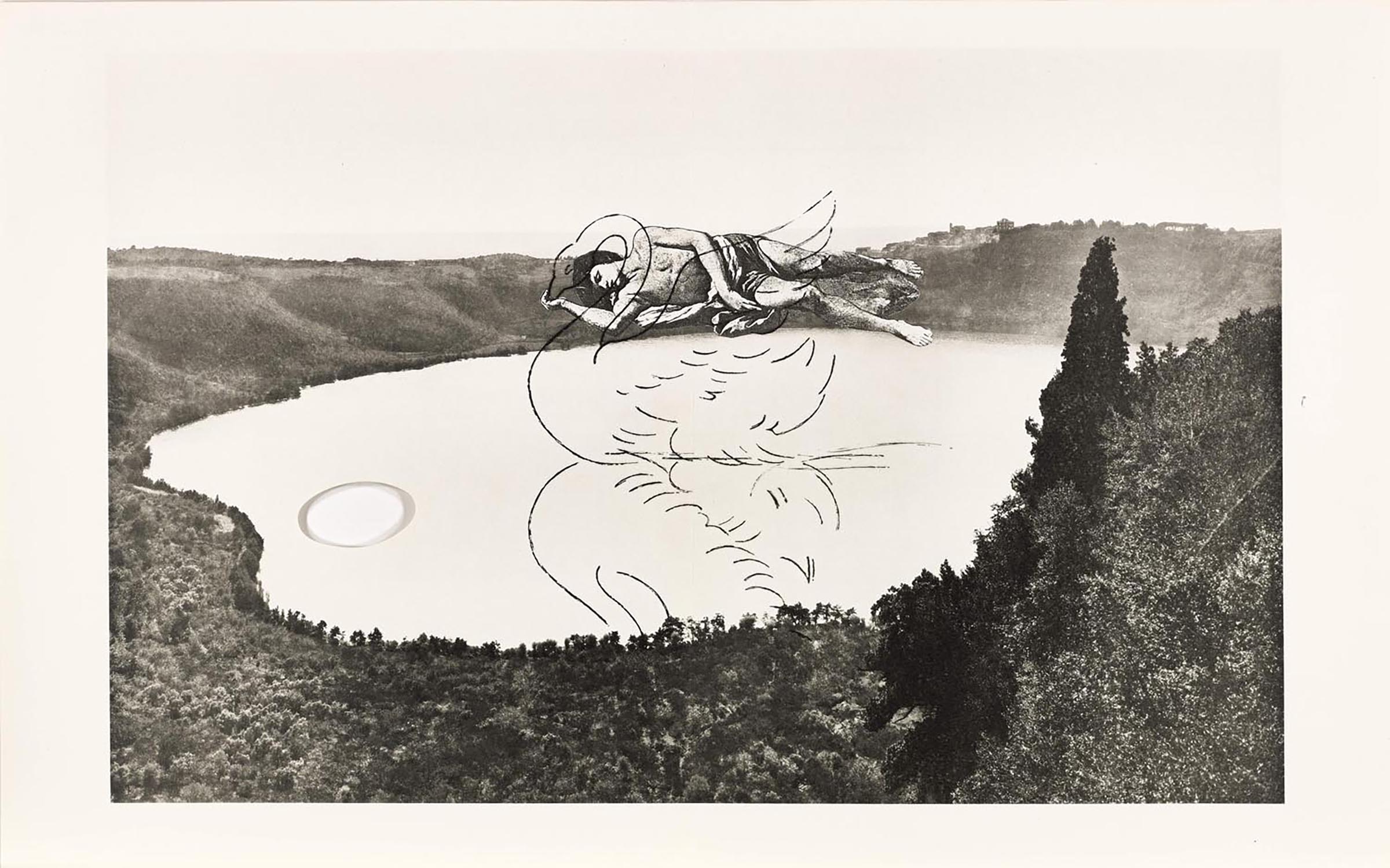
On the shores of Lake Nemi – transformed into a palette thanks to the oval cut-out to the left evoking its finger hole – lies the figure of Narcissus, after the painting Écho et Narcisse (c. 1630) by Nicolas Poussin. Converging in his right hand is the swan's beak drawn on the lake with its reflection, so that there is also complete alignment between the eyes of the two figures.
The association between Narcissus and the swan reflected in the water recalls the famous Greek myth, according to which the handsome young man, while bending over a pool of water to drink, notices his own image reflected in the water and is enthralled by it; attempting to touch it, he dies. Narcissus and the swan represent for Paolini a symbol of beauty and purity, albeit ineffable and unparalleled, as the title tells us. The words “the exile of the swan” recalls the famous last line of the sonnet Le vierge, le vivace et le bel aujourd'hui... (1887) by Stéphane Mallarmé, in which the swan, ideal symbol of the poetic flight, recognizes its exile, that is, its condition as a castaway in a frozen lake, condemned to motionlessness and impotence: an "exile" that in a metaphorical key recalls the insufficiency of the language with respect to the dimension of the Absolute.1
Narcisuss' and the swan's fate resounds in the title also through the underlying dilemma of the French homophones “signe” (sign) and “cygne” (swan), alluding to the eternal question whether the drawing remains a mere "sign", or whether instead the artifice of the representation transforms in into a complete image. According to the artist: "Cygne transformed into a cygne or cygne that remains a signe?"2
The print is part of a group of works on the same theme with the same title developed especially in the period 1982-1984, in the form of installations (GPO-0466, GPO-0513) as well as on paper (cf. GPC-0638, GPC-0639).
1 The last tercet in the sonnet, which is often quoted by Paolini in relation to the iconographic theme of the L’exil du cygne, reads: “Fantôme qu’à ce lieu son pur éclat assigne, / Il s’immobilise au songe froid de mépris / Que vêt parmi l’exil inutile le Cygne” (Phantom assigned to this place by his brilliance, / In his useless exile swathed, motionless, /By the Swan's cold dream of defiance").
2 G. Paolini, first publication in the text enclosed with the portfolio Les fausses confidences, 1983, republished in Giulio Paolini, vol. Images/Index (Villeurbanne: Le Nouveau Musée, 1984), p. 78.
• Figure: Nicolas Poussin, Écho et Narcisse, c. 1630, oil on canvas, 74 x 100 cm, Musée du Louvre, Paris; reproduction from L’opera completa di Poussin. Classici dell’arte 72 (Milan: Rizzoli, 1974), plate X, no. 49.
• Landscape: Fratelli Alinari, Nemi – Prov. di Roma. Panorama del Lago e della piccola borgata di Genzano, c. 1890, albumen silver print, 21 x 27 cm, Archivi Alinari, Florence (ACA-F-006861-0000).
| 1986 | Stuttgart, Staatsgalerie Stuttgart, Giulio Paolini, 20 September - 2 November, vol. 4 La visione / Die Vision, cited in the checklist of exhibited works no. 48 p. 53, not repr. |
| 1992 | Bonn, Bonner Kunstverein, Giulio Paolini. Impressions graphiques. Das graphische Werk 1967-1992, 24 February - 29 March (catalogue Impressions graphiques. L’opera grafica 1967-1992 di Giulio Paolini [Turin: Marco Noire Editore, 1992], cat. no. 44). |
| 1993 | Winterthur, Kunstmuseum Winterthur, Giulio Paolini. Impressions graphiques. Das druckgraphische Werk 1967-1992, 16 January - 7 March (catalogue Impressions graphiques. L’opera grafica 1967-1992 di Giulio Paolini [Turin: Marco Noire Editore, 1992], cat. no. 44). |
| 1995 | Lisbon, Fundação Calouste Gulbenkian / Centro de Arte Moderna José de Azeredo Perdigão, Giulio Paolini. Impressions graphiques. Múltiplos e Obra Gráfica 1969-1995, 16 March - 28 May, not repr. in the exhibition brochure (catalogue Impressions graphiques. L’opera grafica 1967-1992 di Giulio Paolini [Turin: Marco Noire Editore, 1992], cat. no. 44). |
| 1996 | Rome, French Academy, Villa Medici, Giulio Paolini. Correspondances, 13 March - 28 April, cited in the checklist of exhibited works n. pag. (erroneously dated “1983”), repr. no. 10, with quotation from Mallarmé. |
| 1996 | Apolda, Kunsthaus Apolda Avantgarde, Giulio Paolini. Impressions graphiques, 27 September - 27 October (catalogue Impressions graphiques. L’opera grafica 1967-1992 di Giulio Paolini [Turin: Marco Noire Editore, 1992], cat. no. 44). |
| 1997 | Göppingen, Kunsthalle, Giulio Paolini. Impressions graphiques. Das graphische Druckwerk 1967-1995, 9 March - 13 April (catalogue Impressions graphiques. L’opera grafica 1967-1992 di Giulio Paolini [Turin: Marco Noire Editore, 1992], cat. no. 44). |
| 2000 | Turin, Archivio di Stato, Tirannicidi II-III: la Stampa e la Fotografia, 6 September - 15 October. |
| 2000-01 | Bologna, Studio G7, Giulio Paolini. Opere Grafiche, 16 December 2000 - 20 January 2001. |
| 2002 | Paris, Istituto Italiano di Cultura, Impressions graphiques. L’œuvre graphique de Giulio Paolini 1967-2000, 23 April - 21 May, no catalogue. |
| 2002 | Nuoro, MAN Museo d’Arte Provincia di Nuoro, Vis à vis. Autoritrarsi d’artista, 10 May - 30 June, cited in the checklist of exhibited works p. 128, repr. p. 91. |
| 2011 | Bologna, Aula Magna della Biblioteca Universitaria, Libro / Opera. Viaggio nelle pagine d'artista. La collezione di Danilo Montanari, 16 September - 12 October, repr. p. 147. |
| • | G. Paolini, Fantôme..., first published in the text included with the portfolio Les fausses confidences, 1983, cf. GPE-0042; republished in Giulio Paolini, vol. Images/Index (Villeurbanne: Le Nouveau Musée, 1984), p. 78; Id., Giochi d’acqua. Disegni e note 1983-85 (Rome: Galleria Pieroni, 1985), n. pag.; Giulio Paolini. Tutto qui, exhibition catalogue, Ravenna, Pinacoteca Comunale, Loggetta Lombardesca (Ravenna: Agenzia Editoriale Essegi, 1985), p. 138; G. Paolini, Ancora un libro (Rome: Editrice Inonia, 1987, p. 11); Impressions graphiques. L’opera grafica 1967-1992 di Giulio Paolini (Turin: Marco Noire Editore, 1992), cat. no. 44. |
| • | Impressions graphiques. L’opera grafica 1967-1992 di Giulio Paolini (Turin: Marco Noire Editore, 1992), cat. no. 44 (erroneously dated “1983”), repr., with note by the artist Fantôme.... |
| • | M. Disch, Giulio Paolini. Catalogo ragionato 1960-1999, vol. 2 (Milan: Skira editore, 2008), cat. no. 513 p. 524, not repr. |

