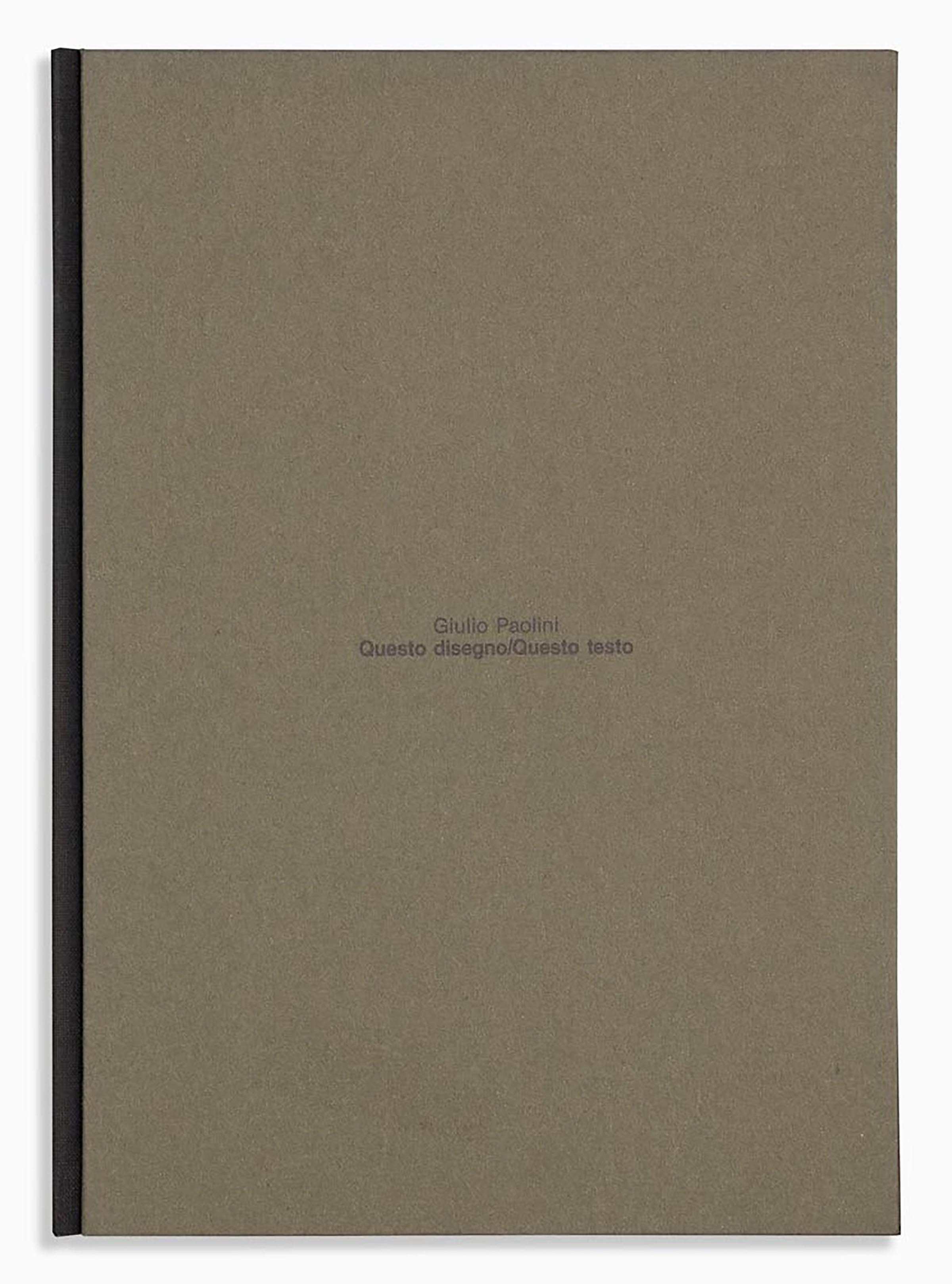
Questo disegno / Questo testo, 1982
GPE-0159
This Drawing / This Text
Photo-lithographic print
Cover: Ventura Affresco, on cardboard
Inside pages: Fedrigoni Golden Star K 115 g
Book 24.5 x 17.5 cm close, 24.5 x 34.7 cm open
No inscriptions
No numbering
850 unnumbered copies
Fabrizio Pozzilli Editore, Rome
Tipolitografia Fernando Begliomini, Rome
The book is part of the series of artist's books Libro-Lavoro, curated and produced by the Roman publisher Fabrizio Pozzilli. The publications all share the same format and binding, with a hard cover and black fabric for the spine. Paolini's volume is the second in the series, which began in 1979 with Michele Parisi.
The colophon of the book includes information regarding the printing technique (Offset Roland), photo-retoucher (Arti Litozincografiche Eliseo, Roma), type of paper, print run, and copyright (© 1982 Giulio Paolini, Fabrizio Pozzilli).
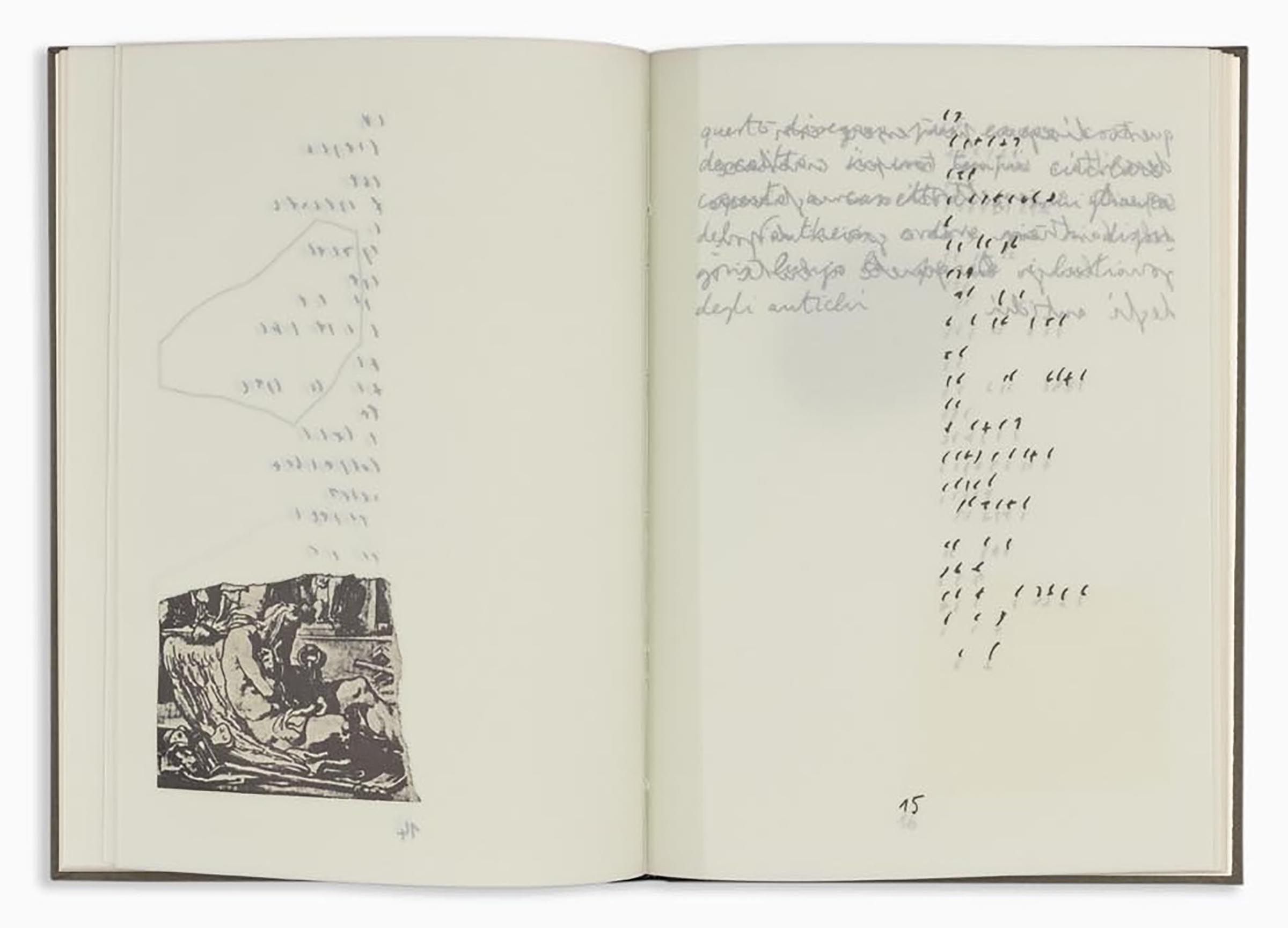
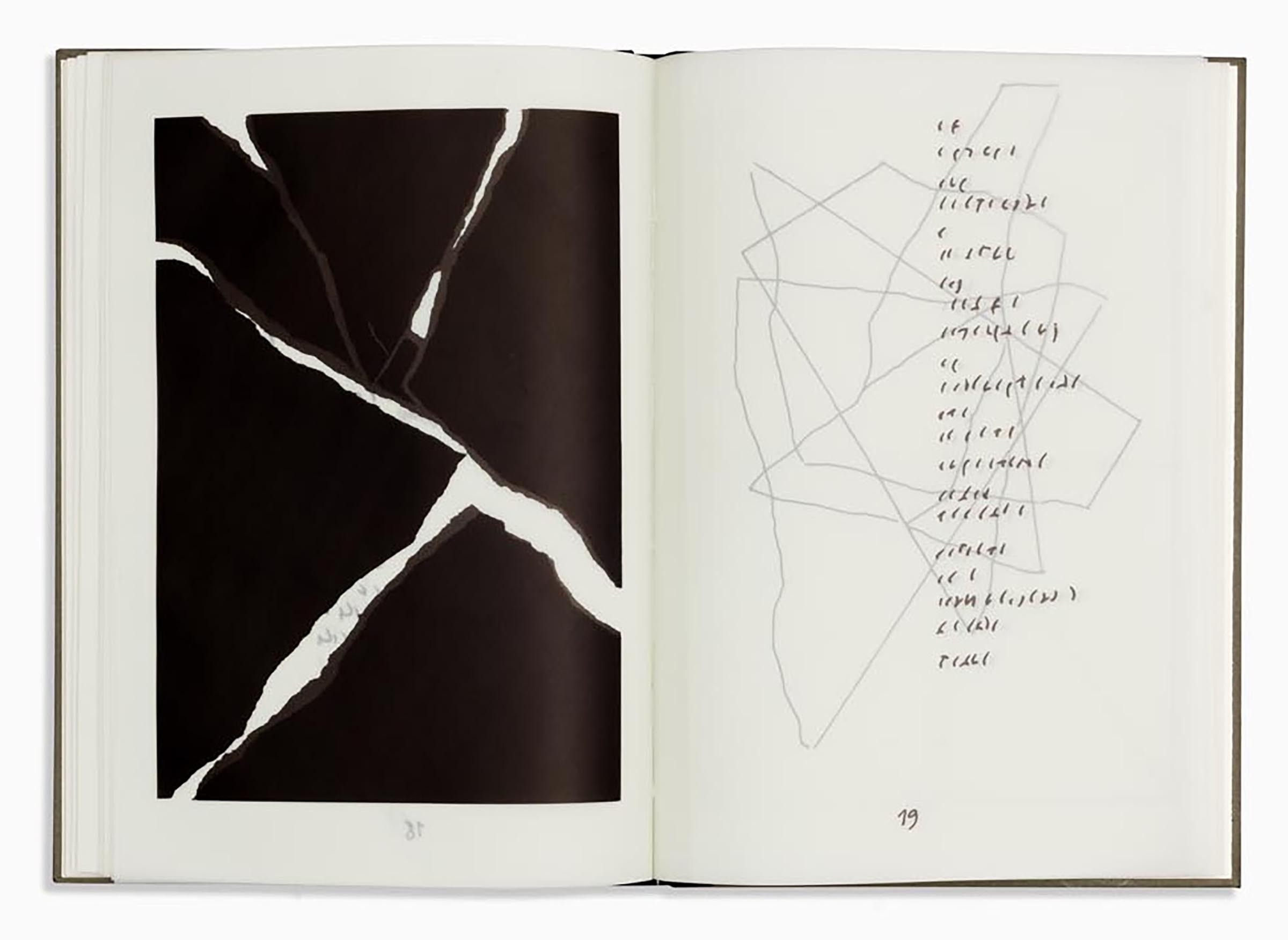
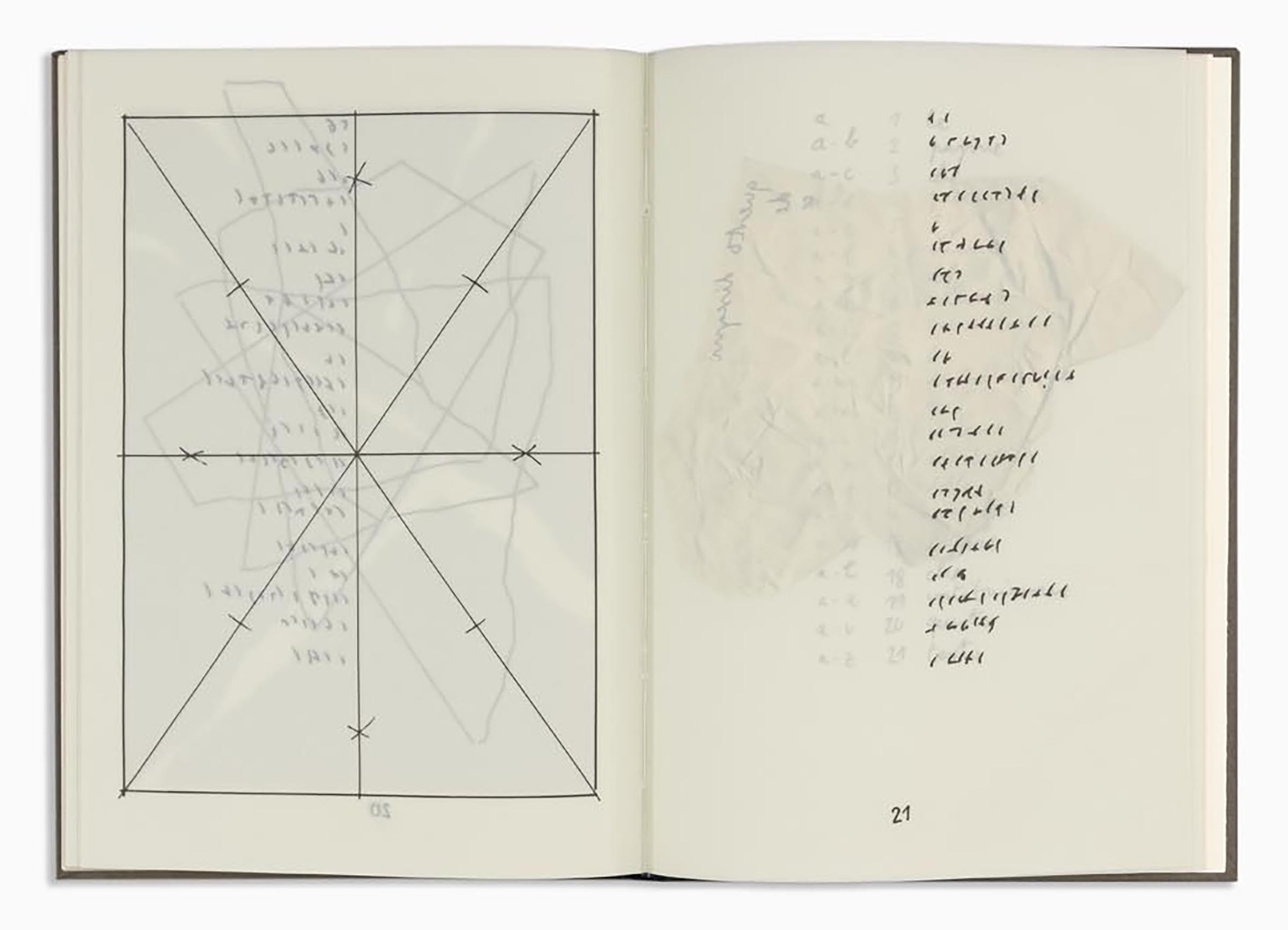
The volume with an olive cardboard cover – black spine, on the front board titles in black, with blank end papers in off-colour paper – is made up of 112 pages of tracing paper.1 As the two segments of the title tell us, the contents of the book involve a "drawing" and a "text", the first of which developed on the pages to the left, and the second of which on the pages to the right.2
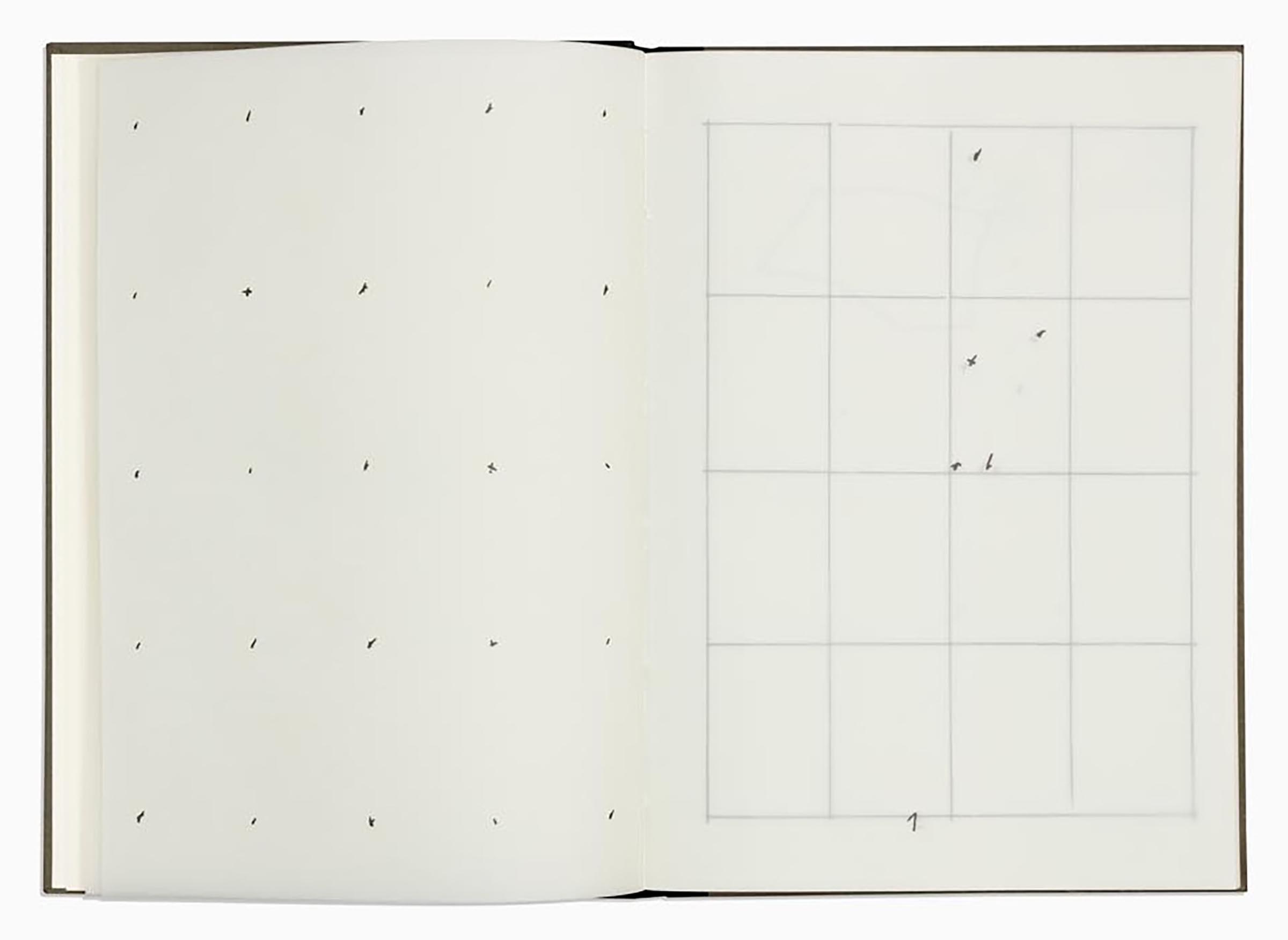
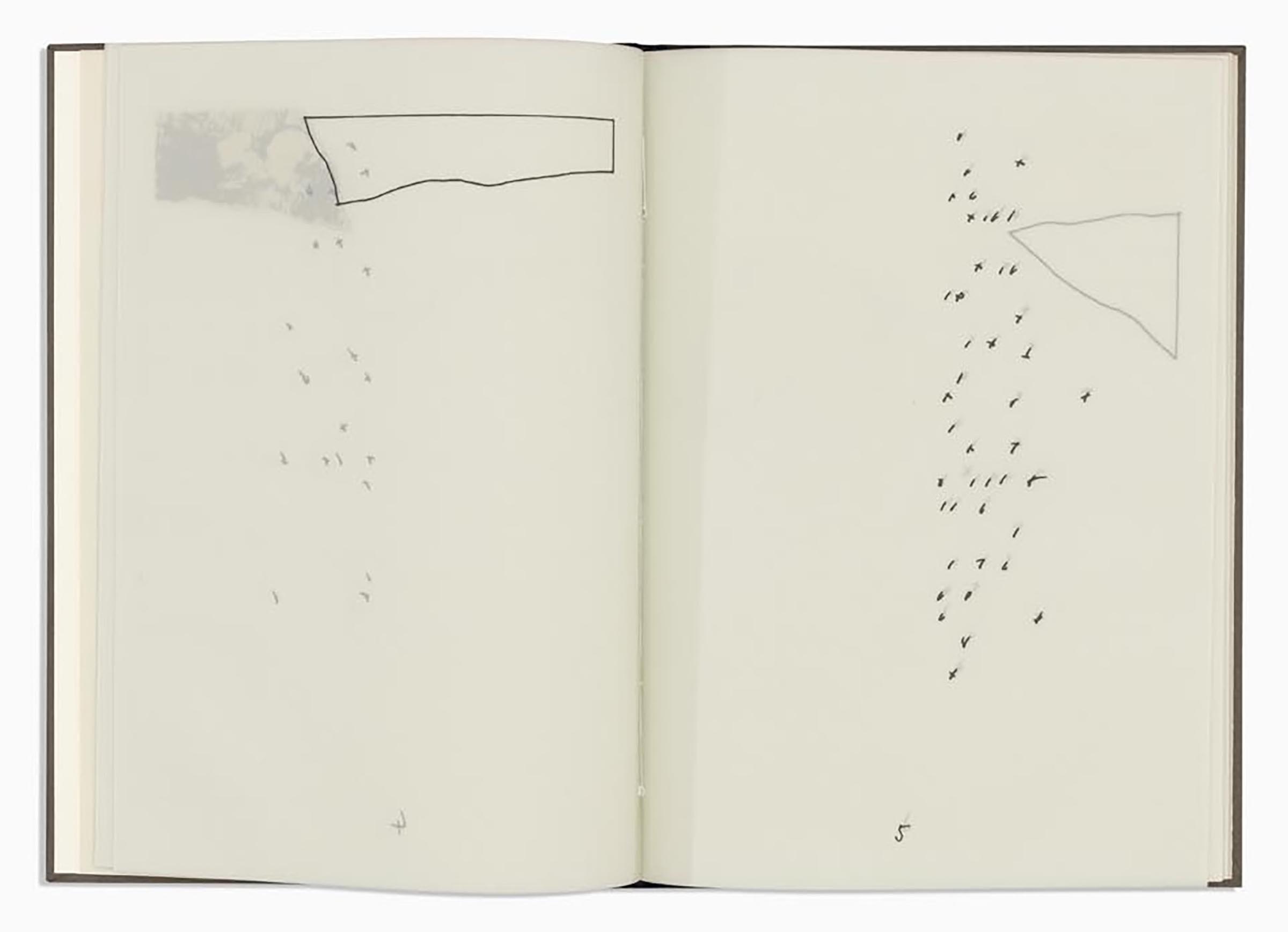
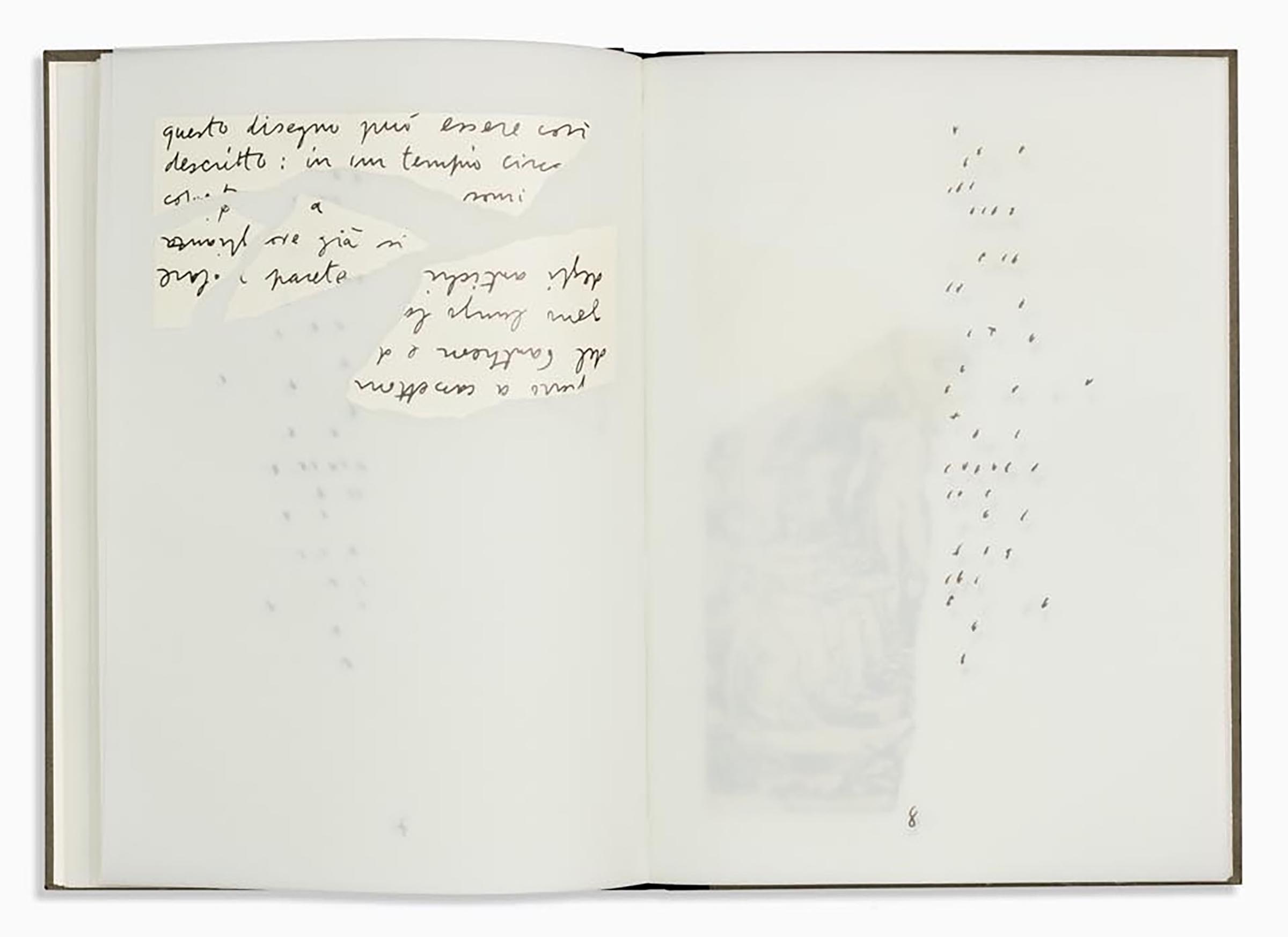
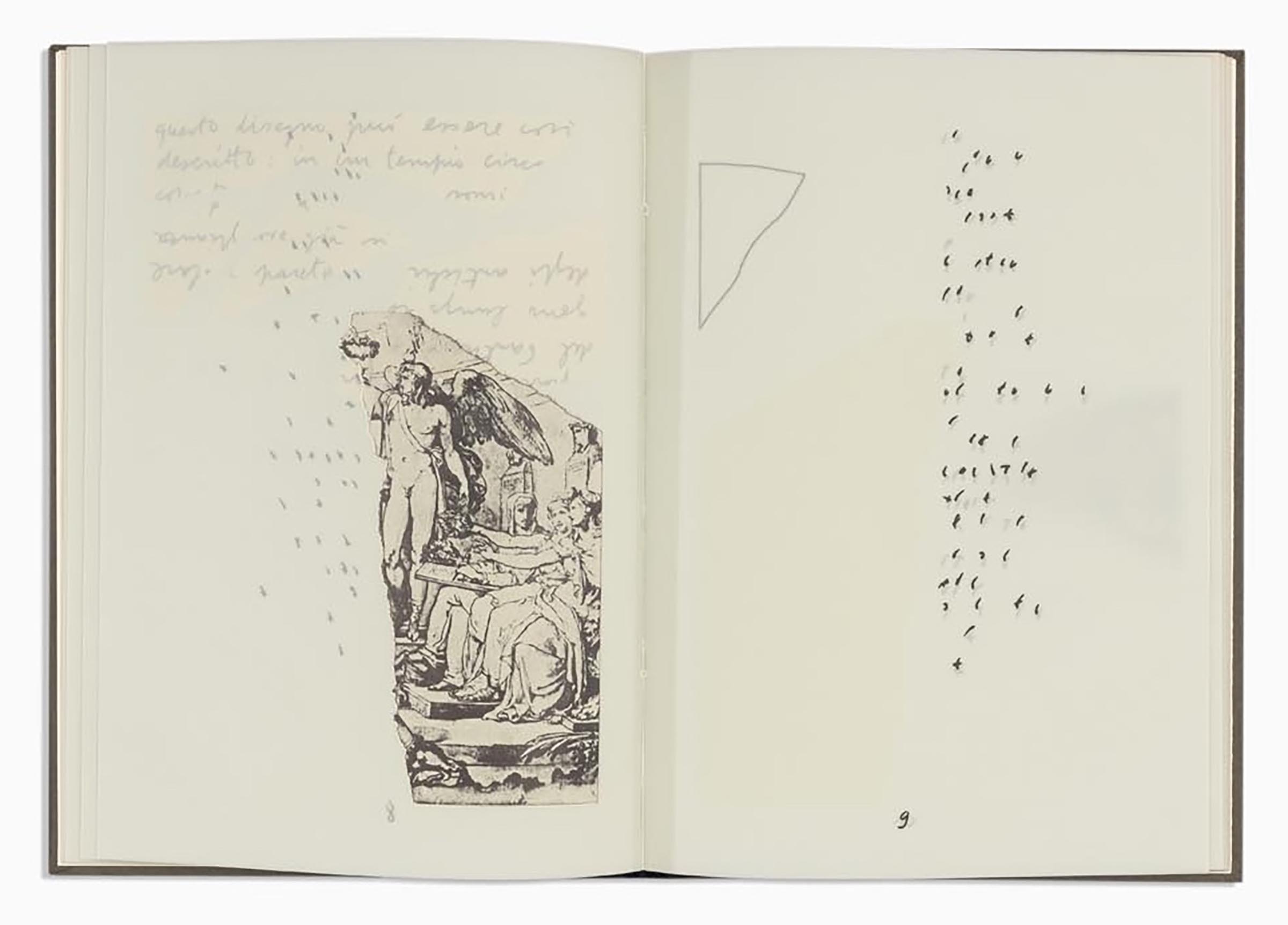
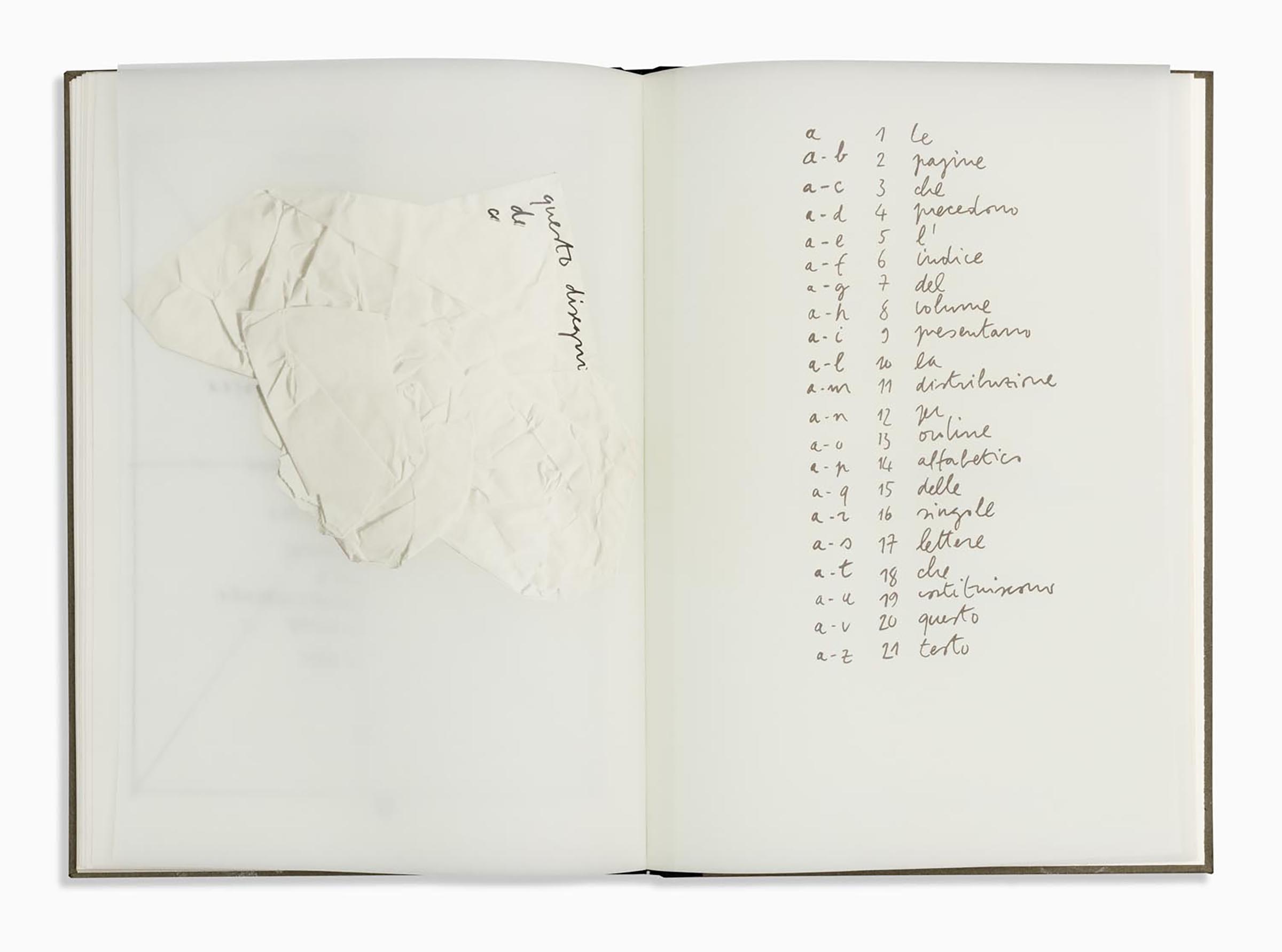
To the left, the succession of pages opens with a pattern of small signs that trace over the intersection points of the modules of a regular grid, reproduced on the following left page. The following pages feature the torn fragments of an ancient drawing3 – limited to the linear outline or taken from a photographic reproduction – alternated with fragments of the description of the alleged drawing (the manuscript text is torn or overwritten by the same text t reflected horizontally4). The last pages instead present torn black fragments, arranged to compose an incongruous surface, limited to the drawing of the outline, overlapping one another. In closing, to complement the initial grid, the geometric drawing of the squaring appears, followed by the image of a crumpled up sheet that allows the viewer to glimpse the start of the description (”this drawing”), as if it were the manuscript of the text glimpsed on the previous pages.
To the right, the pages in numbered succession feature minuscule abstract signs that, little by little, in alphabetical order from “a” to “z” mark the position of the individual letters that make up the text featured in the final contents. Indicated on page 1 with just a sign are all the times the letter “a” occurs, on page 2 all the times the letters “a” and “b” occur, and so on until page 21 that traces all the letters of the Italian alphabet that make up the sentence scanned in the contents, in 21 lines corresponding to 21 pages of “text”. The sentence is as follows: “The pages that precede the contexts of the volume feature the distribution in alphabetical order of the individual letters that make up this text."
The volume thus presents an anatomical reading of the visual and textual language, broken down into minimum units, which, unlike the analytical appearance, dissolves the image and the writing into forms and signs that are devoid of their original meaning. The “drawing” remains unknown, and the “text” is illegible; the end of each reading returns to the beginning, in a closed circuit. In the pages to the left, the drawing and the writing chase each other without ever coming together, while in the pages to the right the signs referred to the textual language become the clues for a hypothetical drawing. Furthermore, in the succession of translucid pages, the signs of the text and the parts of the drawing mutually follow each other, for an inextricable ambiguity that belies the clear separation announced in the title as well as the precise identity indicated by the demonstrative adjective "this".
On a conceptual level, the "drawing" as well as the "text" do not reveal anything to bring the viewer's attention back to the preliminary line – to the premise – which oversees their hypothetical becoming. The "drawing", in addition to by way of the paging of the fragments, announces itself via "the conditions of spatial framing5 (the grid at the beginning, the drawing of the squaring at the end); the "text" is limited to pointing to the table of contents of the volume, which by definition announces the contents of a book.
1 The pages include, in this order: subheading with information concerning the series, the title-page, six blank pages, eighty-eight pages with interventions by the artist, six blank pages, a page that seals the part of the contents dated “Torino 1981-1982”, the colophon, a page featuring the imprint date and details about the printer and the publisher, and two final blank pages.
2 As the book is made up of tracing paper, each printed double page (left and right) is followed by an unprinted double page (corresponding to the verso, blank, of the printed pages). The pages on the left, which are reserved for the "drawing", are unnumbered, while the ones on the right, relating to the "text", bear autograph numbering from 1 to 21, reported in the final in contents.
3 The drawing, which has not yet been identified, in all likelihood represents an allegory of the arts, probably dated to the eighteenth century.
4 The manuscript text reads: “This drawing can be described as follows: a circular temple covered with coffering similar to the Pantheon and where already on display along the wall are the busts of the ancients".
5 Paolini expresses himself in these terms as concerns his first painting, Disegno geometrico, 1960 (GPO-0001), in which the squaring of the surface of the canvas is limited to indicating the "conditions of the spatial setting in which the painting could be conceived" (cf. M. Pistoi, “Presentazioni: Giulio Paolini", in Marcatrè 19-22 [Milan], April, 1966, p. 385, interview republished in Giulio Paolini 1960-1972, edited by G. Celant [Milan: Fondazione Prada, 2003], pp. 178, 180).
| 1989 | Turin, Salone del Libro, Impressions graphiques. Progetti e collaborazioni editoriali di Giulio Paolini, 12-18 May, cat. no. 8 (section “Edizioni a tiratura numerata”), not repr. |
| 1992 | Bonn, Bonner Kunstverein, Giulio Paolini. Impressions graphiques. Das graphische Werk 1967-1992, 24 February - 29 March (catalogue Impressions graphiques. L’opera grafica 1967-1992 di Giulio Paolini [Turin: Marco Noire Editore, 1992], cat. no. 39). |
| 1993 | Winterthur, Kunstmuseum Winterthur, Giulio Paolini. Impressions graphiques. Das druckgraphische Werk 1967-1992, 16 January - 7 March (catalogue Impressions graphiques. L’opera grafica 1967-1992 di Giulio Paolini [Turin: Marco Noire Editore, 1992], cat. no. 39). |
| 1995 | Lisbon, Fundação Calouste Gulbenkian / Centro de Arte Moderna José de Azeredo Perdigão, Giulio Paolini. Impressions graphiques. Múltiplos e Obra Gráfica 1969-1995, 16 March - 28 May, not repr. in the exhibition brochure (catalogue Impressions graphiques. L’opera grafica 1967-1992 di Giulio Paolini [Turin: Marco Noire Editore, 1992], cat. no. 39). |
| 1995 | Limoges, Saint-Yrieix-la-Perche, Théâtre du Centre Jean-Pierre Fabrègue, Bookmakers. Une exposition des livres d’artistes de Zona Archives, 2 June - 15 August, cited in the checklist of exhibited works n. pag., not repr. |
| 1996 | Turin, Galleria Martano, Artists’ Books, 8 May - 10 June, cited in the checklist of exhibited works n. pag., not repr. |
| 1996 | Apolda, Kunsthaus Apolda Avantgarde, Giulio Paolini. Impressions graphiques, 27 September - 27 October (catalogue Impressions graphiques. L’opera grafica 1967-1992 di Giulio Paolini [Turin: Marco Noire Editore, 1992], cat. no. 39). |
| 1997 | Göppingen, Kunsthalle, Giulio Paolini. Impressions graphiques. Das graphische Druckwerk 1967-1995, 9 March - 13 April (catalogue Impressions graphiques. L’opera grafica 1967-1992 di Giulio Paolini [Turin: Marco Noire Editore, 1992], cat. no. 39). |
| 2002 | Paris, Istituto Italiano di Cultura, Impressions graphiques. L’œuvre graphique de Giulio Paolini 1967-2000, 23 April - 21 May, no catalogue. |
| 2002 | Modena, Biblioteca civica d’arte Luigi Poletti, Giulio Paolini. Pagine, 20 September - 23 November, col. repr. p. 38 (caption p. 91). |
| 2016 | Turin, Norma Mangione Gallery, I/2.3.4..., 20 February - 9 April. |
| 2023 | Milan, Libreria Antiquaria Pontremoli, Arte Povera, 16 February - 2 March, col. repr. pp. 75 (ook cover and title page), 76, entry by R. Colombo and C. Lietti pp. 74-75. |
| • | Impressions graphiques. L’opera grafica 1967-1992 di Giulio Paolini (Turin: Marco Noire Editore, 1992), cat. no. 39, repr. |
| • | Giulio Paolini, vol. Images/Index (Villeurbanne: Le Nouveau Musée, 1984), repr. pp. 56-57. |
| • | F. Poli, “Note di lettura”, in Giulio Paolini (Turin: Lindau, 1990), p. 41, not repr.; republished in Giulio Paolini. Von heute bis gestern / Da oggi a ieri, exhibition catalogue, Graz, Neue Galerie im Landesmuseum Joanneum (Ostfildern-Ruit: Cantz Verlag, 1998), p. 67, not repr. |
| • | L. Dematteis, G. Maffei, Libri d’artista in Italia 1960-1998 (Turin: Regione Piemonte, 1998), cat. no. 2091 p. 178, repr. p. 177 (cover). |
| • | Guardare Raccontare Pensare Conservare. Quattro percorsi del libro d’artista dagli anni Sessanta ad oggi, exhibition catalogue, Mantua, Casa del Mantegna (Mantua: Corraini Edizioni, 2005), repr. p. 85. |
| • | Galleria Nazionale d'Arte Moderna & MAXXI. Le Collezioni 1958-2008, vol. II, edited by S. Frezzotti, C. Italiano and A. Rorro (Milan: Mondadori Electa, 2009), repr. p. 771. |

