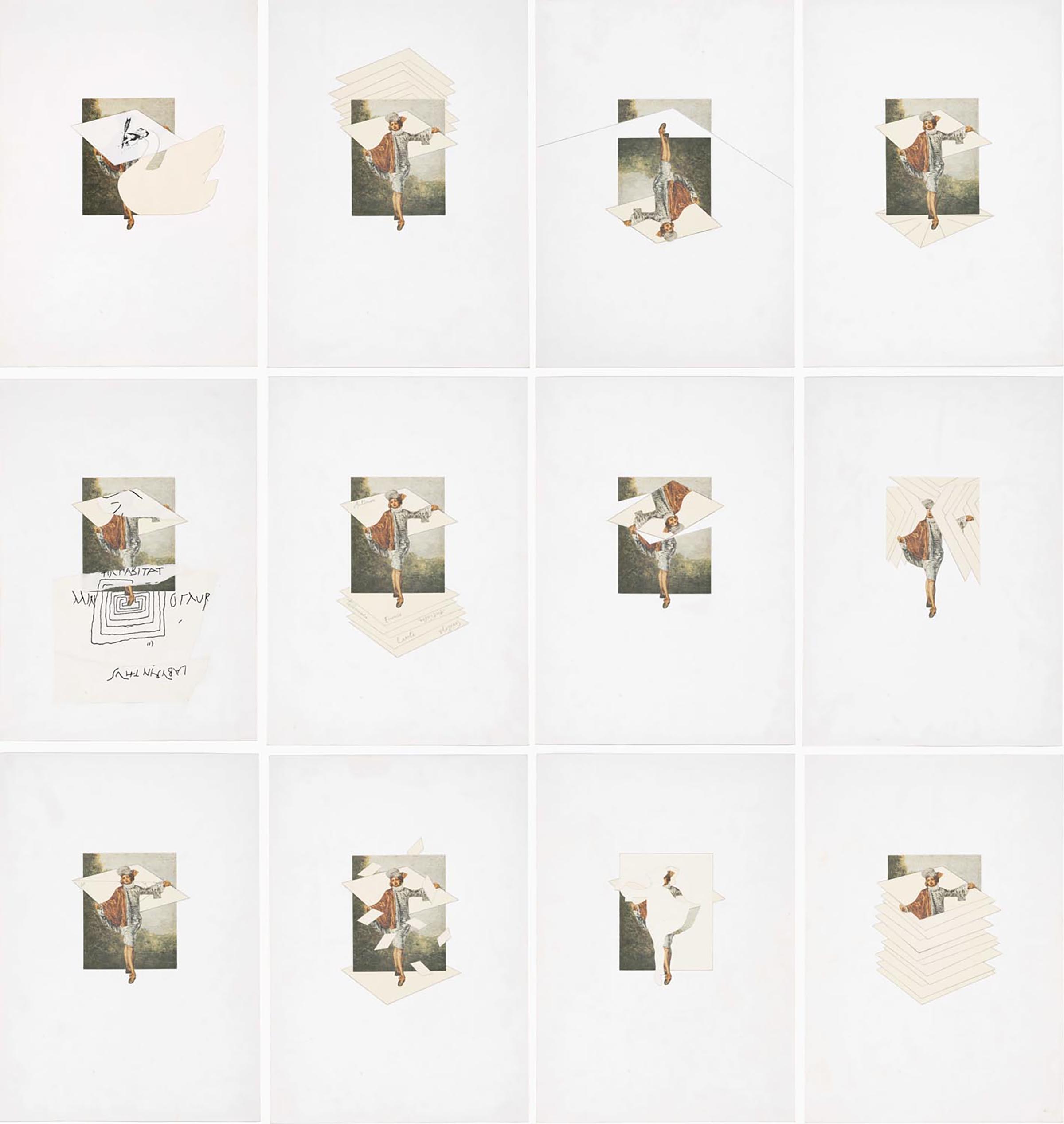
Les fausses confidences, 1983
GPE-0042
Lithograph
Twelve plates 47.6 x 33.8 cm each
Signed on the recto of each plate, bottom right: “G.P.”
Autograph numbering on the recto of each plate, bottom right
100 in Arabic numerals from 1/100 to 100/100
20 in Roman numerals from I/XX to XX/XX
Giulio Einaudi editore, Turin
Pozzo Gros Monti, Moncalieri (Turin)
The graphic portfolio was commissioned from the artist by Giulio Einaudi. The artist's relationship with the Turin-based publishing house began in 1969, through Paolo Fossati, with the first collaborations as a graphic designer, which continued into the 1970s. As an author, in 1975 Paolini published his first collection of writings and interviews, titled Idem and introduced by an essay by Italo Calvino.
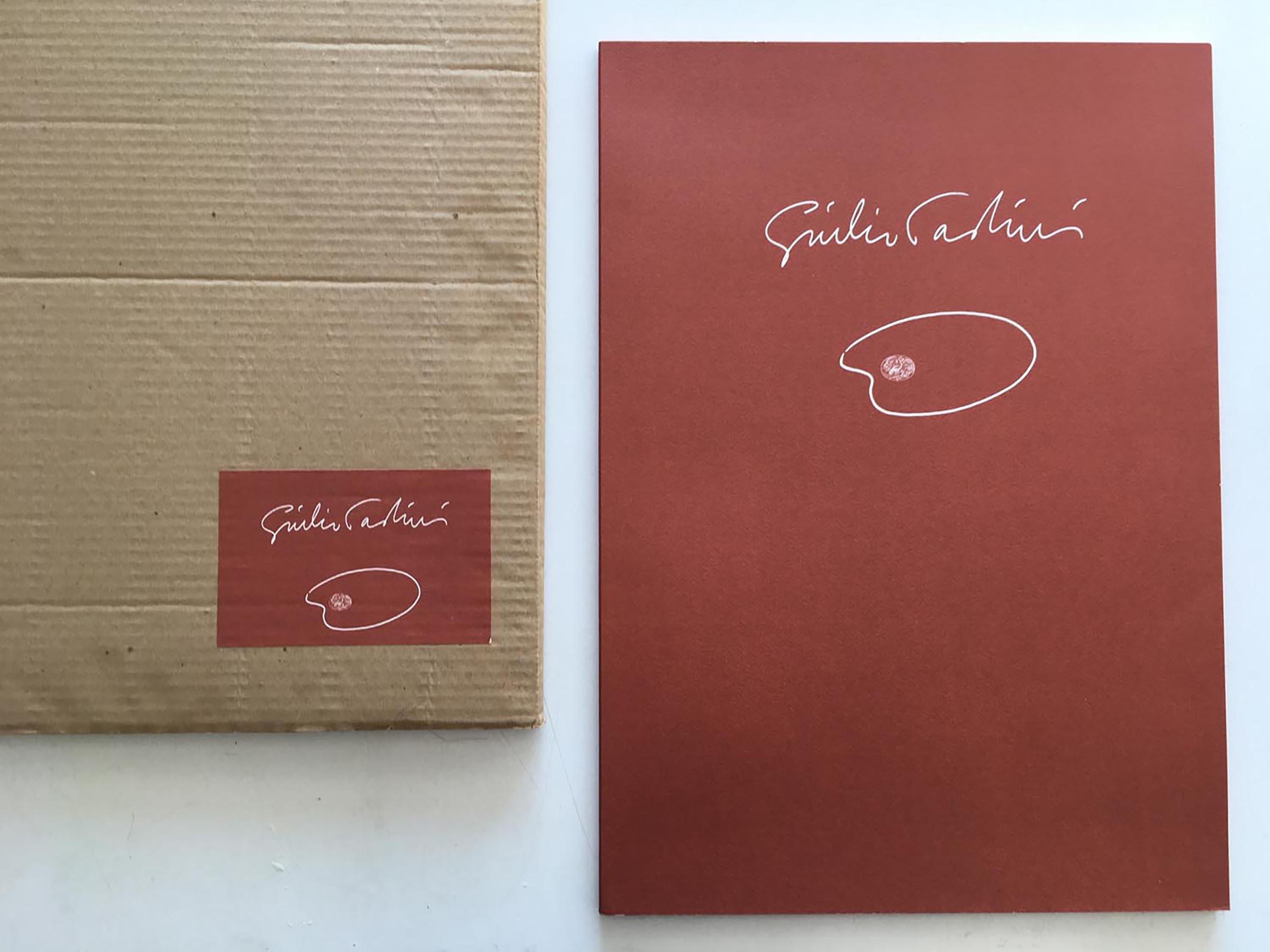
Havana corrugated cardboard folder with flaps, closed format 49 x 35.5 x 1.6 cm; on the front board red label reproducing the author's signature and the publisher's logo inscribed in the outline of an oval-palette. Three-sided red cardboard folder with two flaps, closed format 48 x 34.5 x 1 cm; cover with reproduction of the author's signature, publisher's logo inscribed in the outline of an oval-palette. Contains fifteen bi-folios: the first with title-page and copyright; the following twelve include the plates and come with, on the first side to the lower right, a progressive number and a variable title; the last two bi-folios, inserted one inside the other, include a text by the author (paged on the first side of each bi-folio), the colophon, and details concerning the imprint date, and the printer.
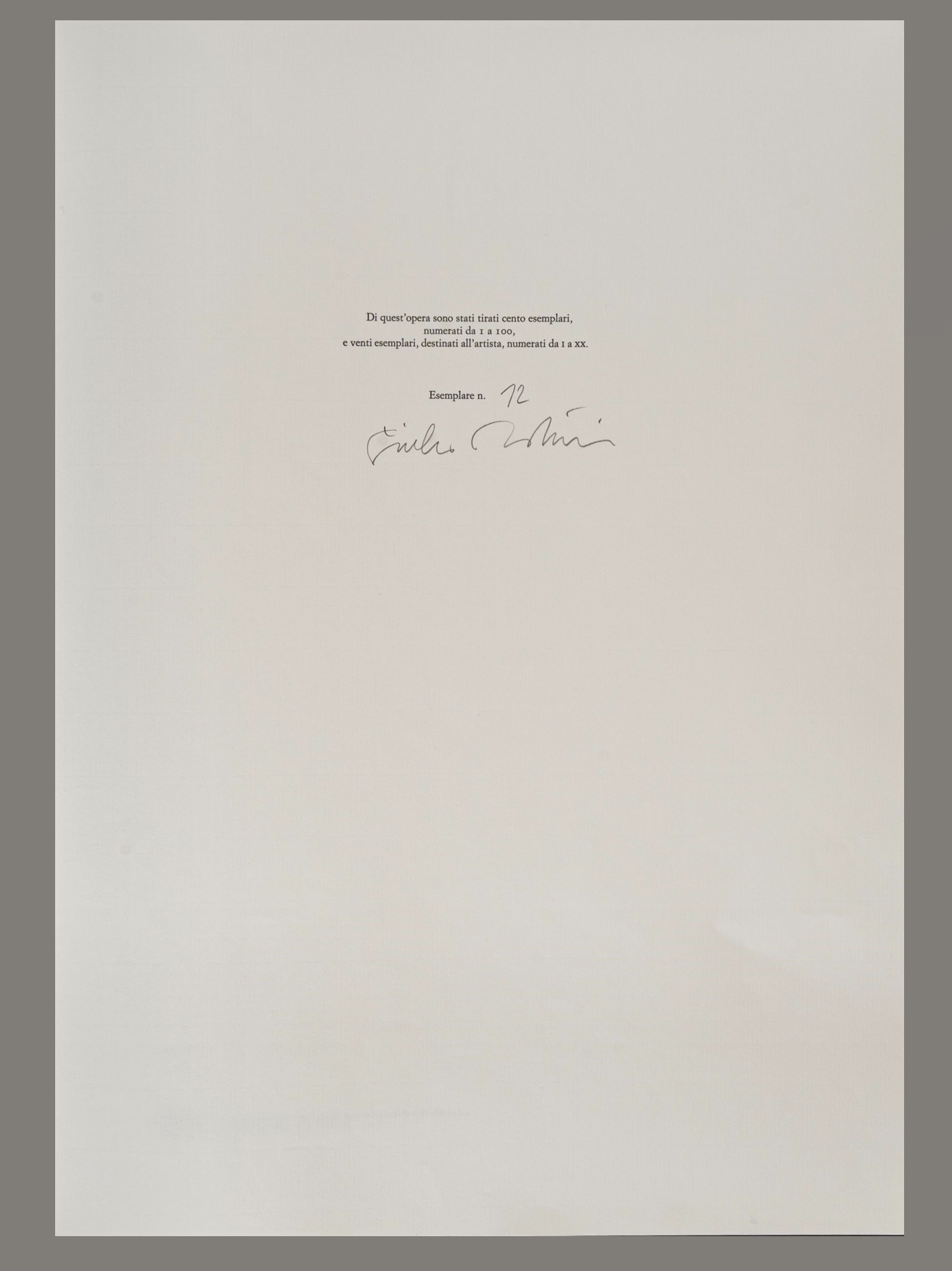
Includes information regarding edition size. Numbering and signature at the centre.
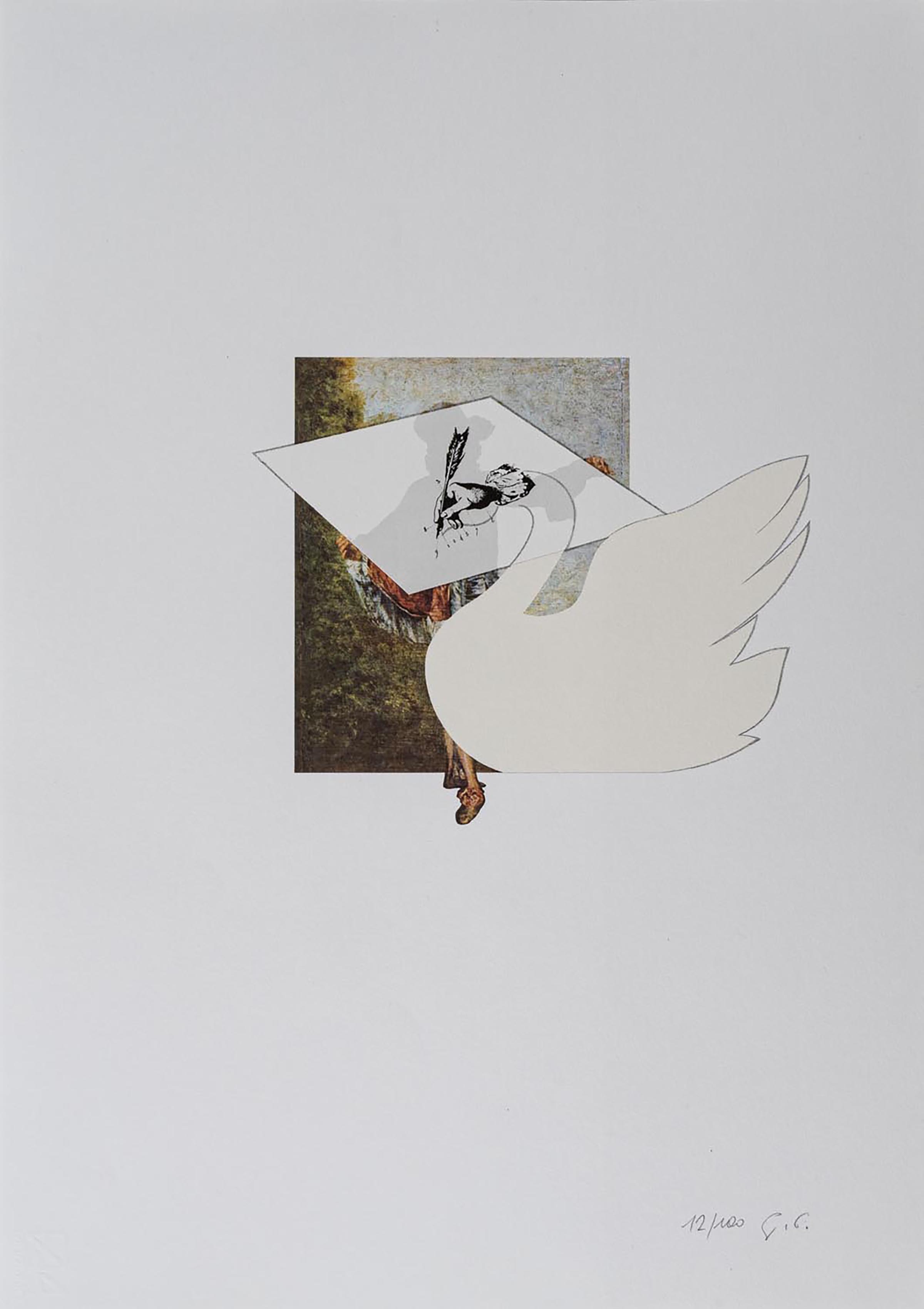
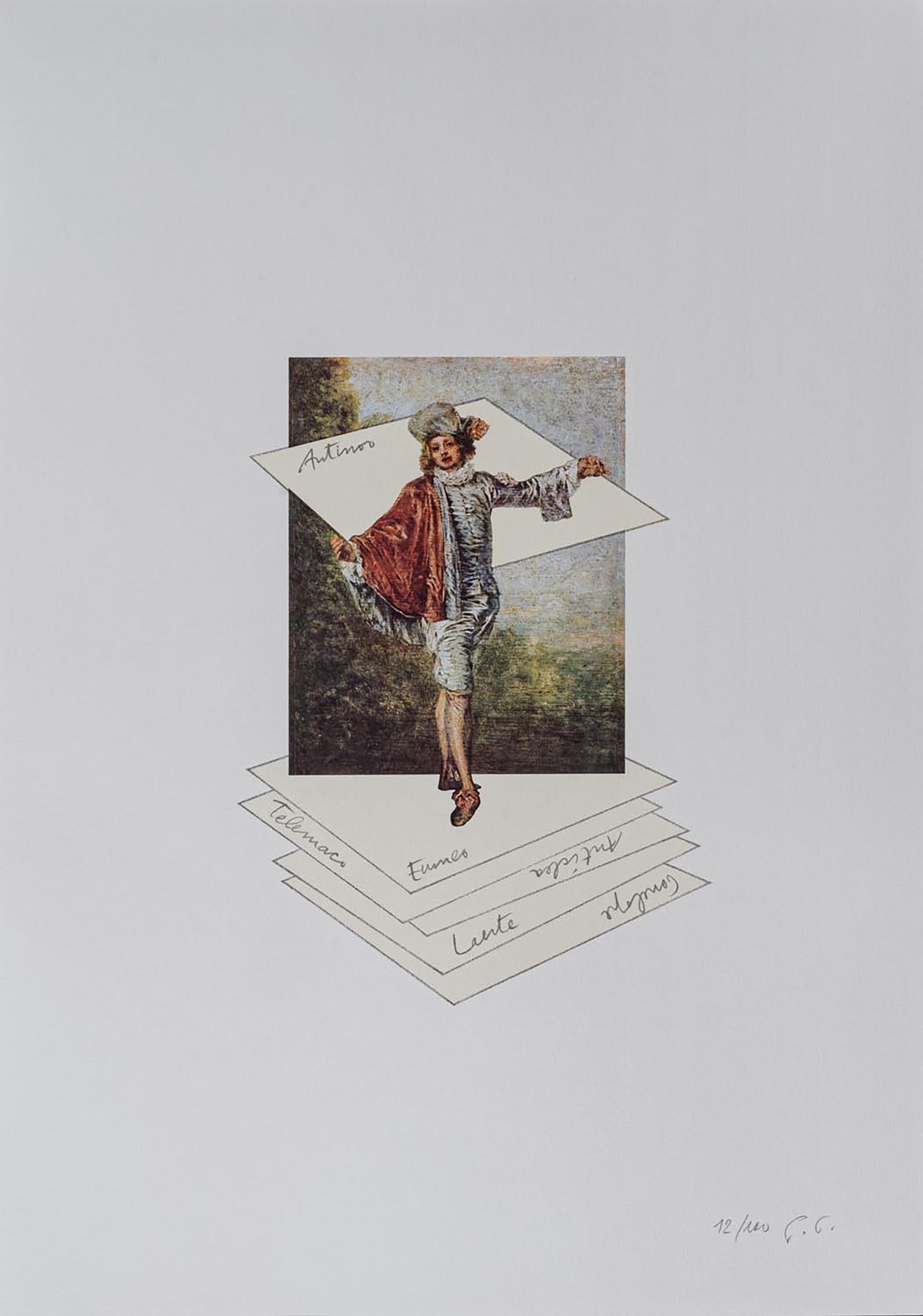
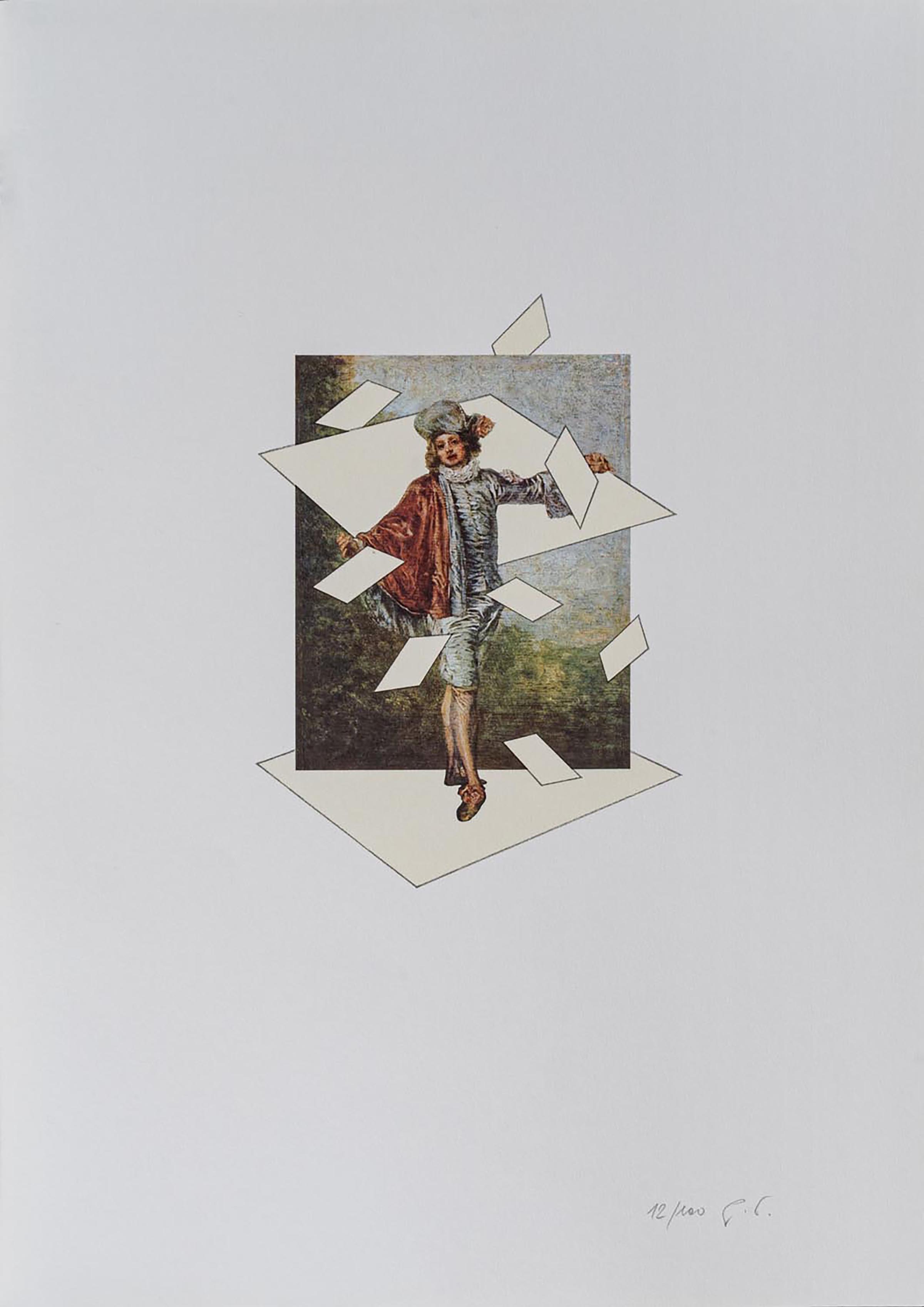
Text by the artist, divided into a preface (Ebbene, ho quarantadue anni...) and twelve short texts that reiterate the numbering and the titles associated with the twelve plates (1. L’exil du cygne, 2. L’origine della pittura, 3. Il ponte dei suicidi, 4. Hierapolis, 5. Casa di Lucrezio, 6. Platea, 7. Cythère, 8. I trentasei poeti immortali, 9. Mnemosine, 10. Scene di conversazione, 11. The private life, 12. Melanconia ermetica).
The installation of the twelve plates, each framed individually without a passepartout, depends on the exhibition room. Generally speaking, they can be arranged in three parallel rows of four units each, at regular intervals (overall dimensions around 150 x 145 cm). Whatever the installation may be, the predetermined sequence of the plates follows their progression, numbered and titled, in the original portfolio containing them: 1. L’exil du cygne, 2. L’origine della pittura, 3. Il ponte dei suicidi, 4. Hierapolis, 5. Casa di Lucrezio, 6. Platea, 7. Cythère, 8. I trentasei poeti immortali, 9. Mnemosine, 10. Scene di conversazione, 11. The private life, 12. Melanconia ermetica.
The protagonist of the twelve plates is the male figure borrowed from the painting by Jean-Antoine Watteau titled L’Indifférent (1717), associated with one or more white quadrilaterals. Each plate also recalls, via an iconographic citation or a detail in the composition, a previous work by the artist.1
Like a juggler engaged in proving his skill, the eighteenth-century actor who performs in virtuoso acts represents a stand-in for the author, intent on reviewing a series of conjectures having to do with the becoming of a potential work.
The title recalls the eighteenth-century comedy by the French playwright Pierre de Marivaux, in which false confidences are actually the revelations of false secrets, and the power of language affects being and appearing in a basic ambiguity.
The theme of the actor as protagonist, introduced in 1980 (cf. the print with the same title, GPE-0038), is developed in the eponymous large-scale work that was also made during the final months of 1983 (GPO-0506).
The original collages from which the portfolio originates are documented in the online Catalogue Raisonné of works on paper at number GPC-0454.
1 The works involved are also recalled by the title present on the first page of the bi-folios that in the portfolio contain the plates. According to the progressive numbering of the plates, the titles read: L’exil du cygne (cf. GPO-0466 e GPC-0629), L’origine della pittura (cf. GPO-0486), Il ponte dei suicidi (hitherto unconfirmed in the works), Hierapolis (cf. GPO-0478), Casa di Lucrezio (cf. GPO-0452), Platea (cf. GPO-0378), Cythère (cf. GPO-0483), I trentasei poeti immortali (hitherto unconfirmed in the works), Mnemosine (cf. GPO-0420), Scene di conversazione (cf. GPO-0498), The private life (hitherto unconfirmed in the works before 1983) and Melanconia ermetica (cf. GPO-0487). The attribution of a title to the individual plates in a composite work is significantly preceded by the documentation of the eleven Studi per “Hortus clausus”, 1981 (GPC-0585) in the catalogue of the solo exhibition held at the Kunstmuseum Luzern, Lucerne, 1981 – a cycle of studies similarly made up of a male figure associated with a series of quadrangle-works.
• Jean-Antoine Watteau, L’Indifférent, 1716, oil on wood, 25 x 19 cm, Musée du Louvre, Paris; reproduction from L’opera completa di Watteau. Classici dell’arte 21 (Milan: Rizzoli, 1968), plate XI.
• First plate: image of the hand from Denis Diderot, Jean-Baptiste D’Alembert, Encyclopédie, ou Dictionnaire raisonné des sciences, des arts et des métiers. Recueil de planches sur les sciences, les arts libéraux et les arts méchaniques, avec leur explication. Seconde livraison, en deux parties. Première partie 23 (Paris: 1763), plate III (“Art d’Ecrire”).
• Fifth plate: drawing of the labyrinth with writing from Enciclopedia Einaudi 8 (Turin: 1979), p. 12 (entry “labirinto”).
• Title from the comedy by Pierre de Marivaux, Les fausses confidences, 1737.
| 1984 | Villeurbanne, Le Nouveau Musée, Giulio Paolini, 20 January - 18 March, vol. Images/Index, repr. pp. 144-145 (plates Scene di conversazione, L’origine della pittura, Cythère, I trentasei poeti immortali). |
| 1984 | Milan, Studio Marconi, Giulio Paolini, from 9 February, not repr. (reproduction of one of the projected images of the installation Les fausses confidences, n. pag.). |
| 1985 | Ravenna, Pinacoteca Comunale, Loggetta Lombardesca, Giulio Paolini. Tutto qui, 15 June - 22 September, not repr. |
| 1985-86 | Montreal, Musée d’art contemporain, Giulio Paolini, 7 July - 8 September, touring to: Vancouver, Vancouver Art Gallery, 29 November 1985 - 19 January 1986, same catalogue as for the solo exhibition Villeurbanne 1984. |
| 1986 | Charleroi, Palais des Beaux-Arts, Giulio Paolini, 15 February - 30 March, same catalogue as for the solo exhibition Villeurbanne 1984. |
| 1986 | Stuttgart, Staatsgalerie Stuttgart, Giulio Paolini, 20 September - 2 November, vol. 4 La visione / Die Vision, cited in the checklist of exhibited works no. 46 p. 53, not repr.; vol. 2 Il Museo / Das Museum, referred to in the text by M. Scholz-Hänsel, p. 12. |
| 1992 | Bonn, Bonner Kunstverein, Giulio Paolini. Impressions graphiques. Das graphische Werk 1967-1992, 24 February - 29 March (catalogue Impressions graphiques. L’opera grafica 1967-1992 di Giulio Paolini [Turin: Marco Noire Editore, 1992], cat. no. 43). |
| 1993 | Winterthur, Kunstmuseum Winterthur, Giulio Paolini. Impressions graphiques. Das druckgraphische Werk 1967-1992, 16 January - 7 March (catalogue Impressions graphiques. L’opera grafica 1967-1992 di Giulio Paolini [Turin: Marco Noire Editore, 1992], cat. no. 43). |
| 1995 | Lisbon, Fundação Calouste Gulbenkian / Centro de Arte Moderna José de Azeredo Perdigão, Giulio Paolini. Impressions graphiques. Múltiplos e Obra Gráfica 1969-1995, 16 March - 28 May, not repr. in the exhibition brochure (catalogue Impressions graphiques. L’opera grafica 1967-1992 di Giulio Paolini [Turin: Marco Noire Editore, 1992], cat. no. 43). |
| 1996 | Rome, French Academy, Villa Medici, Giulio Paolini. Correspondances, 13 March - 28 April, cited in the checklist of exhibited works n. pag., col. repr. no. 9, with text by the artist Ebbene, ho quarantadue anni.... |
| 1996 | Apolda, Kunsthaus Apolda Avantgarde, Giulio Paolini. Impressions graphiques, 27 September - 27 October (catalogue Impressions graphiques. L’opera grafica 1967-1992 di Giulio Paolini [Turin: Marco Noire Editore, 1992], cat. no. 43). |
| 1997 | Göppingen, Kunsthalle, Giulio Paolini. Impressions graphiques. Das graphische Druckwerk 1967-1995, 9 March - 13 April (catalogue Impressions graphiques. L’opera grafica 1967-1992 di Giulio Paolini [Turin: Marco Noire Editore, 1992], cat. no. 43). |
| 2001 | Milan, Association Jacqueline Vodoz et Bruno Danese, Impressions Graphiques. L’opera grafica di Giulio Paolini, 1967-2000, 17 May - 22 June, not repr. |
| 2002 | Modena, Biblioteca civica d’arte Luigi Poletti, Giulio Paolini. Pagine, 20 September - 23 November, col. repr. pp. 42-43 (caption p. 92). |
| 2004 | Ancona, Mole Vanvitelliana, Riflessi nell’arte. Percorsi italiani tra arte pop, transavanguardia e citazionismo, 16 October - 5 December, col. repr. p. 96. |
| 2011 | Bologna, Aula Magna della Biblioteca Universitaria, Libro / Opera. Viaggio nelle pagine d'artista. La collezione di Danilo Montanari, 16 September - 12 October, not repr. (on p. 148 reproduction of the print edition with the same title produced in 1980); esemplare p.a. |
| 2012-13 | Milan, Palazzo Reale, Giulio Einaudi. L’arte di pubblicare, 28 November - 13 January, no catalogue. |
| 2021-22 | San Secondo di Pinerolo, Castello di Miradolo, Oltre il giardino. L’abbecedario di Paolo Pejrone, 15 May 2021 - 26 June 2022, no catalogue; edition 50/100. |
| 2023 | Milan, Libreria Antiquaria Pontremoli, Arte Povera, 16 February - 2 March, col. repr. pp. 77 (portfolio cover and title-page), 78 (L’Exil du cygne), entry by R. Colombo and C. Lietti p. 77; edition 85/100. |
| • | F. Pasini, “La parola e la mano. Intervista a Giulio Paolini”, in L’illustrazione italiana 5, n.s., no. 24 (Milan), November, 1985, col. repr. p. 26 (Mnemosine). |
| • | Impressions graphiques. L’opera grafica 1967-1992 di Giulio Paolini (Turin: Marco Noire Editore, 1992), cat. no. 43, col. repr., with text by the artist Ebbene, ho quarantadue anni.... |
| • | L. Protto, Le stanze della memoria. Poesie (Venice: Edizioni del Leone, 2005), col. repr. on cover (Scene di conversazione). |

