Black out, 1996
GPE-0097
Lithograph
Five plates 34 x 22.2 cm each folded, 34 x 44.5 cm each open
Signed on the colophon of the book: “Giulio Paolini”
Autograph numbering on the colophon of the book
100 in Arabic numerals from 1/100 to 100/100
Exit Edizioni, Lugo (Ravenna)
Grafiche Morandi, Fusignano (Ravenna)
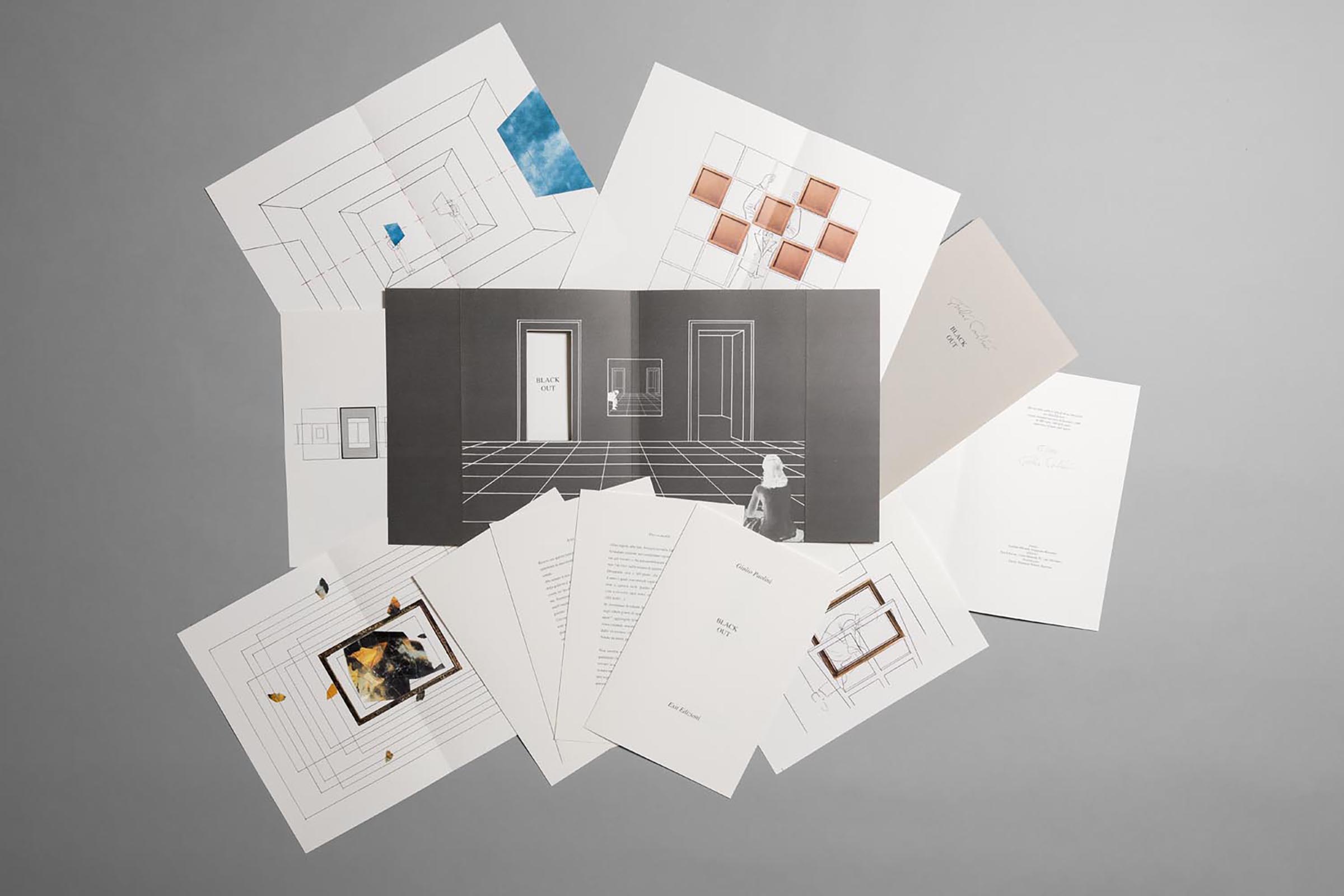
The plates were produced for the book by Paolini titled Black out, published by Exit Edizioni, a publishing house founded in 1976 in Lugo (Ravenna) by Alvaro Becattini. The book is the second in a trilogy of publications curated by the artist in collaboration with Becattini between 1995 and 1998 (cf. Lezione di pittura, 1995, GPE-0095, and Giro di boa, 1998, GPE-0102).
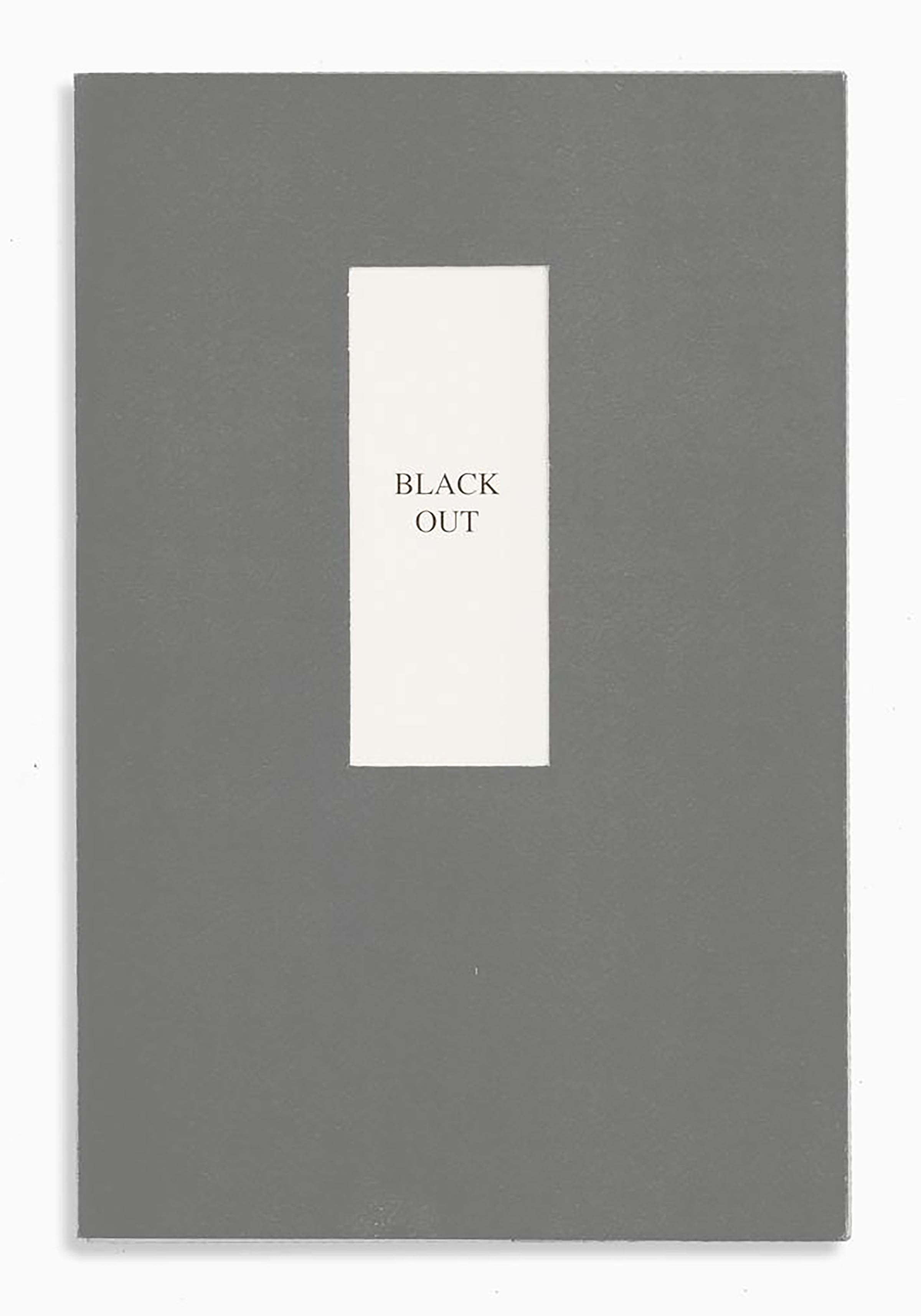
Giulio Paolini, Black out (Lugo: Exit Edizioni, 1996). 34 x 22.5 cm, nine bi-folios collected in a double soft cover, die-cut dust jacket by the author. Writings by the author, five folded colour plates. Limited edition of 800 copies, of which 100 numbered and signed.
The colophon of the book includes information regarding the publisher, date of printing (December 1996), print run, printer, and distribution. Numbering and signature top centre.
Writings by the artist on his thoughts about art (1995-96) titled Controcampo, Aria condizionata, Libertà provvisoria, Vivo o morto.
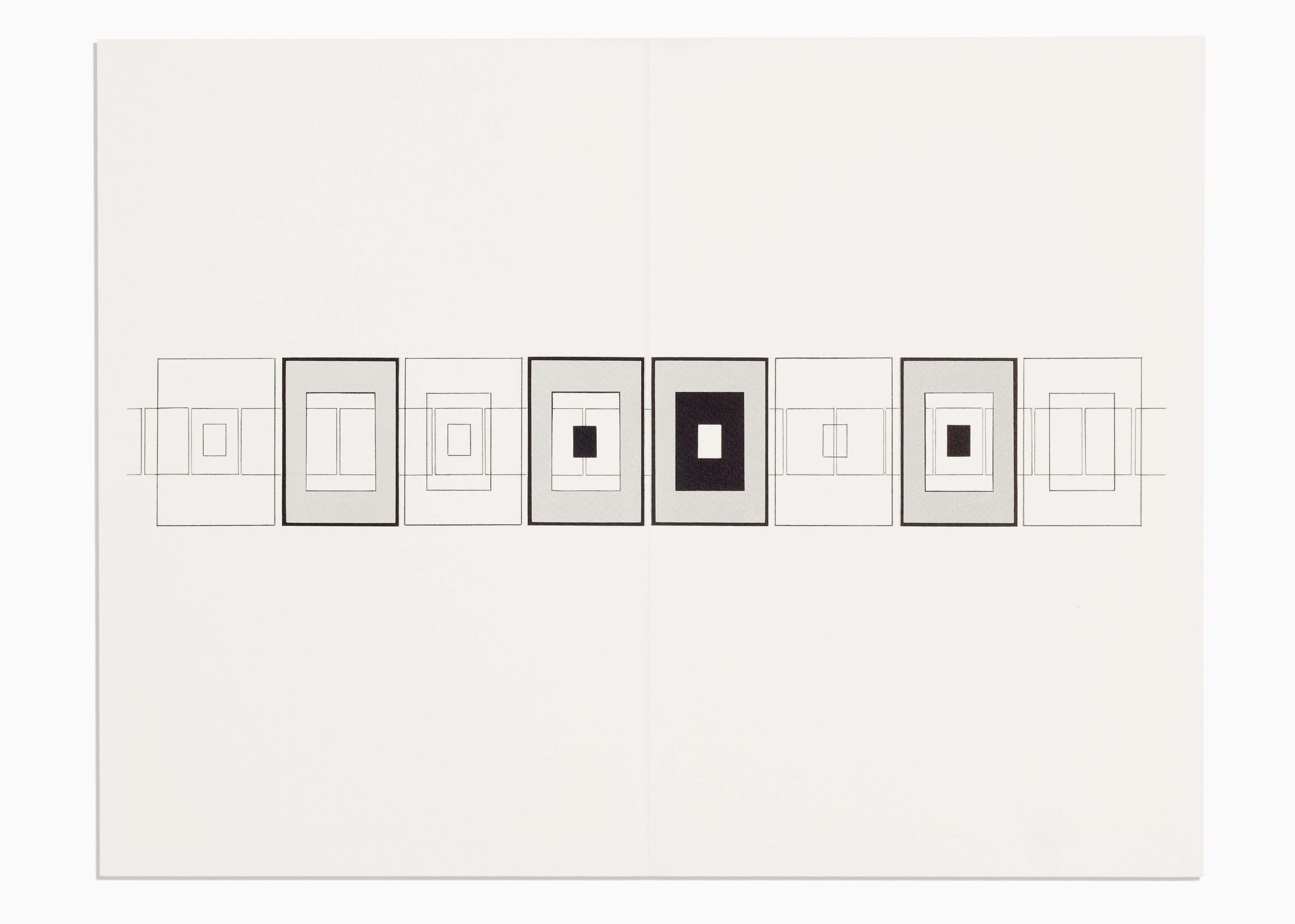
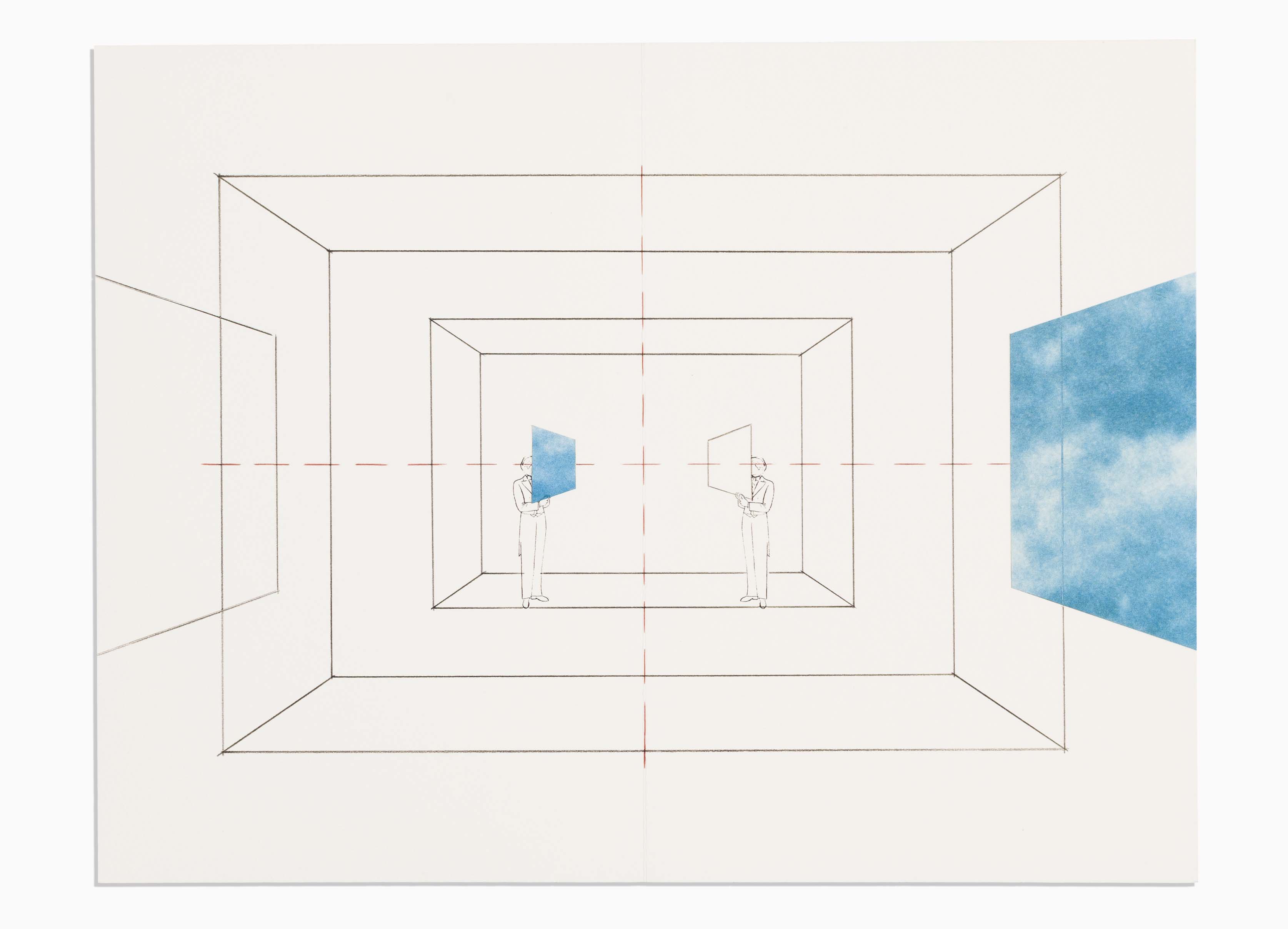
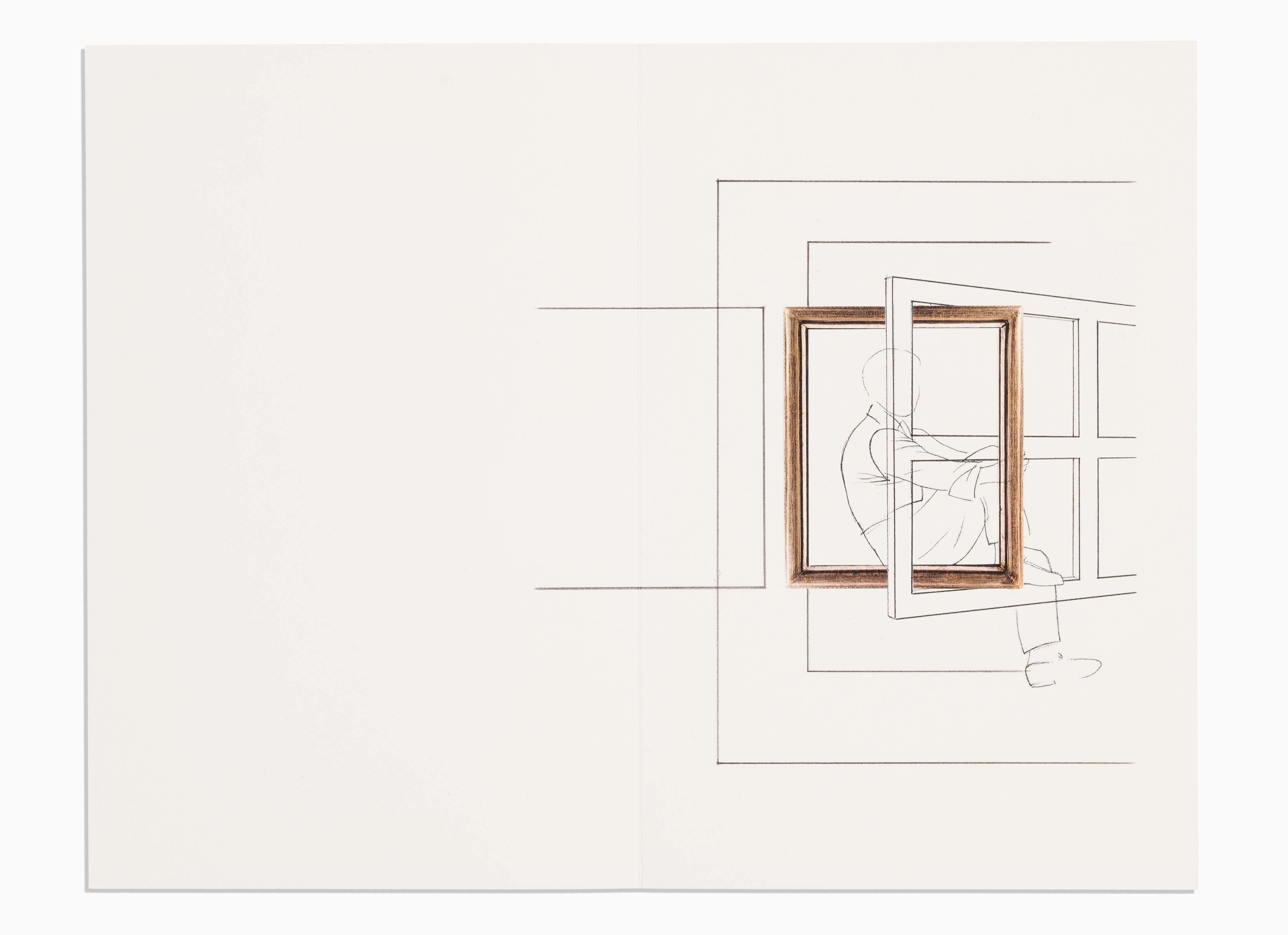
The five plates conceived for the volume of writings by the artist titled Black-out are each marked with its own title, in this order: Prima o poi, Due personaggi in cerca d’autore, Autoritratto, Segni particolari, and Panorama.
Prima o poi (Sooner or Later) features a frieze of rectangular units corresponding to a segment of the large-scale work having the same title dated 1996-97 (GPO-0785). The alternating of fulls and voids, positive and negative traces various interchangeable hypotheses, akin to a combinatory game, open-endedly postponing – as the title suggests – the definition of a fullfilled image.
Due personaggi in cerca d’autore (Two Characters in Search of an Author) features, in the foreground, two trapezoidal quadrilaterals – hypothetical paintings hanging on the side walls of a room – that orient the gaze towards the central drawing. The drawing represents a room viewed in perspective, on whose back wall an analogous drawing evokes a "painting". Inside the latter, two male figures wearing tails and mirroring each other, observe and each present a "painting" that reflects the quadrilaterals in the foreground. The ensemble of frames is squared by the median axes, dotted in red, which emphasize the blind vanishing point of the perspective. The title, echoing the title of a famous play by Luigi Pirandello (Sei personaggi in cerca d’autore, 1921), refers to the two anonymous stand-ins who replace the author, who has left the scene to sit in the seating area in the guise of a spectator. Among other things, the "search" is twofold: the author searches for the ideal painting (as suggested by the portion of sky, which for Paolini symbolizes an absolute dimension), just as the unknown painting is awaiting an author-spectator ready to receive it. The same iconographic theme was developed in the large-scale work having the same name, made during the same year (GPO-0781).
In Autoritratto (Self-Portrait), the author, who is drawn in profile and partially included in a gilt frame, is portrayed as a spectator, intent on observing the painting of which we can glimpse the back, evoked through the stretcher, and foreshortened. Other barely sketched out frames multiply that of the gilt frame.
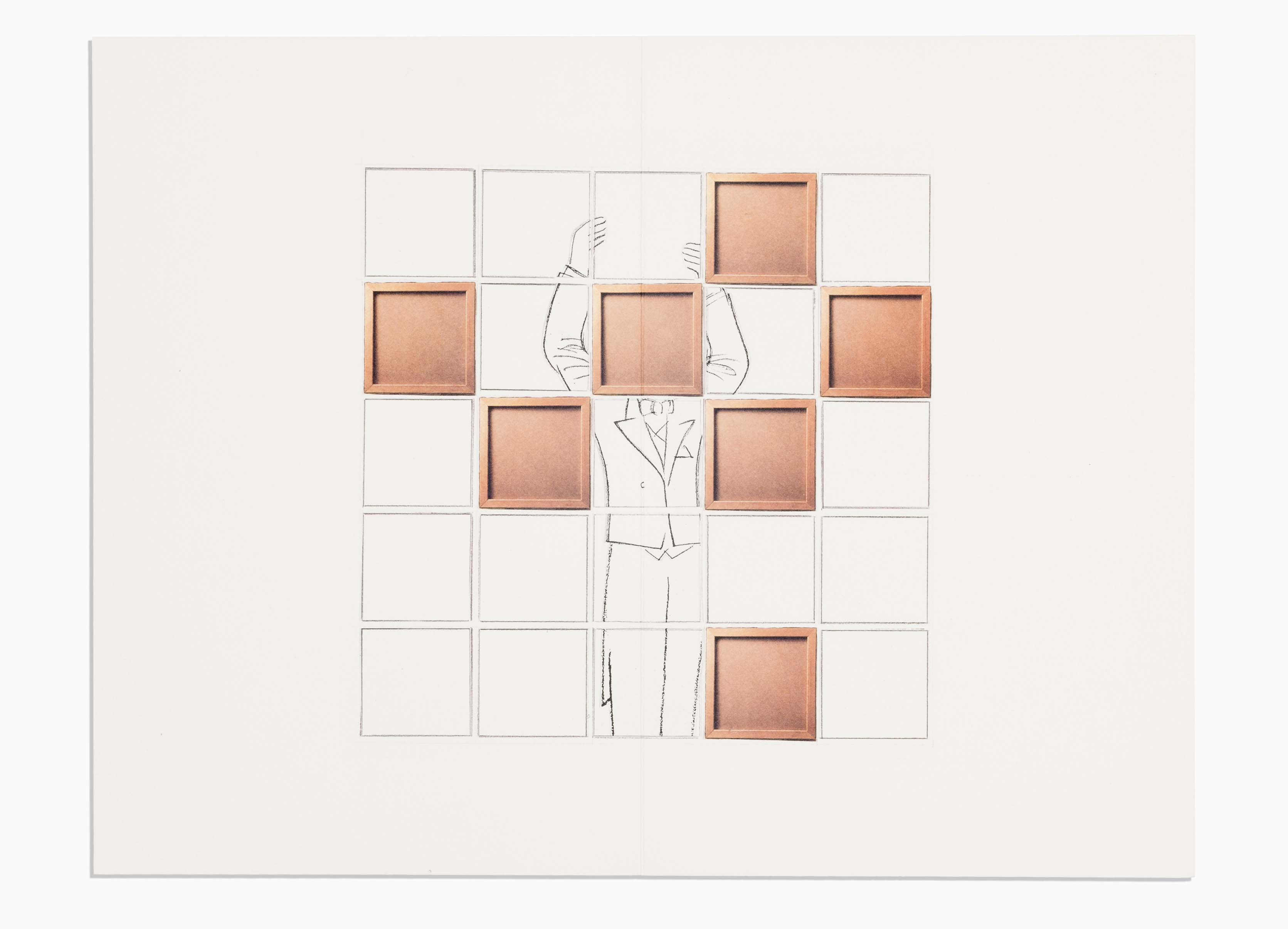
Segni particolari (Particular Signs) presents a chessboard of canvases viewed from the recto and the verso, as the piece of a mosaic in fieri, which the drawn figure is intent on composing. The “particular signs” announced in the title are the features that distinguish the protagonist in ceremonial dress – another stand-in for the author – in search of his painting. The same iconography was used in 1998 for a large-scale work with the same title (GPO-0821).
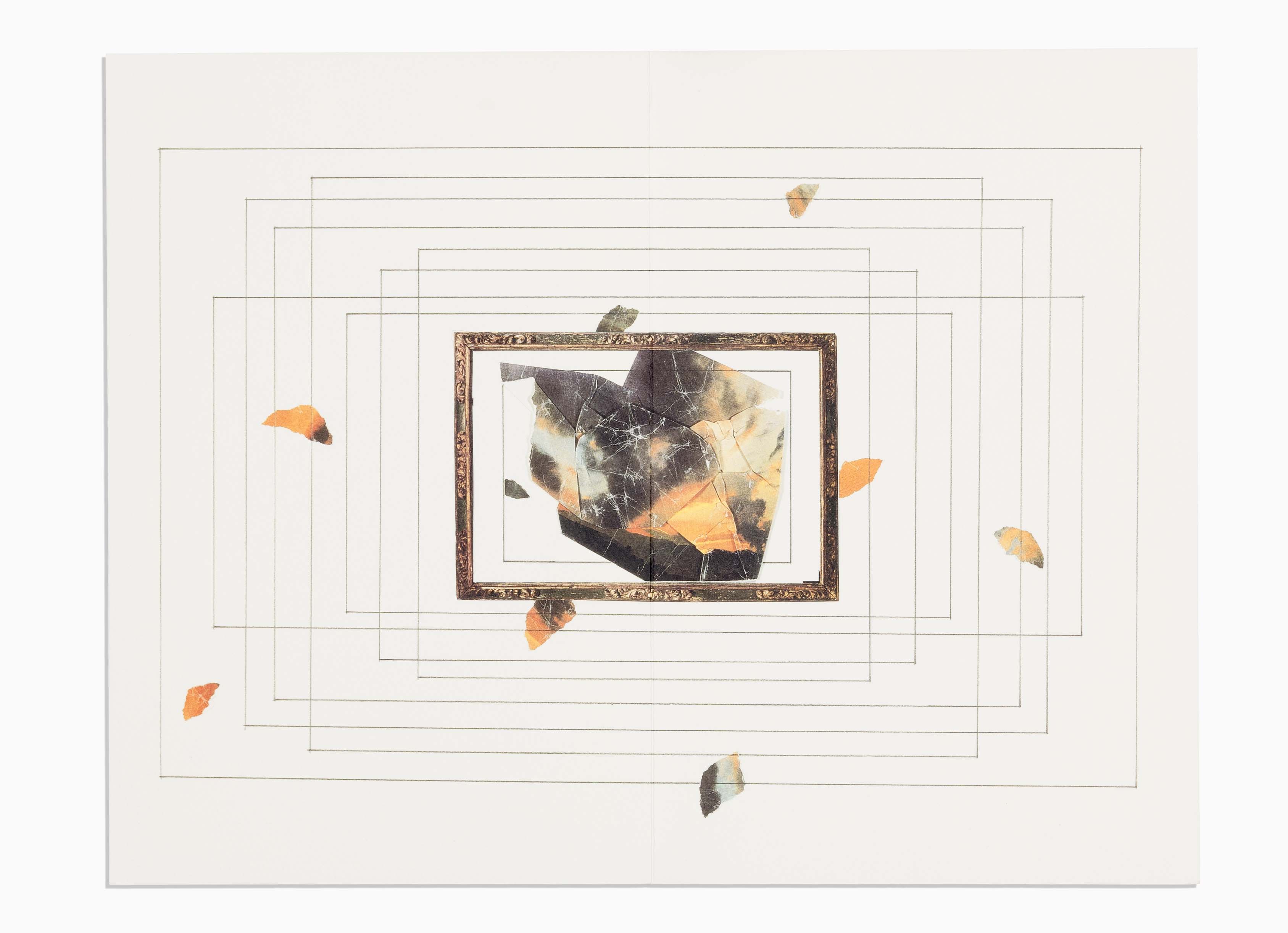
Panorama consists of an antique frame, in a central position, which holds the crumpled reproduction of a landscape at sunset (the scattered fragments come from the same source), while all around a complex drawing of rectangles reverberates and amplifies the format of the antique frame. The title refers to the subject of the photographic reproduction, and to the drawing in expansion that broadens the view, extending the horizon towards infinity. The same iconography is formulated in the large-scale work having the same name made during the same year (GPO-0794).
The original collages on which the prints is based are documented in the online Catalogue Raisonné of the works on paper at numbers GPC-0918 (Studio per “Prima o poi”), GPC-0911 (Due personaggi in cerca d’autore), GPC-910 (Autoritratto), GPC-0916 (Studio per “Parade (Segni particolari)”), GPC-0915 (Panorama).
Along with the five plates, Paolini also designed the book jacket, which features inside the negative impression (white on black as if to suggest the “black out” mentioned in the title) the drawing of a room in perspective, with two doors at the back (the one to the left is die-cut) and a floor marked by a perspectival grid.1 In the foreground, to the right, a female figure seen from behind (takem from a painting by Salvador Dalì) observes the "painting" situated at the centre of the rear wall, which repeats the image itself of the setting in perspective, inhabited by a stand-in for the author: a man holding his head in his hands absorbed in thought.
In the dust jacket, just like in the five plates, the actors that alternate on the scene or are set in relation to one another are the same: the author, the spectator, the painting, captured in a suspended situation of silent expectation or proliferating multiplication.
1 The basic theme of the dust jacket (the setting in perspective, with the room of the left door cut out) is the same in the three books of writings by the artist titled Lezione di pittura (GPE-0095), Black out, and Giro di boa, 1998 (GPE-0102).
Dust jacket: Lionello Balestrieri, Beethoven, 1900, oil on canvas, 202 x 420 cm, Museo Revoltella, Trieste (figure at the centre); Salvador Dalí, Ma femme nue regardant son propre corps devenir marche, trois vertèbres d’une colonne, ciel et architecture, 1945, oil on wood, 61 x 52 cm, private collection (figure viewed from behind).
| 2001 | Milan, Association Jacqueline Vodoz et Bruno Danese, Impressions Graphiques. L’opera grafica di Giulio Paolini, 1967-2000, 17 May - 22 June, repr. p. 3 (plate Autoritratto), col. repr. pp. 12-13 (plate Due personaggi in cerca d’autore). |
| 2002 | Paris, Istituto Italiano di Cultura, Impressions graphiques. L’œuvre graphique de Giulio Paolini 1967-2000, 23 April - 21 May, no catalogue. |
| 2002 | Modena, Biblioteca civica d’arte Luigi Poletti, Giulio Paolini. Pagine, 20 September - 23 November, col. repr. pp. 78-79 (caption p. 94). |
| 2004 | Bologna, Galleria d’Arte Moderna, Ritratto dell’editore come artista. I libri e la grafica di Alvaro Beccatini, 18 September - 17 October, no catalogue. |
| 2005 | Lugo (Ravenna), Pescherie della Rocca, Exit. Alvaro Becattini, 30 April - 15 May, not repr. (on p. 27 reproduction of the cover of the book). |
| 2013 | Ravenna, Aula Magna della Biblioteca Classense, Una biblioteca d'artista. La collezione e le edizioni di libri d'artista di Danilo Montanari, 4 May - 1 June, not repr. |
| • | Giulio Paolini. Von heute bis gestern / Da oggi a ieri, exhibition catalogue, Graz, Neue Galerie im Landesmuseum Joanneum (Ostfildern-Ruit: Cantz Verlag, 1998), col. repr. pp. 327 (Autoritratto), 328 (Prima o poi). |
| • | Giulio Paolini. Impressions graphiques, l’opera grafica (Turin: Marco Noire Editore, 2005), update supplement 1996-2005 to the volume Impressions graphiques. L’opera grafica 1967-1992 di Giulio Paolini (Turin: Marco Noire Editore, 1992), cat. no. 98, col. repr. |
| • | L. Dematteis, G. Maffei, Libri d’artista in Italia 1960-1998 (Turin: Regione Piemonte, 1998), cat. no. 2101 p. 179, repr. p. 178 (cover). |
| • | G. Paolini, Quattro passi. Nel museo senza muse (Turin: Giulio Einaudi editore, 2006), repr. pp. 71 (Segni particolari), 73 (Prima o poi). |

