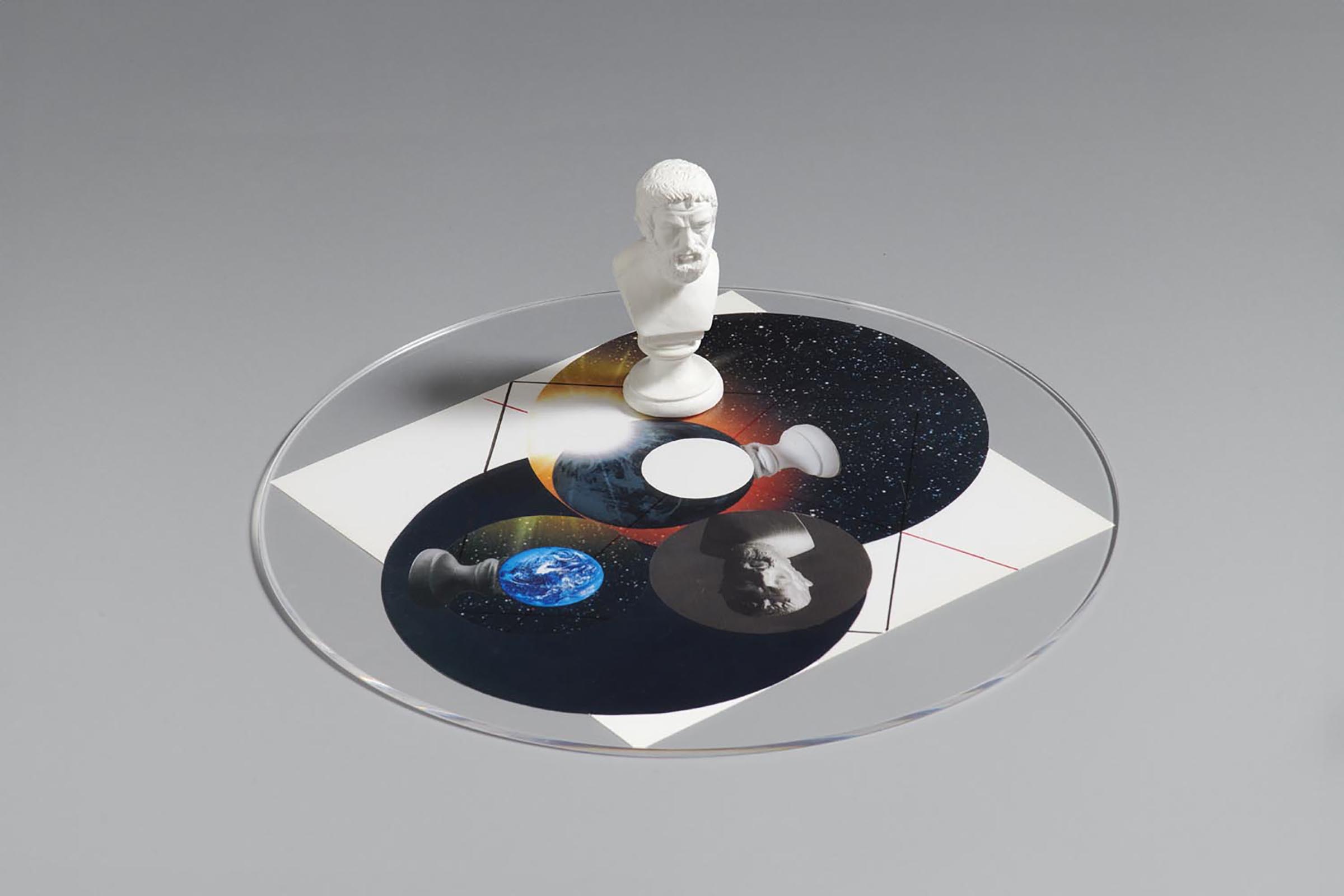
Elea, 2009
GPE-0120
Lithograph on die-cut card stock, plexiglas sheet, plaster cast
Die-cut card stock 33 x 41 cm, sheet Ø 47 cm, cast h 14.5 cm
15 x 47 x 47 cm
Signed on the colophon included with the multiple: “Giulio Paolini”
Numbering on the colophon included with the multiple
150 in Arabic numerals from 1/150 to 150/150
15 artist’s proofs in Arabic numerals from 1/15 (p.a.) to 15/15 (p.a.)
Banca della Svizzera Italiana, Lugano
The multiple was commissioned from the artist by the Banca della Svizzera Italiana (since 2017 part of the EFG International group) as a gift for its clients.
White cardboard box with a blue lid, blank, 8.5 x 48.5 x 48.5 cm. Contains the multiple and a sheet for the colophon with indications for the installation of the work, a note by the artist, and a biographical profile, in Italian and in English.
Includes information regarding technique, measurements, edition size, and display design. Signature and numbering bottom centre.
Note by the artist, Elea, antica colonia greca..., referring to the subject of the multiple, and a biographical profile of the artist by Maddalena Disch.
The installation requires that the work be placed on a support surface (white plinth or table with a neutral surface), starting from the die-cut card stock, with the plexiglas sheet on top of it. The plaster cast should be placed on top of the sheet, not far from the white tondo, so that it is reflected in its own image, reproduced in the round photograph.
A plaster bust of the Greek philosopher Parmenides is set on a circular plexiglas sheet that holds down a photographic image – made up of two round shapes arranged so that they are askew – which is, in turn, applied to a blank sheet featuring a linear drawing. On the photographic image other images in a circular format are printed as though they were orbiting in outer space: a negative image of the bust of Parmenides and the base of the same plaster cast – one time positive, another time negative – associated with a white circle or with the reproduction of a planet. The various iconographic elements reproduce a game of echoes and reflection, which amplifies the crossed gazes between the plaster cast and its photographic image.
In the artist's own words: “Elea, an ancient Greek colony – and a name that no longer designates any place today – was situated on the Cilento coastline near what is currently Salerno: it was the seat of the Eleatic School, that of a Pre-Socratic philosophy of which Parmenides was the main representative. The image that evokes it here, far-removed from any territorial reference, alludes to the light-years crossed by the figures of Time: Parmenides' face seems to discover and recognize itself in its negative reflection among the celestial bodies".1
The prototype for the multiple is documented in the online Catalogue Raisonné of the paintings, sculptures, and installations, at number GPO-1179.
1 G. Paolini, note in the colophon that accompanies the multiple..
Bust of Parmenides, Neoclassical period, unknown source.
| • | G. Paolini, Elea, antica colonia greca..., note to the work published on the title-page included with the multiple. |
| • | Conservare il futuro. L’arte contemporanea alla Fondazione Querini Stampalia / Conserving the Future. Contemporary art at the Querini Stampalia Foundation, edited by C. Bertola and M. Savaris (Venice: Grafiche Veneziane, 2015), n. pag. (entry on the work in the exhibition chronology), col. repr. n. pag. |
| • | G. Paolini, “A come Accademia”, in Giulio Paolini. A come Accademia, exhibition catalogue, Rome, Accademia Nazionale di San Luca (Rome: Gangemi Editore, 2023), col. repr. p. 18. |

