Elea, 2009
GPO-1179
Red ink, black ink and collage on paper, plexiglas sheet, plaster cast
Collage 33 x 41 cm, plexiglas sheet Ø 47 cm, plaster cast h 14.5 cm, overall dimensions 15 x 47 x 47 cm
Titled, dated, and signed on the recto, on the sheet of white paper: ""Elea" / 2009 / Giulio Paolini"
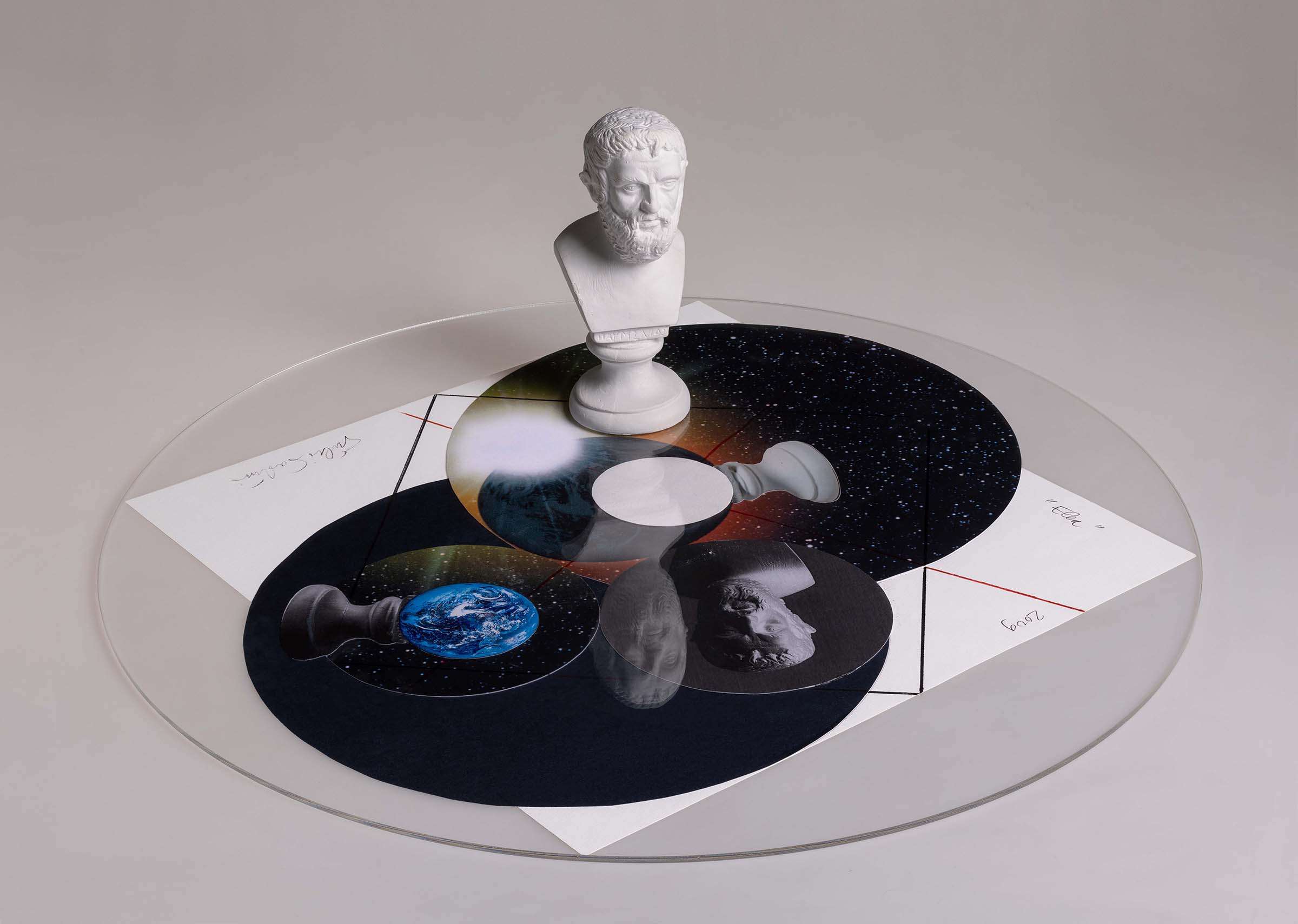
The installation requires that the work be placed on a support surface (white plinth or table with a neutral surface), starting from the collage, with the plexiglas sheet on top of it. The plaster cast should be placed on top of the sheet, not far from the white tondo, so that it is reflected in its own image, reproduced in the round photograph.
A plaster bust of the Greek philosopher Parmenides is set on a circular plexiglas sheet which holds down two circular elements that are slightly askew. One is made of black paper, the other features a cosmic motif. Other images in a circular format are applied to these same elements, as though they were orbiting in outer space. The circular elements applied by collage reproduce a negative image of the bust of Parmenides and the base of the same plaster cast – one time positive, another time negative – associated with a white circle or with the reproduction of a planet. The various iconographic elements reproduce a game of echoes and reflections, amplifying the crossed gazes between the plaster cast and its photographic image. The ensemble of tondi overlaps a blank sheet featuring a line drawing in red and black ink that continues onto the two larger tondi.
In the artist's own words: “Elea, an ancient Greek colony – and a name that no longer designates any place today – was situated on the Cilento coastline near what is currently Salerno: it was the seat of the Eleatic School, that of a Pre-Socratic philosophy of which Parmenides was the main representative. The image that evokes it here, far-removed from any territorial reference, alludes to the light-years crossed by the figures of Time: Parmenides' face seems to discover and recognize itself in its negative reflection among the celestial bodies".1
The work is the prototype for the multiple of the same title, made during the same year (GPE-0120).
The bust of Parmenides features in another work as well, also titled Elea but completely different, and also executed in 2009 (GPO-0981).
1 G. Paolini, note in the colophon that accompanies the multiple Elea, 2009 (GPE-0120).
Bust of Parmenides, Neoclassical period, unknown source.

