
Idea del Tempio della Pittura, 1983
GPE-0044
Idea of the Temple of Painting
Lithograph
Four plates 25 x 37 cm each
Signed on the recto of the fourth plate, bottom right: “Giulio Paolini”
Autograph numbering on the recto of the fourth plate, bottom right
100 in Arabic numerals from 1/100 to 100/100
6 unnumbered artist’s proofs
Editrice Inonia, Rome
Litografia Colitti, Rome
The portfolio is part of the production of multiplied art by the publishing house Inonia, founded in 1980 in Rome by Bruno and Liana Corà (the publishing house is named after the title of a work by the Russian poet Sergey Aleksandrovich Esenin). Over the course of the 1980s, Corà curated for Inonia graphic editions by Carla Accardi, Marco Bagnoli, Bizhan Bassiri, Alighiero Boetti, Daniel Buren, Luciano Fabro, Jannis Kounellis, Sol LeWitt, Mario Merz, Giulio Paolini, Vettor Pisani, Michelangelo Pistoletto, and Ettore Spalletti. The works were produced to support the activity of the art journal A.E.I.U.O., an offshoot of the publishing house Inonia.
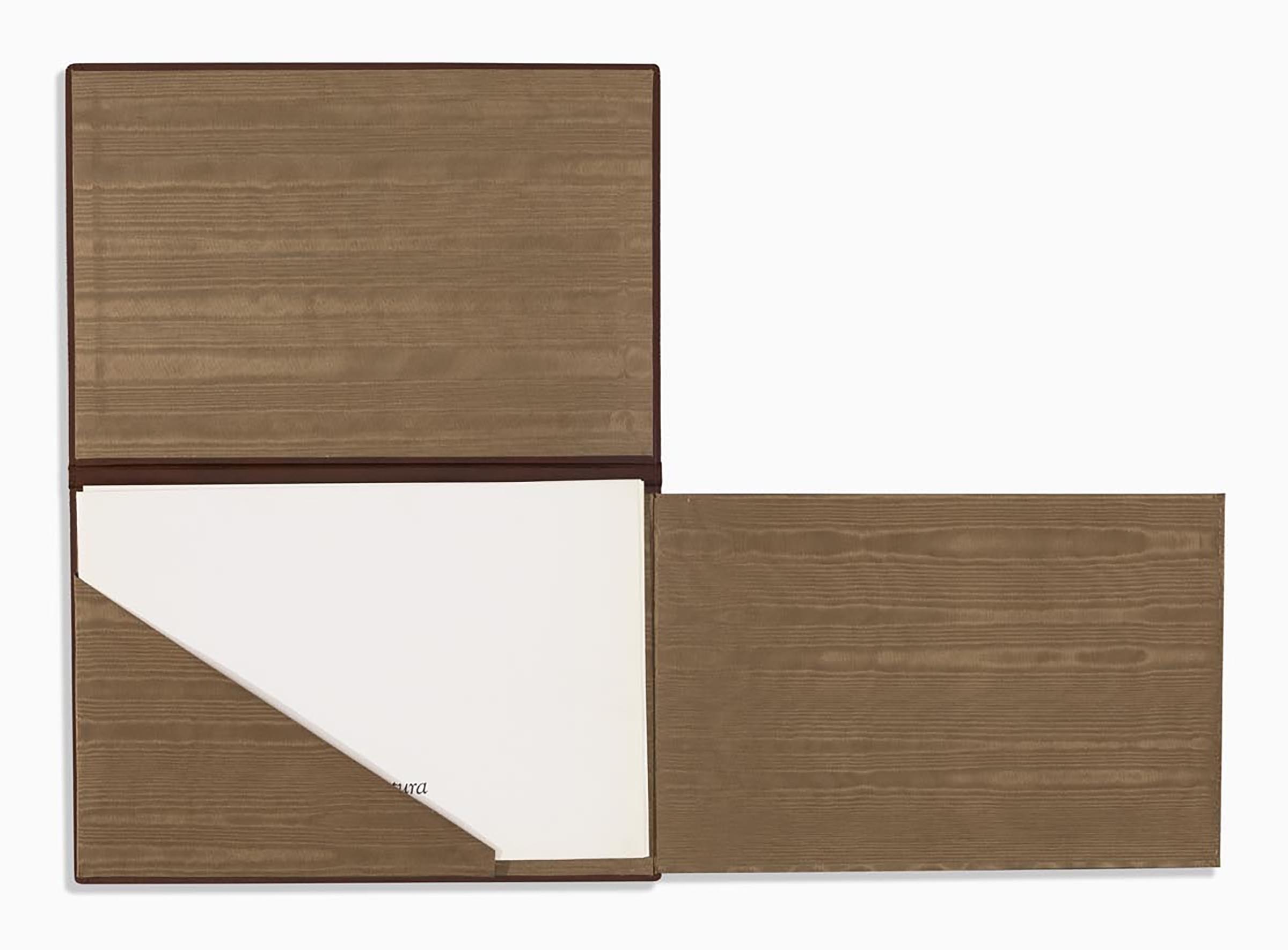
Three-sided brown leather horizontal folder, inside boards lined with light brown silk, with internal pocket, closed format 26.5 x 39 x 1 cm; on the front board gilded titles (author, title). Contains a bi-folio with the title-page (first side) and a text by the artist (third side), the four plates, and a sheet with a text by Bruno Corà (on the recto) and the colophon (on the verso).
Includes information regarding the contents, printer, date of printing (December 1983), type of paper, measurements, leather covering, edition size, inscriptions by the artist, text by Bruno Corà, and publisher.
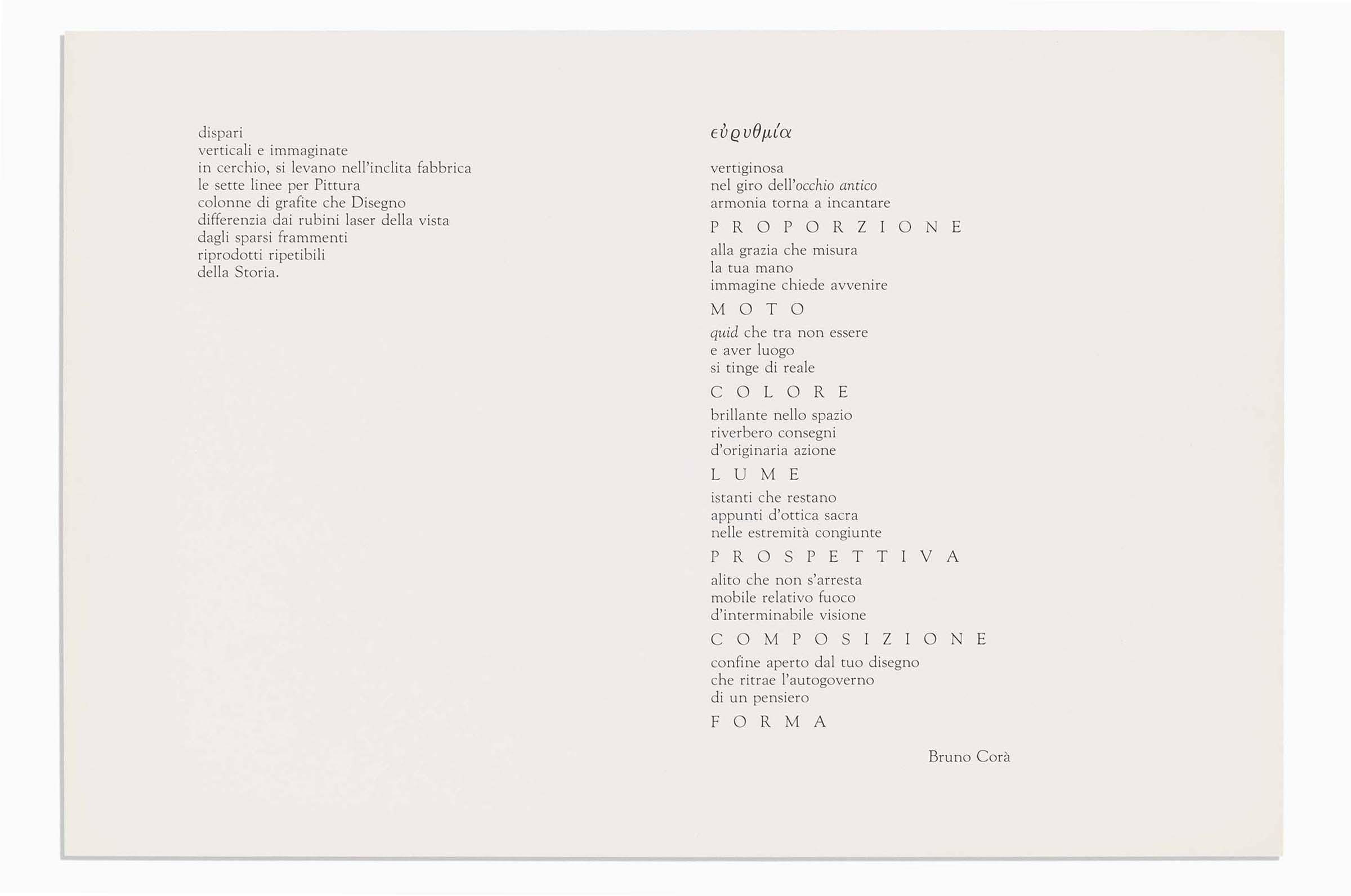
• Verse composition by Bruno Corà, dedicated to Painting and to Drawing, divided into seven thematic parts (proportion, motion, colour, light, perspective, composition, form).
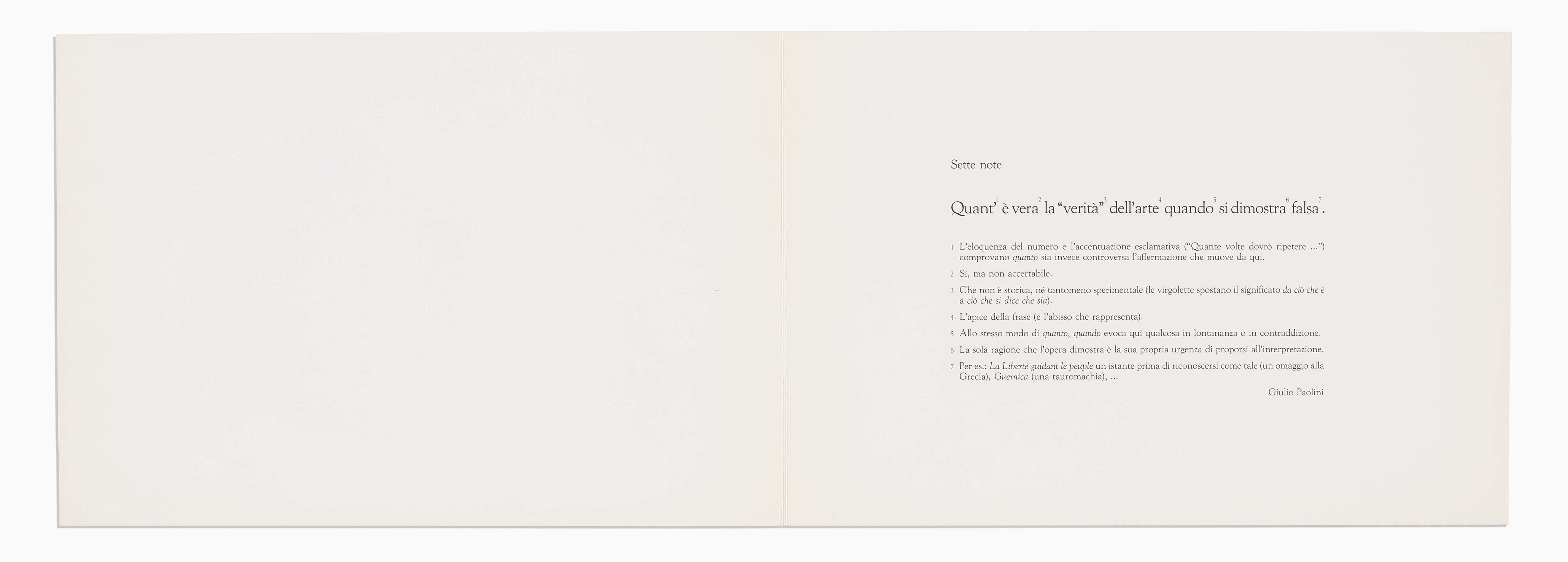
• Text by the artist about art titled Sette note written for the occasion.
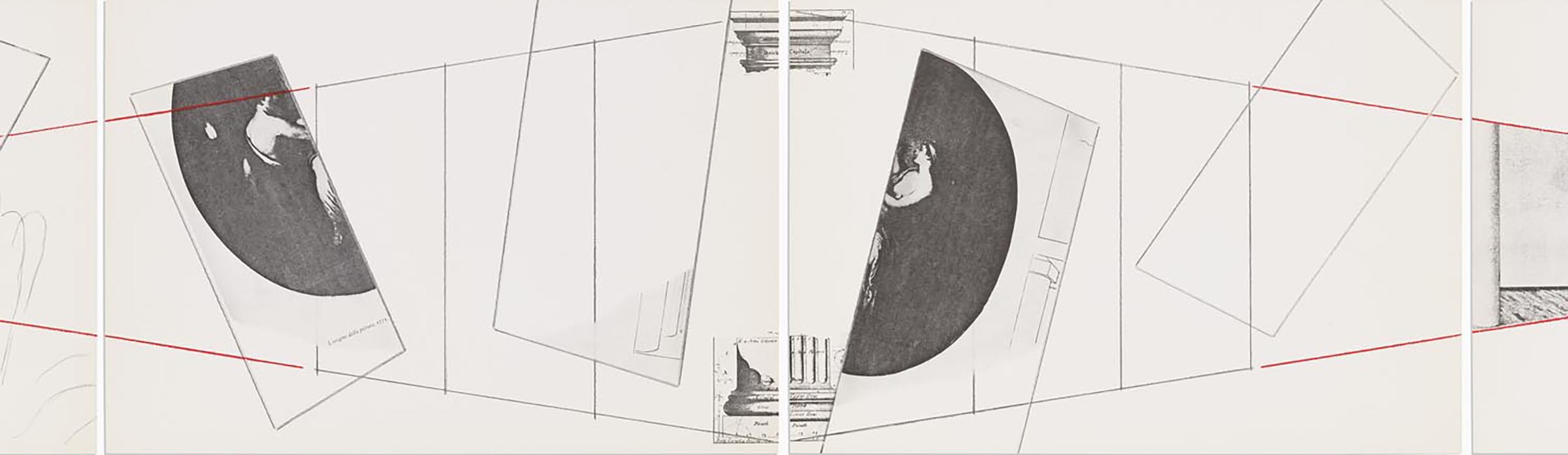
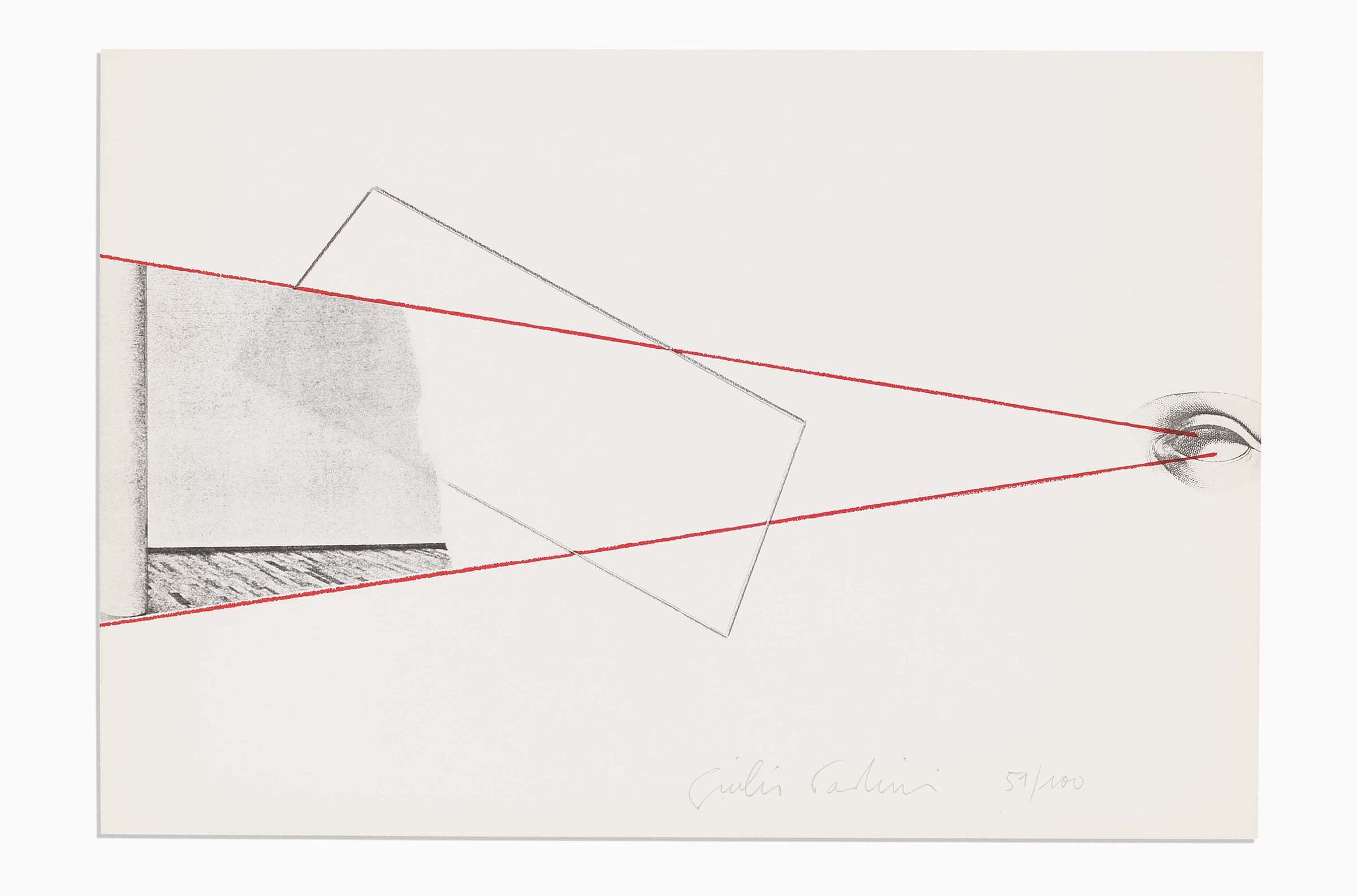
The four plates, each individually framed without a passepartout, must be arranged close together and horizontally (overall dimensions around 26 x 158 cm). The order of the sequence is binding: the first plate features the drawing of a hand, the second one the photographic reproduction of a male figure, the third one the image of a female figure, the last one the drawing of the eye.
The arrangement of the four plates in a horizontal sequence composes, at the centre, the fragmentary image of an ancient column, suggested by the capital and an incongruous plinth consisting of the details of different origins. Spreading out from this column, on both sides and in a mirror-like image is a perspectival drawing, which at the same time continues the visual cone, outlined in red starting from the two ends of the composition (in the latter plate the cone begins from the reproduction of an eye). In the visual field of this mirrored gaze is a series of randomly arranged trapezoidal rectangles gradually reduced (in compliance with the vanishing point of the perspective). Some of them are empty, others include the fragment of a drawing of columns; two rectangles offer a reproduction, in two parts, of the painting by David Allan The Origin of Painting (The Maid of Corinth) (1775), while the image in the last plate reproduces an architectural detail of a space with a column.1 The visual cone and the eye find a complementary figure in the drawing of the hand in the first plate, which seeks to hold down the dizzying "flight" of trapezoidal shapes.
The title – borrowed from the treatise of the same name by the Mannerist painter Giovanni Paolo Lomazzo, who imagined a Neoplatonic theory of painting organized in the architectural structure of a temple – suggests the key to interpretation. The motif of the column alludes to a temple, while Allan's allegorical painting recalls the founding myth of painting. In this “Tempio della Pittura” (Temple of Painting), the gaze embraces a multitude of paintings – potentially endless – that echo the idea of painting, which nonetheless escapes any attempt at a univocal definition.
The original project on which the print is based was made in 1981 (GPC-0586) as a study for a large-scale work that was never realized.2
1 The painting by Allan represents the origins of painting according to the legend of Pliny the Elder that describes a young woman intent on fixing her lover's shadow on the wall. The photographic detail of a space is taken from a view of the Galerie Paul Maenz, Cologne.
2 The project was published in the art journal A noir, E blanc, I rouge, U vert, O bleu (2, no. 3, March 1981, pp. 3-12), accompanied by a caption prepared by the editorial board announcing the work in preparation, “to be exhibited in two subsequent versions, that Summer in Berlin and in the Autumn in Paris. The first occasion is related to a solo show at the Neuer Berliner Kunstverein in Berlin, which was planned for the Summer of 1981 but then postponed to the Summer of the following year (in which Paolini showed Del bello intelligibile. Parte quinta: “Museumsinsel”, GPO-0467, a work that can also be related to his interest in Lomazzo's theory); the aforementioned Paris exhibition instead remains unknown.
• Figures: David Allan, The Origin of Painting (The Maid of Corinth), 1775, oil on wood, 38.70 x 31 cm, Scottish National Gallery, Edinburgh.
• Image of the eye from Opere di G. G. Winckelmann, prima edizione italiana completa 13 (Prato: Fratelli Giachetti, 1830-34), plate XXV, no. 60 (“Occhio di un Bacco”).
| 1984 | Villeurbanne, Le Nouveau Musée, Giulio Paolini, 20 January - 18 March, not repr. |
| 1985 | Ravenna, Pinacoteca Comunale, Loggetta Lombardesca, Giulio Paolini. Tutto qui, 15 June - 22 September, not repr. |
| 1985-86 | Montreal, Musée d’art contemporain, Giulio Paolini, 7 July - 8 September, touring to: Vancouver, Vancouver Art Gallery, 29 November 1985 - 19 January 1986, same catalogue as for the solo exhibition Villeurbanne 1984. |
| 1986 | Charleroi, Palais des Beaux-Arts, Giulio Paolini, 15 February - 30 March, same catalogue as for the solo exhibition Villeurbanne 1984. |
| 1992 | Bonn, Bonner Kunstverein, Giulio Paolini. Impressions graphiques. Das graphische Werk 1967-1992, 24 February - 29 March (catalogue Impressions graphiques. L’opera grafica 1967-1992 di Giulio Paolini [Turin: Marco Noire Editore, 1992], cat. no. 46). |
| 1993 | Winterthur, Kunstmuseum Winterthur, Giulio Paolini. Impressions graphiques. Das druckgraphische Werk 1967-1992, 16 January - 7 March (catalogue Impressions graphiques. L’opera grafica 1967-1992 di Giulio Paolini [Turin: Marco Noire Editore, 1992], cat. no. 46). |
| 1995 | Lisbon, Fundação Calouste Gulbenkian / Centro de Arte Moderna José de Azeredo Perdigão, Giulio Paolini. Impressions graphiques. Múltiplos e Obra Gráfica 1969-1995, 16 March - 28 May, not repr. in the exhibition brochure (catalogue Impressions graphiques. L’opera grafica 1967-1992 di Giulio Paolini [Turin: Marco Noire Editore, 1992], cat. no. 46). |
| 1996 | Apolda, Kunsthaus Apolda Avantgarde, Giulio Paolini. Impressions graphiques, 27 September - 27 October (catalogue Impressions graphiques. L’opera grafica 1967-1992 di Giulio Paolini [Turin: Marco Noire Editore, 1992], cat. no. 46). |
| 1997 | Göppingen, Kunsthalle, Giulio Paolini. Impressions graphiques. Das graphische Druckwerk 1967-1995, 9 March - 13 April (catalogue Impressions graphiques. L’opera grafica 1967-1992 di Giulio Paolini [Turin: Marco Noire Editore, 1992], cat. no. 46). |
| 2002 | Modena, Biblioteca civica d’arte Luigi Poletti, Giulio Paolini. Pagine, 20 September - 23 November, col. repr. pp. 44-45 (caption p. 92). |
| 2006 | Rivoli, Castello di Rivoli Museo d'Arte Contemporanea, Libri Books Bücher, 29 April - 30 July, no catalogue. |
| • | G. Paolini in the interview with S. Taylor, “A Conversation with Giulio Paolini”, in The Print Collector’s Newsletter 15, no. 5 (New York), November-December, 1984, pp. 167-168, in English; republished in Giulio Paolini. La voce del pittore – Scritti e interviste 1965-1995, edited by M. Disch (Lugano: ADV Publishing House, 1995), pp. 198-199, in Italian. |
| • | S. Taylor, “A Conversation with Giulio Paolini”, in The Print Collector’s Newsletter 15, no. 5 (New York), November-December, 1984, pp. 167-168, repr. pp. 166-167. |
| • | Alighiero e Boetti, Sol LeWitt, Giulio Paolini, exhibition catalogue, Rome, Galleria Pieroni (Rome: Edizioni Pieroni, 1984), repr. n. pag. |
| • | F. Poli, Giulio Paolini (Turin: Lindau, 1990), repr. no. 47 pp. 44-45. |
| • | Impressions graphiques. L’opera grafica 1967-1992 di Giulio Paolini (Turin: Marco Noire Editore, 1992), cat. no. 46, col. repr. (artist’s proof), with text by the artist Sette note; the caption is erroneously linked to catalogue number 45 in the unpaginated list of works. |

