
Del bello intelligibile. Parte quinta: “Museumsinsel”, 1978-82
GPO-0467
On Intelligible Beauty. Part Five: "Museumsinsel"
Pencil inscription on gilt-framed offset prints (pencil drawing on wall varies with installation)
Ninety-one parts 33 x 24 cm each, overall dimensions variable
MAM Musée d’Art Moderne de Paris, Parigi
Acquired in 2002, inventory no. AMVP 2940
The installation varies according to the specific exhibition. Depending on the amount of space available it includes either all or only a part of the framed elements. The components can be placed close together at short intervals from each other in a continuous horizontal line (based on what is viable, forming the frieze of an ideal temple evoked by a series of antique columns, outlined on the wall in their actual size). Or they can alternate with linear rectangles of the same size, so as to create a discontinuous horizontal sequence or a pattern covering the entire wall, with spaces in between. Or they can be arranged to produce large empty frames, whether or not integrated with a pattern of rectangles scattered partly inside and partly outside.
• 1978, Paris, Musée d’Art Moderne de la Ville de Paris: parts I, II and III; elements placed close together to form the frieze of an ideal temple, evoked by a series of antique columns, outlined on the wall in their actual size.
• 1981, Turin, Mole Antonelliana: parts I, II, III and IV; elements placed close together to form the frieze of an ideal temple, evoked by a series of antique columns, outlined on the wall in their actual size, taken from the exterior facade of the Mole Antonelliana.
• 1982, Bielefeld, Kunsthalle and Wuppertal, Von der Heydt-Museum: parts I, II, III and IV; elements arranged so as to form large empty frames.
• 1982, Kassel, Documenta: part IV; elements arranged on two opposite walls: on one side, placed close together to form a large frame, on the other, installed in scattered order on the wall; on both walls, the elements were alternated or integrated with a pattern of rectangles (in the case of the frame, partially in the interior and partially in the exterior of the same).
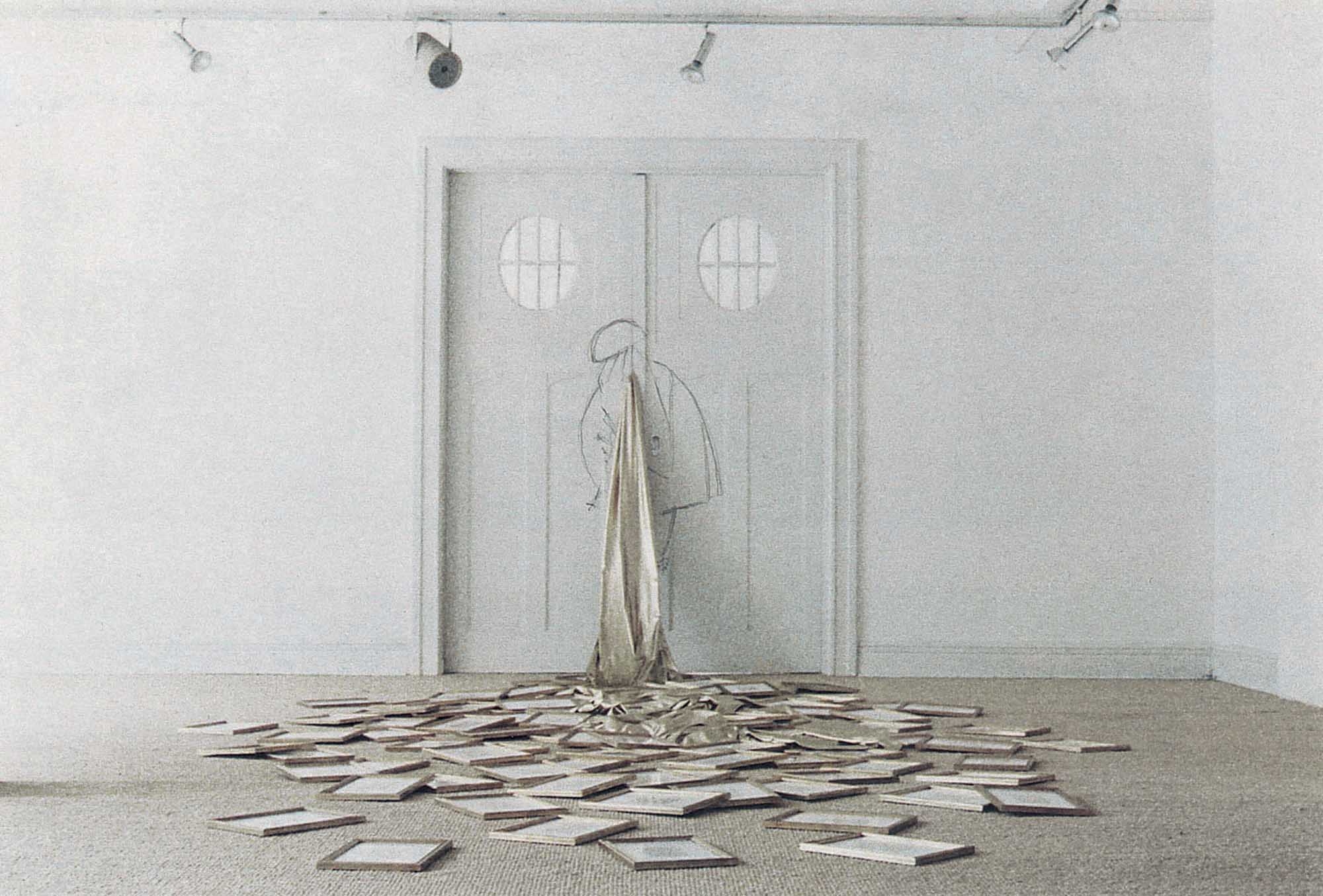
• 1982, Berlin, Neuer Berliner Kunstverein: part V; elements strewn across the floor, on the golden cloak of a figure drawn on the wall borrowed from a painting by Jean-Antoine Watteau.
• 1984, Villeurbanne, Le Nouveau Musée: part IV; elements spread over at least two walls, full height, alternating with linear squares of the same size so as to form a pattern separated by
empty spaces.
• 1986, Charleroi, Palais des Beaux-Arts: part IV; elements alternating with linear rectangles of the same size, so as to make up a discontinuous horizontal sequence at the top of the wall.
• 1986, Stuttgart, Staatsgalerie: part V; elements placed close together to form the frieze of an ideal temple, evoked by a series of antique columns, outlined on the wall in their actual size.
• 1988, Rome, GNAM: part I; elements placed close together to form a long frieze, with no drawn columns.
• 2002, Paris, Musée d’Art Moderne de la Ville de Paris: parts I, III and V; elements placed together to form the frieze of an ideal temple, evoked by a series of antique columns, outlined on the wall in their actual size in the niches of the Rotunda on the lower floor of the museum.
• 2006, Paris, Musée d’Art Moderne de la Ville de Paris (on the occasion of the reopening of some of the restored rooms): parts I, III and V; elements placed close together to form the frieze of an ideal temple, evoked by a series of antique columns, outlined on the wall in their actual size on the walls of an oval space on the lower level of the museum; on the left wall part I (65 elements from the first to the sixty-fifth in numerical order), on the right wall part V (65 elements), on the curved wall part III (15 elements).
Del bello intelligibile is the general title of a cycle comprising five works, made between 1978 and 1982 (GPO-0401, GPO-0402, GPO-0403, GPO-0448, GPO-0467). Each work includes a specific number of lithographs printed in gold and placed in gilded frames, each of which repeats the same mosaic of minuscule reproductions, marked each time, however, by a different caption, written in pencil and referring each time to one of the small images that make it up, so that all together the inscriptions recompose the photographic mosaic in words. From one work to the next the subjects of the reproductions and the number of framed prints change, according to the number of units that make up the mosaic.
Inspired by the yearning for a sublime register of the universal itinerary of art history,1 Del bello intelligibile breaks up the vision of the work in a multitude of illegible images, in a scenography of golden reflections. “Gold recalls the mythical object, it inscribes the sublime; it is the elementary indication of the homage to the unfathomable that tends towards the absolute”,2 says the artist. And in regard to the intelligibility of beauty – the title of the cycle comes from Plotinus (Enneads, V: 8) – Paolini writes: “Intelligibility is a window through which the work of art looks but that then seems to partially close immediately afterwards or at least not open completely”.3
The installation varies depending on the exhibition space and it contemplates the totality or even only a part of the framed elements. In the first presentation of Del bello intelligibile in Paris in 1978, Paolini placed together the components of the first three parts of the cycle so that they formed the frieze of an ideal temple, evoked by a series of antique columns, expressed on the wall in a life-size image (the installation was repeated using a different number of elements in Turin in 1981 and in Stuttgart in 1986). Two alternative forms of the installation involved arranging the components in a frieze, without the drawing of the columns, or else with the components arranged so that they formed large empty frames (Bielefeld and Wuppertal 1982). At other times they were integrated with rectangles, some of which inside and others outside the frames (Kassel 1982).
In the fifth and last segment, the photographic mosaic joins ninety-one interior or exterior views of international museums, marked each time with the name of one of the museums. The subtitle refers to the museums in Berlin located on the "Museum Island". In the artist’s own words: "The images of a journey refer to another journey: towards the place where art is housed".4
For the presentation of this part in Berlin in 1982, Paolini conceived a particular installation that included framed elements scattered on the floor, on the train of the golden cloak worn by a male figure – reproduced in the Berlin replica of Embarquement pour Cythère (1718) by Jean-Antoine Watteau – traced on the surface of a door.
1 G. Paolini in conversation with B. Corà (4 February 1996) in Dopopaesaggio. Figure e misure del giardino, edited by M. Scotini and L. Vecere (Siena: Maschietto & Musolino, 1996), p. 96. The idea of the list and above all of a "temple" of painting from every era harkens back to Idea del tempio della Pittura by G.P. Lomazzo (1590), which Paolini was interested in at the time. As concerns the theme of the list of works see also the cycle Idem (GPO-0244).
2 G. Paolini interviewed by C. Grenier, in Flash Art 3 (Milan, French edition), Spring, 1984, p. 40; republished in Giulio Paolini. La voce del pittore – Scritti e interviste 1965-1995, edited by M. Disch (Lugano: ADV Publishing House, 1995), p. 189, with incorrect details in the bibliographical source.
3 G. Paolini, La verità in quattro righe e novantacinque voci (Turin: Giulio Einaudi editore, 1996), p. 103 (under “Intelligibilità”).
4 G. Paolini in Giulio Paolini. Del bello intelligibile, exhibition catalogue, Bielefeld, Kunsthalle Bielefeld,1982, p. 79.
Title from Plotinus, Enneads (V, 8).
| 1982 | Bielefeld, Kunsthalle Bielefeld, Giulio Paolini. Del bello intelligibile, 7 March - 25 April, touring to: Wuppertal, Von der Heydt-Museum, 4 May - 13 June; Berlin, Neuer Berliner Kunstverein, 13 August - 11 September, col. repr. pp. 79-95, text by E. Franz on the cycle titled Del bello intelligibile pp. 4-10; in Bielefeld and Wuppertal installation in the form of frames of various sizes, proportionate to the exhibition walls (see the note by E. Franz p. 119); in Berlin floor installation, with a figure drawn on the wall and a golden fabric. |
| 1986 | Stuttgart, Staatsgalerie Stuttgart, Giulio Paolini, 20 September - 2 November, cited in the checklist of exhibited works vol. 4 no. 34 p. 52, col. repr. vol. 4 p. 39 (detail), repr. vol. 1 on back cover (exhibition view), referred to in the text by M. Scholz- Hänsel vol. 2 p. 8; installation with drawn columns. |
| 2002-03 | Paris, Musée d’Art Moderne de la Ville de Paris, installation of the Collection; Autumn 2002 - Autumn 2003; installation featuring a frieze with drawn columns, conceived by the artist for the niches in the Rotunda on the lower level of the museum. |
| 2006-08 | Paris, Musée d’Art Moderne de la Ville de Paris, installation of the Collection; from 2 February; installation featuring a frieze with drawn columns, conceived by the artist for a room with an oval plan on the lower level of the museum. |
| • | G. Paolini in Giulio Paolini. Del bello intelligibile, exhibition catalogue, Bielefeld, Kunsthalle Bielefeld, 1982, pp. 27, 29, 45, 53, 71, 79, 97, 109 (note related to the complete cycle, in Italian and German); republished in Italian in Giulio Paolini, vol. Images/Index (Villeurbanne: Le Nouveau Musée, 1984), pp. 94-95, 96, 100; in French in Pratiques. Réflexions sur l’Art 2 (Rennes), Autumn, 1996, pp. 29-33. |
| • | G. Paolini, La verità in quattro righe e novantacinque voci (Turin: Giulio Einaudi editore, 1996), p. 103 (entry “Intelligibilità”). |
| • | Giulio Paolini, vol. Images/Index (Villeurbanne: Le Nouveau Musée, 1984), pp. 91-100 (studies and documentation referred to the complete cycle titled Del bello intelligibile), repr. p. 95 (detail). |
| • | L. Rogozinski, “La position crépusculaire. Notes sur l’art italien d’aujourd’hui”, in Parachute 34 (Montreal), March-April-May, 1984, pp. 8-10 (in general on the cycle titled Del bello intelligibile), not repr. |
| • | J.L. Maubant, “Giulio Paolini ou le triomphe de la mélancolie”, in Paolini. Melanconia ermetica, exhibition catalogue, Paris, Galerie Maeght Lelong, 1985, pp. 9-10 (in general on the cycle titled Del bello intelligibile), not repr. |
| • | G. Inboden, “Giulio Paolini – Triumph des Modells der Repräsentation”, in Giulio Paolini, exhibition catalogue, Stuttgart, Staatsgalerie Stuttgart, 1986, vol. 1, pp. 25-26 (in general on the cycle titled Del bello intelligibile), not repr. |
| • | M. Scholz-Hänsel, “Das imaginäre Museum Giulio Paolinis”, in Giulio Paolini, exhibition catalogue, Stuttgart, Staatsgalerie Stuttgart, 1986, vol. 2, pp. 12-14, 16 (in general on the cycle titled Del bello intelligibile), repr. p. 8 (detail). |
| • | F. Poli, “Note di lettura”, in Id., Giulio Paolini (Turin: Lindau, 1990), p. 36 (in general on the cycle titled Del bello intelligibile); republished in Giulio Paolini. Von heute bis gestern / Da oggi a ieri, exhibition catalogue, Graz, Neue Galerie im Landesmuseum Joanneum (Ostfildern-Ruit: Cantz Verlag, 1998), p. 59, not repr. |
| • | Avanguardie in Piemonte 1960-1990, exhibition catalogue, Alessandria, Palazzo Cuttica (Turin: Lindau, 1992), col. repr. n. pag. (exhibition view Berlin 1982). |
| • | F. Poli, “Giulio Paolini”, in Giulio Paolini al Palazzo della Ragione, exhibition catalogue, Padua, Salone del Palazzo della Ragione (Milan: Fabbri Editori, 1995), p. 33 (in general on the cycle titled Del bello intelligibile), not repr. |
| • | M. Disch, “Giulio Paolini. Hors-d’oeuvre”, in Giulio Paolini. La voce del pittore – Scritti e interviste 1965-1995, edited by M. Disch (Lugano: ADV Publishing House, 1995), p. 131 (in general on the cycle titled Del bello intelligibile), not repr. |
| • | E. Franz, “Visibilité du général. Une description de ‘Del Bello Intelligibile’, oeuvre de Giulio Paolini”, in Pratiques. Réflexions sur l’Art 2 (Rennes), Autumn, 1996, pp. 34-46, repr. p. 33 (detail); French translation of the essay published in Giulio Paolini. Del bello intelligibile, exhibition catalogue, Bielefeld, Kunsthalle Bielefeld, 1982. |
| • | M. Disch, “L'atto espositivo. Appunti sul lavoro di Giulio Paolini”, in Giulio Paolini. Von heute bis gestern / Da oggi a ieri, op. cit. (Ostfildern-Ruit: 1998), repr. p. 119 (exhibition views Wuppertal 1982, b/w repr. on top, and Berlin 1982, col. repr. on bottom). |
| • | A. Lugli, “L’assemblage’ come collezione”, in Id., Assemblage (Paris: Adam Biro, 2000); republished in Italian in Id., Arte e meraviglia. Scritti sparsi 1974-1995, edited by A. Serra (Turin: Umberto Allemandi & C., 2006), pp. 188-189 (in general on the cycle titled Del bello intelligibile), not repr. |
| • | Inventaire des collections du musée d’Art moderne de la Ville de Paris. Peintures, sculptures, installations..., edited by S. Pagé (Paris: Paris Musées, 2006), p. 242, col. repr. (exhibition view Paris, 2006, detail). |
| • | M. Disch, Giulio Paolini. Catalogo ragionato 1960-1999, vol. 1 (Milan: Skira editore, 2008), cat. no. 467 p. 479, col. repr. (detail and exhibition view Berlin 1982). |
| • | Musée d’Art moderne de la ville de Paris. La Collection, edited by S. Pagé (Paris: Paris Musées, 2009), entry by B. Parent p. 416, not repr. (col. repr. p. 417 of the Parte prima: “E che dirò del fulgore dell’oro?”, exhibition view Paris 2006). |
| • | E. Franz, “’Vedo e non vedo’”, in E. Franz et al., Giulio Paolini. Vedo e non vedo. In tema 1 (Turin-Mantua: Fondazione Giulio e Anna Paolini and Corraini Edizioni, 2014), pp. 28, 30, 32, not repr. |

