Come è / Come se, 2014
GPE-0130
As It Is / As If
Lithograph
Plate 33 x 33 cm folded, 66 x 99 cm open
Signed on the recto, bottom centre: “Giulio Paolini”
Autograph numbering on the recto, bottom centre
60 in Arabic numerals from 1/60 to 60/60
10 in Roman numerals from I/X to X/X
Danilo Montanari Editore, Ravenna
Grafiche Morandi, Fusignano (Ravenna)
The print is part of the multiplied art released by the publisher Danilo Montanari, Ravenna, director from 1980 to 1993 of the Agenzia Editoriale Essegi. The catalogue of publications includes books, multiples, and graphic editions by contemporary artists created in close collaboration with the authors.
Double-sided three-flap white card stock folder, closed format 35 x 35 cm; cover with titles in black (author, title, publisher). Contains the title-page, the folded plate, two sheets with a text by the author, respectively in Italian and in English, and the colophon.
Includes information regarding edition size, printer, publisher, and date of printing (October 2014).
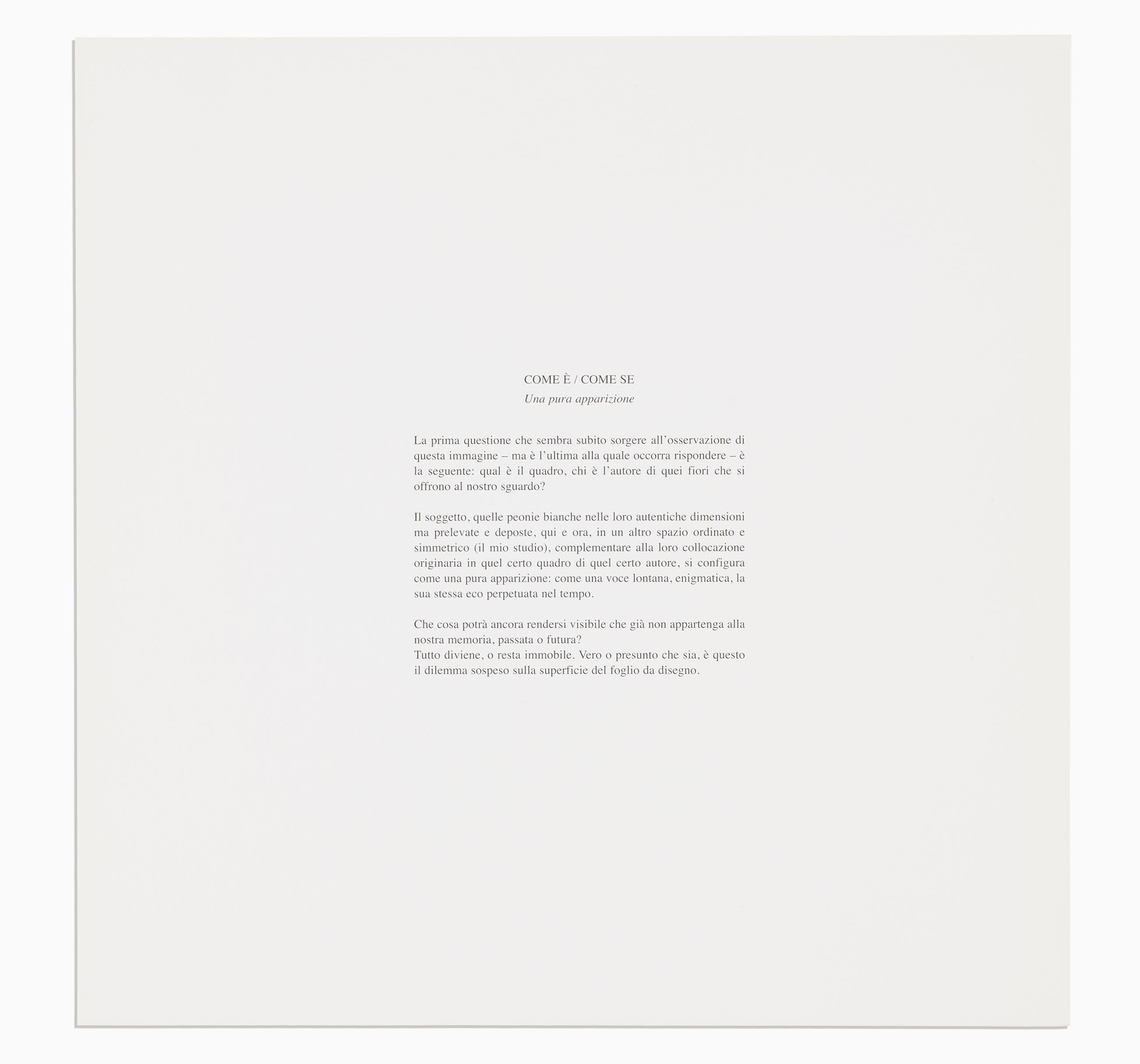
Text by the artist, Come è / Come se. Una pura apparizione, referring to the subject of the print.
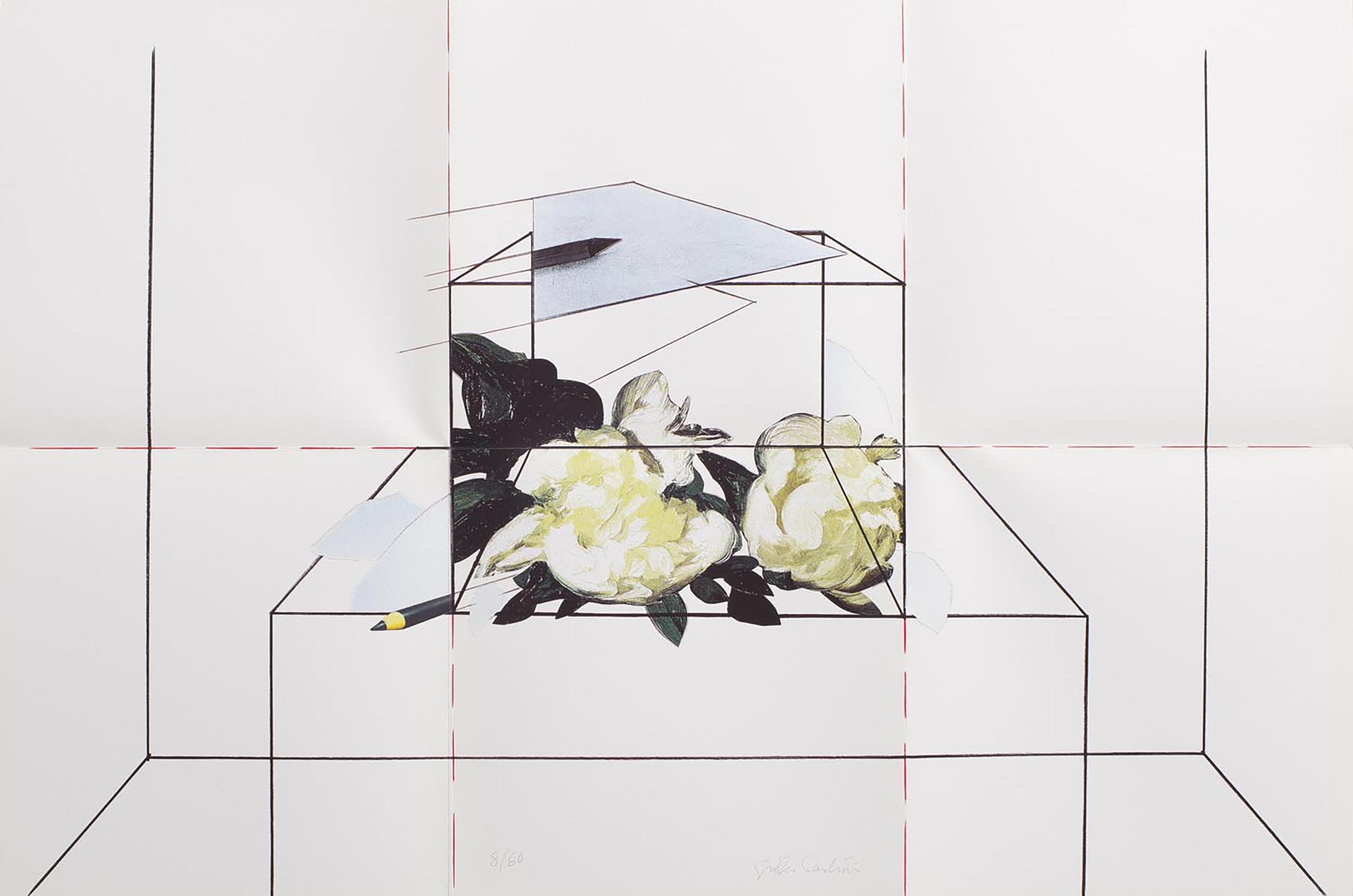
The drawing, reproduced full-bleed on a sheet of paper folded three times portrays a room in perspective, with a table at the centre, on which there is a case containing two white peonies borrowed from a painting by Édouard Manet.1 Arranged on the table as well is a pencil and several pieces of blank paper that recall the leaves of the peonies. Laid down on top of the case are a blank sheet and a pencil, while another sheet that is lightly sketched seems to fall freely. Several dotted lines in red follow the folds of the sheet and at the same time divide the image plane.
The interpretation is suggested by the title, which calls into play the dilemma between being and appearing, that is, the enigma itself of the representation. Manet's flowers are reproduced in the exact same size with respect to the painting ("just as they are” in the original painting), but at the same time they are a "pure apparition", the echo of an absent original ("as if" they were Manet's flowers). The pencil that prepares to transcribe the actual situation (the flowers “as they are”) will always and only suggest a presumed image, a "distant voice" ("as if" they were those flowers). Metaphorically, the scene takes place in the artist's studio, who at his table must always come to terms with the challenge that is implicit in the creation of an image.
The print is part of the development of a theme formulated that same year in two large-scale works (GPO-1037, GPO-1041), as well as in two works on paper (GPC-1864, GPC-1865). As concerns the motif of the table in a room see also the variant on paper formulated in 2014 (GPC-0607) and used for a print edition from 2021 (GPE-0148).
1 With respect to the original painting (Branche de pivoines blanches et sécateur, 1864), Paolini left out the scissors at the lower left and added several leaves near the edge of the table.
Édouard Manet, Branche de pivoines blanches et sécateur, 1864, oil on canvas, 30.5 x 46.5 cm, Musée d’Orsay, Paris.
| • | G. Paolini, Come è / Come se. Una pura apparizione, note to the work included with the print edition, in Italian and English. |

