
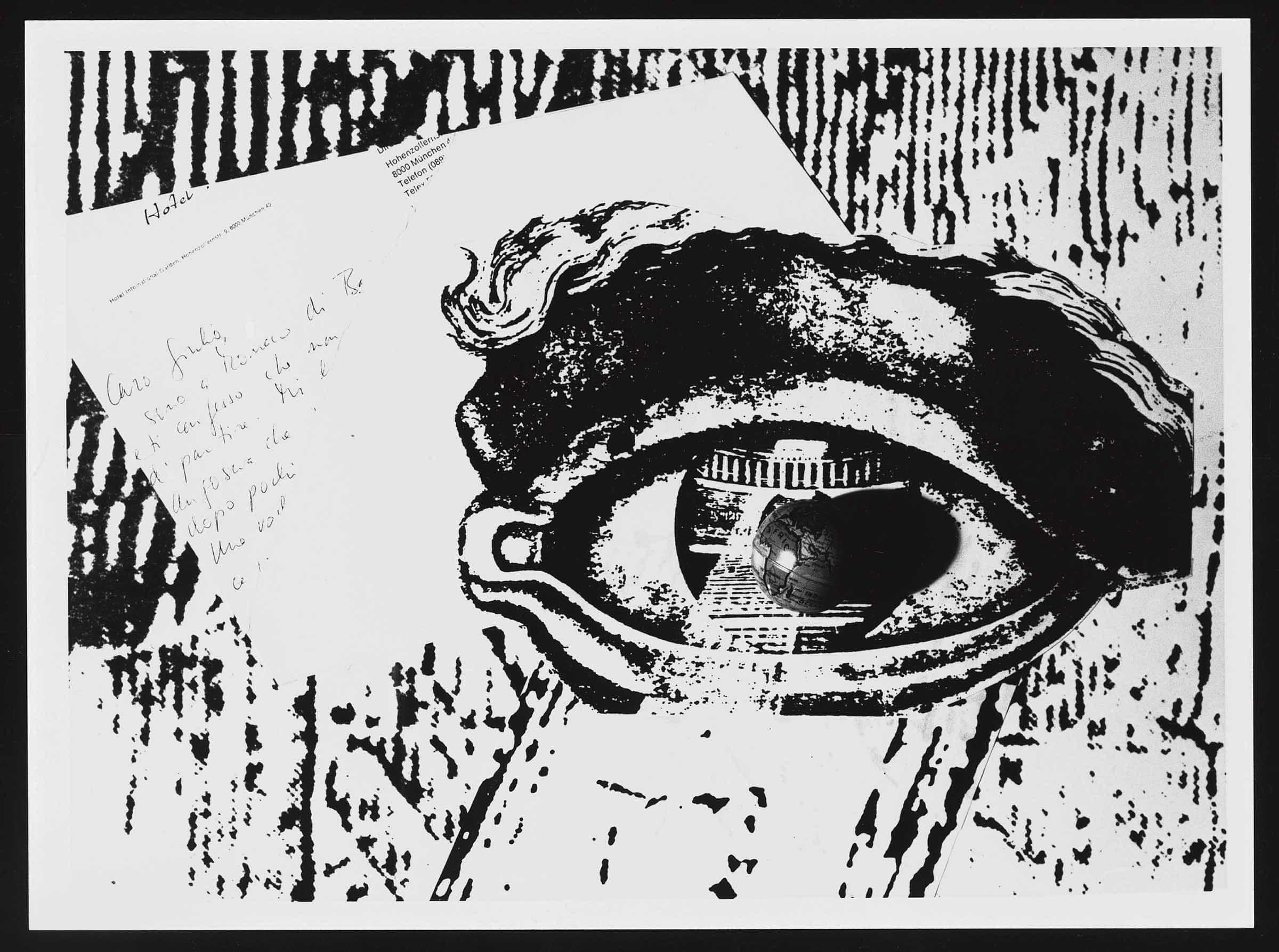
Tout ce qu’il y a de beau en Italie, 1986
GPO-0570
Collage on photo print and on glass
Twelve framed parts 75.5 x 75.5 cm each, overall dimensions 308 x 231 cm
Private collection
Twelve framed elements placed at short intervals to form a large painting reproduce an engraving portraying a draughtsman in a landscape with ruins.1 The artist turned the nineteenth-century image into the image of a face seen from the side, adding an eye2 and hiding the upper part with a strip of black paper to emphasize the shape of the hypothetical head. Each of the twelve elements is made up of a collage consisting of: 1) a detail of the draughtsman of ruins, each time rotated and included in a spiral path that converges in the cavern-ear, 2) a small circular fragment of a colour reproduction of the solar system, 3) one or two torn fragments of the answer given to the artist by nine friends, when asked to express a suggestion as concerns "all that is beautiful in Italy".3 The element with the eye also bears a tiny metal globe in the area of the pupil, applied to the glass. At the top, the black paper background is studded with celestial bodies represented by small elements of white and silver paper.
The complex image finds its keystone in the number nine, intended as a sign of the absolute. The spokesperson for the nine figures who were consulted, the author-draughtsman repeated nine times in the landscape of ruins renews without stopping his own limitless and risky desire to gather Everything, symbolized by the globe in the ear-theatre, by the nine planets, and by the totality mentioned in the title. A desire destined, nevertheless, to become lost in the black hole of the cavern-ear, evoking a zero.
1 The photograph reproduces the engraving Artist Recording Assyrian Bas-reliefs, taken from A.H. Layard, Nineveh and Its Remains, vol. 2 (London: 1849).
2 This is the eye that reflects the interior of the theatre designed by Claude Nicolas Ledoux for Besançon. Cf. C.N. Ledoux, L’Architecture, vol. 2 (Paris: 1804), p. 113.
3 The correspondence between the artist and the nine interlocutors – Mario Diacono, Rudi Fuchs, Remo Guidieri, Pontus Hulten, Françoise Lambert, Sol LeWitt, Dora Stiefelmeier, Cy Twombly, Gianfranco Verna – is published in Ultime, exhibition catalogue, Radda in Chianti, Castello di Volpaia, 1986, pp. 98-105. The French expression, put forward as a reason for reflection to the nine friends, is taken from a declaration made by Louis XIV to his Minister Colbert around 1661: “Nous devons faire en sorte d’avoir en France tout ce qu’il y a de beau en Italie” (We must do what is necessary for France to have all that Italy has that is beautiful).
• Austen Henry Layard, Artist recording Assyrian bas-reliefs, 1849, engraving; reproduction from Res 9 (Cambridge University Press), Spring, 1985.
• Eye: engraving featuring the interior of the theatre at Besançon designed by Claude-Nicolas Ledoux; reproduction from Claude Nicolas Ledoux, L’Architecture, vol. II (Paris: 1804), p. 113.
• Correspondence between Giulio Paolini and nine friends – Mario Diacono, Rudi Fuchs, Remo Guidieri, Pontus Hulten, Françoise Lambert, Sol LeWitt, Dora Stiefelmeier, Cy Twombly, Gianfranco Verna – published in Ultime, exhibition catalogue, Radda in Chianti, Castello di Volpaia, 1986, pp. 98-105.
• Title from Francis Haskell, Nicholas Penny, Taste and the Antique: The Lure of Classical Sculpture 1500-1900 (New Haven, Connecticut: Yale University Press, 1982), chapter VI.
| 1986 | Radda in Chianti, Castello di Volpaia, Ultime, 6-21 September, not repr., monographic chapter including various documents pp. 93-111. |
| 1989 | Milan, Le Case d’Arte, Giulio Paolini, [unknown dates] 1989. |
| • | G. Paolini in Ultime, exhibition catalogue, Radda in Chianti, Castello di Volpaia, 1986, 95-98, 107; republished in Id., Suspense. Breve storia del vuoto in tredici stanze (Florence: Hopeful Monster editore, 1988), pp. 72-75. |
| • | G. Paolini, Suspense. Breve storia del vuoto in tredici stanze (Florence: Hopeful Monster editore, 1988), repr. pp. 73 (exhibition view Radda in Chianti 1986), 74-75 (detail). |
| • | S. Vertone, “Il gioco delle regole”, in Giulio Paolini, exhibition catalogue, Rome, Galleria Nazionale d’Arte Moderna (Milan-Rome: Arnoldo Mondadori Editore and De Luca Edizioni d’Arte, 1988), pp. 15-16, not repr. |
| • | F. Poli, “Note di lettura”, in Id., Giulio Paolini (Turin: Lindau, 1990), p. 28, repr. no. 156 (exhibition view Radda in Chianti 1986); republished in Giulio Paolini. Von heute bis gestern / Da oggi a ieri, exhibition catalogue, Graz Neue Galerie im Landesmuseum Joanneum (Ostfildern-Ruit: Cantz Verlag, 1998), p. 45, not repr. |
| • | Giulio Paolini, Mimmo Paladino (Lugano: BSI SA, 2000), col. repr. n. pag. (the small globe applied to the glass is missing). |
| • | Oggi per domani. Cinque artisti contemporanei nella Collezione BSI, exhibition catalogue, Lugano, Museo Cantonale d’Arte (Milan: Skira editore, 2001), pp. 120-121 cat. no. 79 (not exhibited since it was stolen before the exhibition), col. repr. (the small globe applied to the glass is missing). |
| • | D. Lancioni, “Squadratura, quadro, quadrante”, in Giulio Paolini: Quadrante. Viaggio intorno a un’idea di esposizione, exhibition catalogue, Rome, Villa Medici (Rome: Edizioni dell’Oca, 2002), p. 61, not repr. |
| • | Nello spazio del cosmo, exhibition catalogue, Milan, Fonte d’Abisso Arte (Milan: Mazzotta, 2005), repr. p. 22. |
| • | M. Bandini, M.C. Mundici, M.T. Roberto, Luciano Pistoi: “inseguo un mio disegno” (Turin: Hopefulmonster editore, 2008), repr. pp. 63, 327 (exhibition views Radda in Chianti 1986). |
| • | M. Disch, Giulio Paolini. Catalogo ragionato 1960-1999, vol. 2 (Milan: Skira editore, 2008), cat. no. 570 pp. 582-583, col. repr. |

