
Platea, 1978
GPO-0378
Audience
Collage on photographic reproductions, pencil and red pencil on paper
Six parts 30 x 40 cm each, overall dimensions variable
Private collection, Pozzuoli
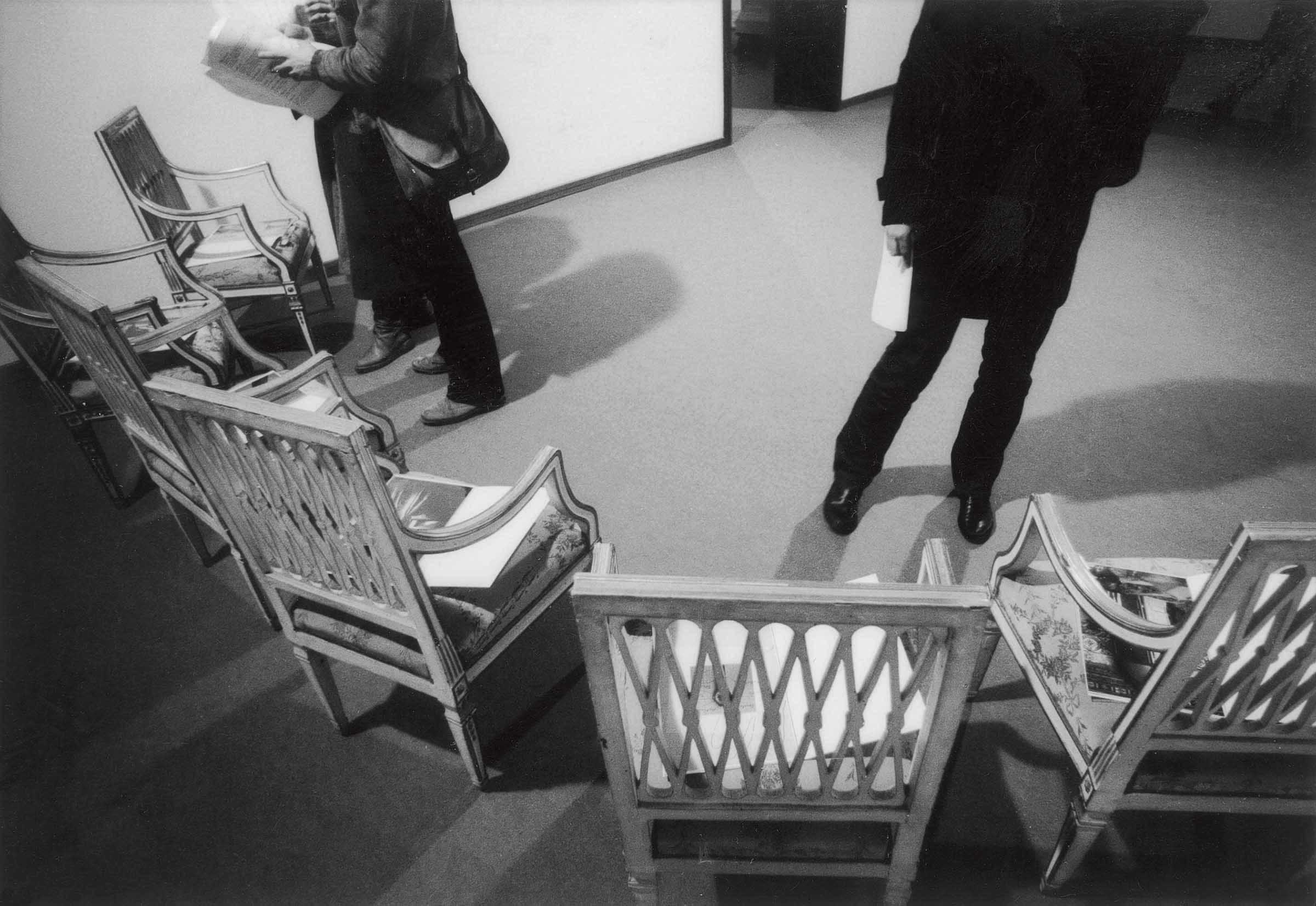
The six collages – each of which arranged upon the right side of a white folder and accompanied by an autograph inscription on the left side of the folder – should be arranged upon six chairs (director's chair, or older in style, depending on the exhibition context). The chairs must be placed close together at short intervals from each other, along a slightly curved path (never in a straight line).
As an alternative they can be displayed on the wall, lined up horizontally in a row, at short intervals, or placed at short and regular intervals so that they produce a rectangular ensemble of 3 x 2 x 2 x 3 units.
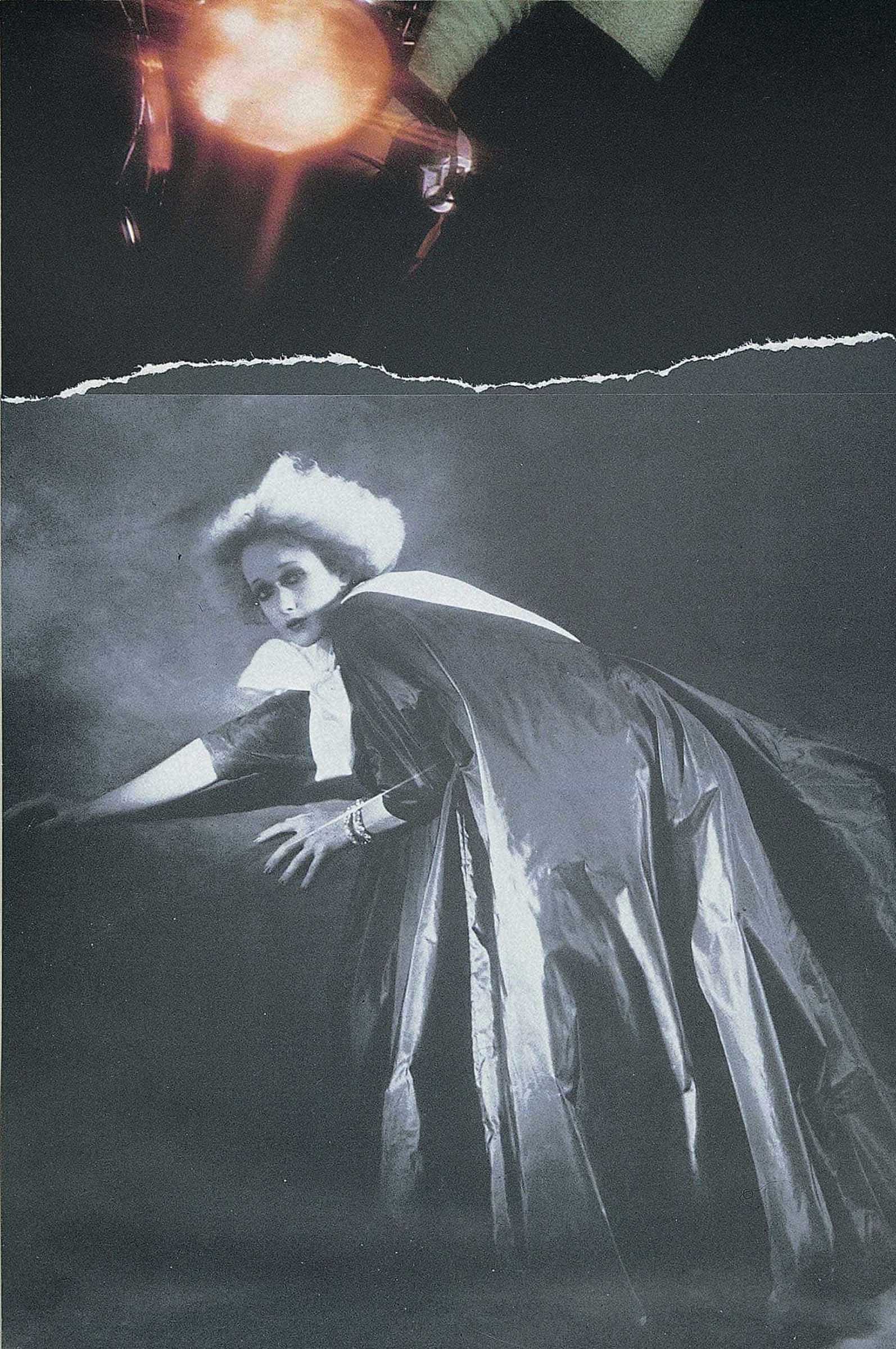
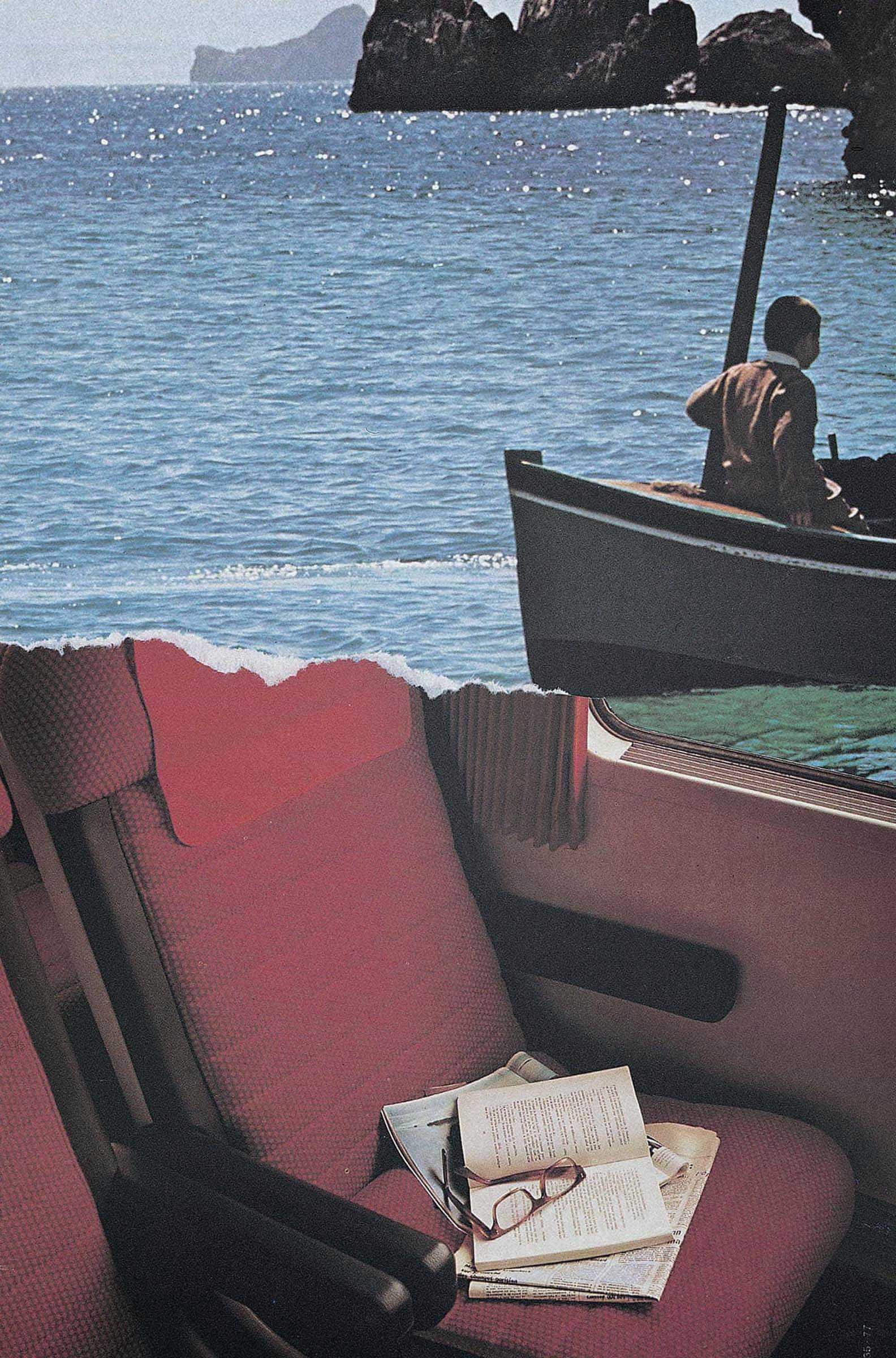
The six framed elements are each constituted by a white folder. On the left side of the folder the artist has written a name with the initial in red, while applied to the right side is a collage with a male or female figure. The six names identify the six subjects with the protagonists who in the final part of Homer's Odyssey were called to recognize Ulysses upon his return to Ithaca: Penelope, Laertes, Anticlea, Telemachus, Eumaeus, and Antinous. When read in a sequence the initials form the word “platea” (audience), referred to in the title. Each character is connoted by a distinctive attribute: Penelope is represented by the photograph of a woman surrounded by tapestries, who holds before her, as if it were a book, the black and white image of a woman standing at the threshold to a door. The elderly Laertes is recalled via the image of the face of a clock, which overlaps the various sheets that a hand drawn in pencil tries to hold down. Anticlea, Ulysses' mother, is represented by an image of Carla Tatò in this same role in the theatrical project entitled Platea, conceived by Carlo Quartucci and Giulio Paolini. Telemachus, Ulysses' son, is evoked by two travel images, respectively, the seat on a train and a young man on a boat in the middle of the sea. Eumaeus, Ulysses' servant, is represented by the image of a photographic set that has a tear in the middle through which one can glimpse a marine view. Lastly, Antinous is represented by two male models, one photographic and the other drawn, borrowed from a fashion magazine.
In the first display of the work in Naples in 1978, Paolini installed the six elements on an equal number of chairs arranged close together, and turned towards the viewers as if this were the seating area in a theatre. Indeed, the key to interpretation lies in the term “platea”, which designates the area located before the stage in a theatre, the area that is reserved for the public. The six figures recalled in the collages arranged on the chairs that are turned towards the viewer suggest an audience as it awaits the performance – similarly to the previous versions of Platea (GPO-0298, GPO-0348) – while the viewer himself is "on the scene", invited to wear the clothing of Ulysses, the true protagonist of Homer's epic poem as well as of Paolini's work.
| 1978 | Naples, Museo Diego Aragona Pignatelli Cortes, Giulio Paolini, from 9 February, no catalogue. |
| • | G. Paolini, “Platea. Ulisse (lo spettatore) di fronte ai personaggi in attesa della rappresentazione”, in Figure. Teoria e critica dell’arte 2, no. 6 (Rome), 1983, p. 15; republished in Giulio Paolini, vol. Images/Index (Villeurbanne: Le Nouveau Musée, 1984), pp. 142-143. |
| • | Paolo Mussat Sartor Fotografo 1968-1978. Arte e artisti in Italia (Turin: Stampatori Editore, 1979), repr. pp. 176, 177. |
| • | Giulio Paolini. Atto unico in tre quadri, exhibition catalogue, Milan, Studio Marconi (Milan: Gabriele Mazzotta editore, 1979), repr. p. 109. |
| • | G. Paolini, Suspense. Breve storia del vuoto in tredici stanze (Florence: Hopeful Monster editore, 1988), repr. p. 158. |
| • | F. Poli, “Il dèmone della teatralità”, in Giulio Paolini. Il “Teatro” dell’opera, exhibition catalogue, Pesaro, Galleria Franca Mancini (Ravenna: Agenzia Editoriale Essegi, 1991), p. 10, not repr. |
| • | M. Disch, Giulio Paolini. Catalogo ragionato 1960-1999, vol. 1 (Milan: Skira editore, 2008), cat. no. 378 p. 383, repr. (exhibition view Naples 1978) and col. repr. (details). |
| • | Paolo Mussat Sartor Luoghi d’arte e di artisti. 1968-2008 (Zurich: JPR|Ringier, 2008), repr. n. pag. |
| • | M. Disch, “The Author, the Work and the Viewer: The ‘Performative’ Dimension in Giulio Paolini’s Work”, in Entrare nell’opera. Processes and Performative Attitudes in Arte Povera, exhibition catalogue, Vaduz, Kunstmuseum Liechtenstein (Cologne: Verlag der Buchhandlung Walther König, 2019), pp. 190, 193, repr. p. 191; in the German edition published in 2021 pp. 81-82, not repr. |
| • | S. Menichini, “’La caduta di Icaro’ di Giulio Paolini (1981). Uno studio iconografico”, in L’uomo nero. Materiali per una storia delle arti della modernità 17, n.s., no. 17-18, February (Milan - Udine: Mimesis Edizioni, 2021), p. 169, repr. p. 168. |

