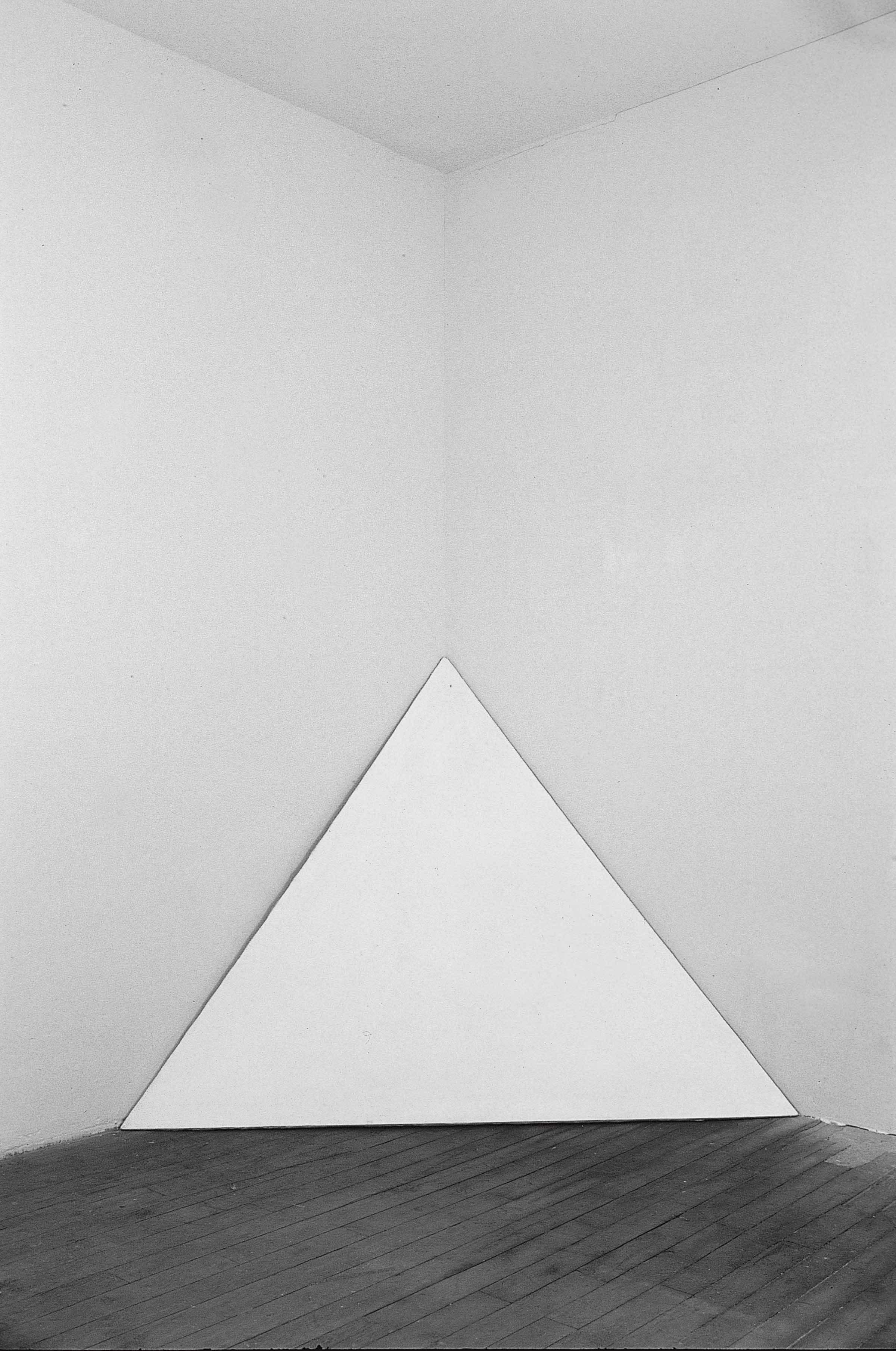
L’esprit de finesse, 1966
GPO-0100
Primed canvas
160 x 210 x 110 cm
Signed, titled, and dated on the verso, lower centre: “Giulio Paolini / L’esprit de finesse / 1966”
Pinault Collection
The upper vertex of the canvas must coincide with the vanishing point of the gaze (160 cm from the ground).
A large equilateral triangular canvas is located in the lower corner of a space, so that the upper vertex coincides with the vanishing point of the gaze.
The work is part of the research that distinguished the artist's output in 1966. Starting from the same premise – canvases juxtaposed so that they mark the corner of a room, seen as the elementary point of origin of a space – many different optical configurations were developed, calling into play the gap between the logical assumption – the elementary and rational given – and the illogical and mutating complexity of the perception.
With respect to the optical spatial configurations generated by most of the other works in this series, in this case the inclined plane of the canvas hiding the spatial nature of the corner offers a situation that is inversely complementary.
The title refers to the concept that Blaise Pascal uses to contrast the "esprit de géométrie” in his Pensées (1670): the “spirit of finess” corresponds to the form of knowledge that is pertinent to the sphere of the senses and direct insight, while the "spirit of geometry" is scientific and analytical knowledge, obtained via geometric and rational processes, far-removed from concrete use.
Title taken from Blaise Pascal, Pensées, 1670.
| 1966 | Milan, Galleria dell’Ariete, Giulio Paolini, from 15 April, cat. no. 6, not repr. |
| 1966 | Turin, Galleria Notizie, Aspetti dell’avanguardia in Italia, from 4 October, cited in the checklist of exhibited works, not repr. |
| 1987 | Paris, Galerie Durand-Dessert, Arte Povera 1965-1971, 10 January - 7 March. |
| 1987 | Nîmes, Musée des Beaux-Arts, Italie hors d’Italie, 10 July - 30 September, cited in the checklist of exhibited works no. 52 p. 214, repr. p. 99. |
| 1995 | Paris, Galerie Durand-Dessert, Arte Povera 1965-1972, 11 March - 13 May. |
| 2006 | Venice, Palazzo Grassi, Where Are We Going? Opere scelte dalla Collezione François Pinault, 30 April - 1 October, col. repr. p. 112. |
| 2013-15 | Venice, Punta della Dogana, François Pinault Foundation, Prima materia, 30 May 2013 - 15 February 2015, cited in the checklist of exhibited works p. 246, col. repr. p. 239 (exhibition view), referred to in the conversation between G. Celant, L. Ufan and M. Govan p. 40. |
| • | Giulio Paolini (Parma: Università di Parma, Centro Studi e Archivio della Comunicazione, 1976), repr. no. 68. |
| • | M. Bouisset, Arte Povera (Paris: Éditions du Regard, 1994), col. repr. p. 53. |
| • | Arte italiana. Ultimi quarant’anni. Pittura aniconica, exhibition catalogue, Bologna, Galleria d’Arte Moderna (Milan: Skira editore, 1998), repr. no. 82 p. 116. |
| • | C. Bouyeure, "Arte Povera, Aperto Libro", in Ligeia 25-28 (Paris), October 1998 • June 1999, pp. 74, 76 (statement by M. Durand-Dessert), repr. p. 73. |
| • | Giulio Paolini 1960-1972, edited by G. Celant (Milan: Fondazione Prada, 2003), repr. p. 163. |
| • | A. Zevi, Peripezie del dopoguerra nell’arte italiana (Turin: Giulio Einaudi editore, 2005), p. 289, not repr. |
| • | Land Art, Concettuale, Arte Povera, Art Now. Corriere della Sera 6, edited by F. Gualdoni (Milan: Skira editore, 2007), col. repr. no. 13 p. 34. |
| • | M. Disch, Giulio Paolini. Catalogo ragionato 1960-1999, vol. 1 (Milan: Skira editore, 2008), cat. no. 100 p. 128, repr. |
| • | R. Cuomo, Giulio Paolini. Lo spazio, 1967. In collezione 4 (Turin-Mantua: Fondazione Giulio e Anna Paolini and Corraini Edizioni, 2016), p. 52, not repr. |
| • | F. Guzzetti, “‘Non si trattava di elaborare degli spazi astratti’: Giulio Paolini all’Ariete, 1966”, in Spazi astratti. Interferenze fra architettura e arti a Milano 1945-1970, edited by A.V. Navone, L. Tedeschi, and S. Setti (Milan: Electa, 2024), pp. 125, 130-131, repr. p. 132 (exhibition view Milan 1966). |

