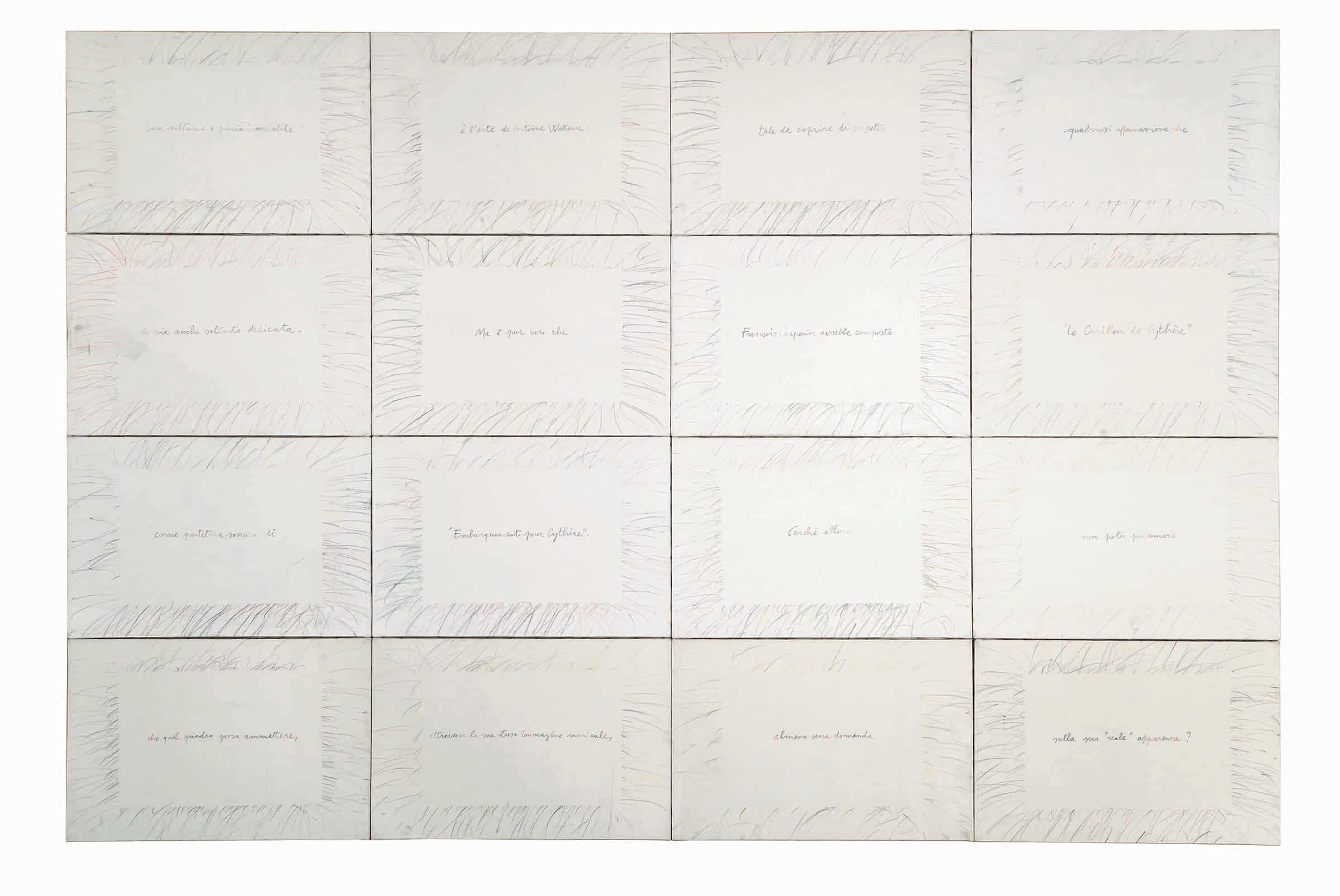
Una visione, 1973
GPO-0256
A Vision
Coloured pencils on primed canvas
Sixteen parts 40 x 60 cm each, overall dimensions 175 x 255 cm
Private collection, Milan
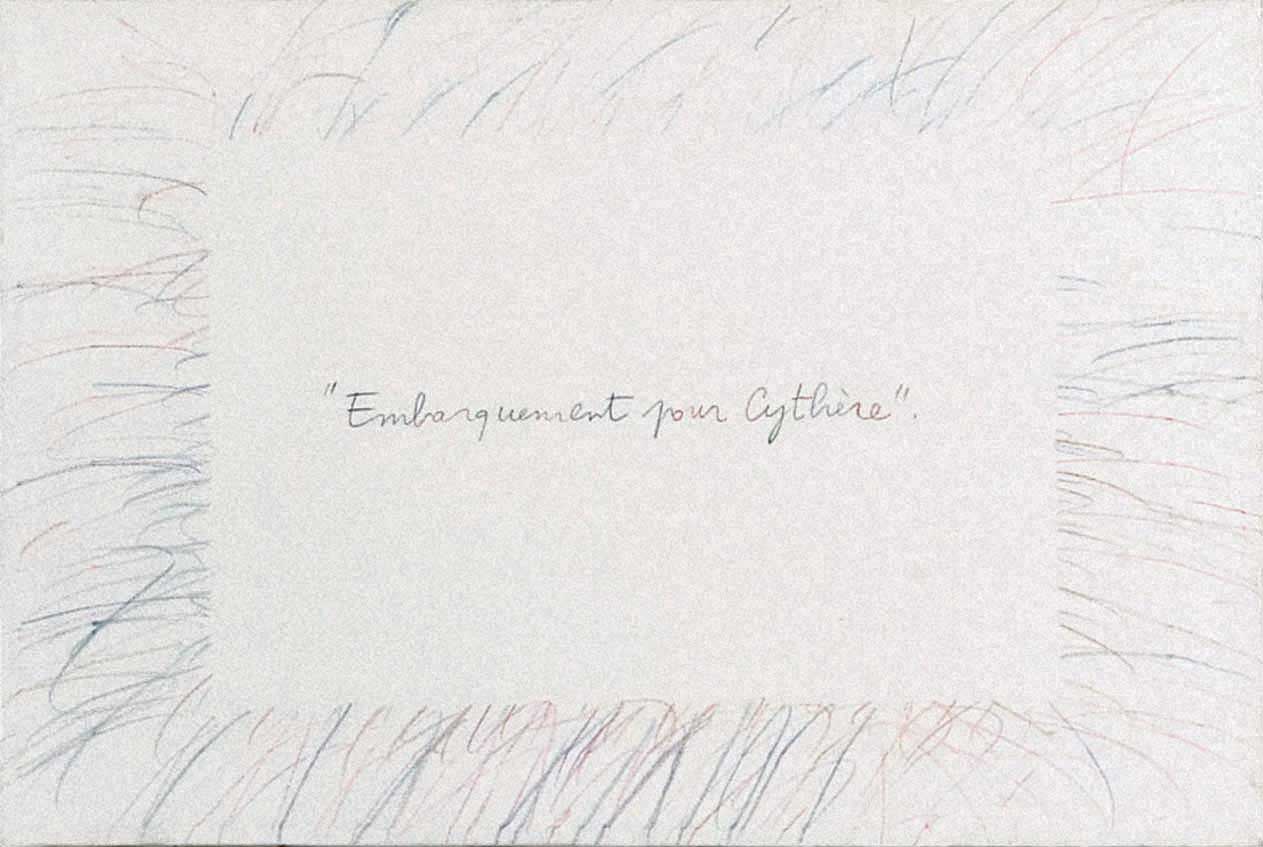
Sixteen lines of text in polychrome characters are located each at the centre of sixteen canvases, placed at short intervals from each other to form a large painting. Each time, a multicoloured, perimetral "drawing" evokes a hypothetical image hidden by the blank rectangle with a line of text at its centre. Overall, the text calls into question the existence of an image, its reason for being as such: “Unique, sublime and therefore unattainable is the art of Antoine Watteau: enough to cover with suspicion any affirmation that is even just dedicated to it. However, it is also true that François Couperin composed Le Carillon de Cythère as a musical score for Embarquement pour Cythère. Why then not presume that that painting can admit, through its own musical image, at least one question on its 'real' appearance?".
With the juxtaposition, or, better yet, the overlapping of two different interpretations of the Greek island of Cythera – the ideal island of love and beauty – Paolini wishes to question the possibility itself of bestowing an image on an absolute dimension. If Couperin and Watteau do not succeed in depicting their subject, which escapes every attempt at representation, the one and the other offer "a vision": a painting, Paolini seems to be saying, first of all underlies the question on the very reason why an image must be as it is. The drawing without a face and the handwritten text call into question the "truth" of a depiction: the idea itself of attributing a "vision" to an image.
The theme of this work corresponds to a formulation from the same year, on a single canvas (GPO-0254).
• Jean-Antoine Watteau, Embarquement pour Cythère, 1718, oil on canvas, 129 x 194 cm, Schloss Charlottenburg, Berlin.
• Jean François Couperin, Le Carillon de Cythère, 1722, piece for harpsichord.
| 1973 | Milan, Studio Marconi, Paolini: opere 1961/73, from 15 November, not repr. |
| • | M. Fagiolo, “Glossario”, in Giulio Paolini (Parma: Università di Parma, Centro Studi e Archivio della Comunicazione, 1976), p. 19, repr. no. 165. |
| • | F. Poli, “Note di lettura”, in Id., Giulio Paolini (Turin: Lindau, 1990), p. 41, not repr.; republished in Giulio Paolini. Von heute bis gestern / Da oggi a ieri, exhibition catalogue, Graz, Neue Galerie im Landesmuseum Joanneum (Ostfildern-Ruit: Cantz Verlag, 1998), p. 67. |
| • | C. Bertola, “Il quadro che contiene tutti i quadri”, in Giulio Paolini. Von heute bis gestern / Da oggi a ieri, op. cit. (Ostfildern-Ruit: 1998), p. 105, not repr. |
| • | M. Disch, Giulio Paolini. Catalogo ragionato 1960-1999, vol. 1 (Milan: Skira editore, 2008), cat. no. 256 p. 268, col. repr. |

