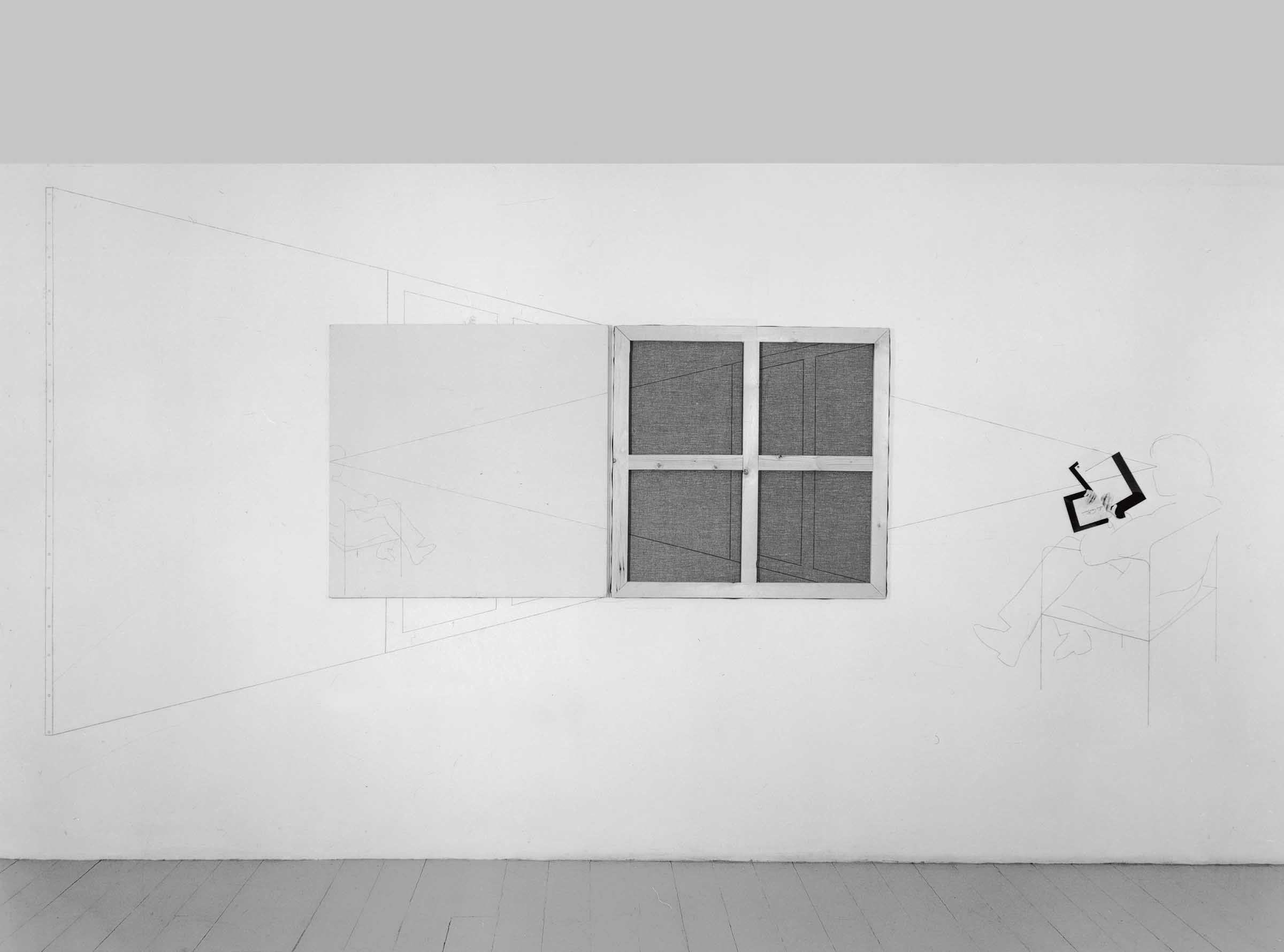
Liber veritatis, 1979
GPO-0406
Pencil on reversed canvas, red pencil on primed canvas and on wall, collage on wall
Dismantled work
The starting point of the lines of sight drawn on the wall and on the canvases is the gaze of a seated male figure, which corresponds to its specular repetition on the canvas viewed from the recto. The life-size figure drawn on the wall, in addition to looking at the two canvases, also looks at the fragments of the image, applied on the wall, and borrowed from the invitation to a solo show, as well as from the photograph, used several times, of a ruler placed on a sheet of drawing paper.
The person who is seated is a stand-in for both the viewer and the author himself, who, for Paolini, coincide in a single gaze. The cone of vision represents a privileged motif to formulate the work as a specular device of the gaze that captures it. The juxtaposition of one canvas seen from the back and another seen from the front suggests a 360-degree panoramic view, which, between the two extremes, includes an infinite number of intermediate poses and images that can be associated with the blank canvas, emphasizing the idea of the work as the “liber veritatis” of its possible configurations.1
The same theme was used in a previous variant, made in 1978 (GPO-0396), and in one from the same year (GPO-0415).
1 The expression “liber veritatis” harkens back to the title of the sketchbook on which Claude Lorrain, starting in 1636, recorded his compositions, reproducing them faithfully, somewhat like a Catalogue raisonné.
Title from Claude Lorrain, Liber Veritatis, 1636-82, British Museum, London.
| 1979 | London, Lisson Gallery, Giulio Paolini. Liber veritatis, 20 March - 13 April. |
| • | Identité Italienne. L’art en Italie depuis 1959, edited by G. Celant (Paris-Florence: Centre Georges Pompidou and Centro Di, 1981), p. 596, not repr. |
| • | M. Disch, Giulio Paolini. Catalogo ragionato 1960-1999, vol. 1 (Milan: Skira editore, 2008), cat. no. 406 p. 414, repr. |
| • | C. Macchi, “‘Il cavo del pensiero’, drawing as enlightened thought in Arte Povera: exposure and underexposure”, in Towards Visibility. Exhibiting Contemporary Drawing 1964-80, edited by J. Enckell Julliard (Vevey-Paris: Musée Jenisch and Roven Éditions, 2015), p. 141, not repr. |
| • | Artist / Work / Lisson (London: Lisson Gallery, 2017), col. repr. p. 949. |

