Crystal Palace, 1997
GPO-0786
Black and golden enamel on wall, plexiglas sheets with coloured edges, white wooden frames with golden thread, plexiglas element, top hat with coloured strip
Golden enamel squares on wall 100 x 100 cm each, six frames and six plexiglas sheets 100 x 100 cm each, plexiglas element 100 x 141 x 70.5 cm, overall dimensions variable
Collection of the artist
The drawing of the doors can be developed over three adjacent walls, or on a single wall, with the doors drawn on the two side of a passageway or an opening.
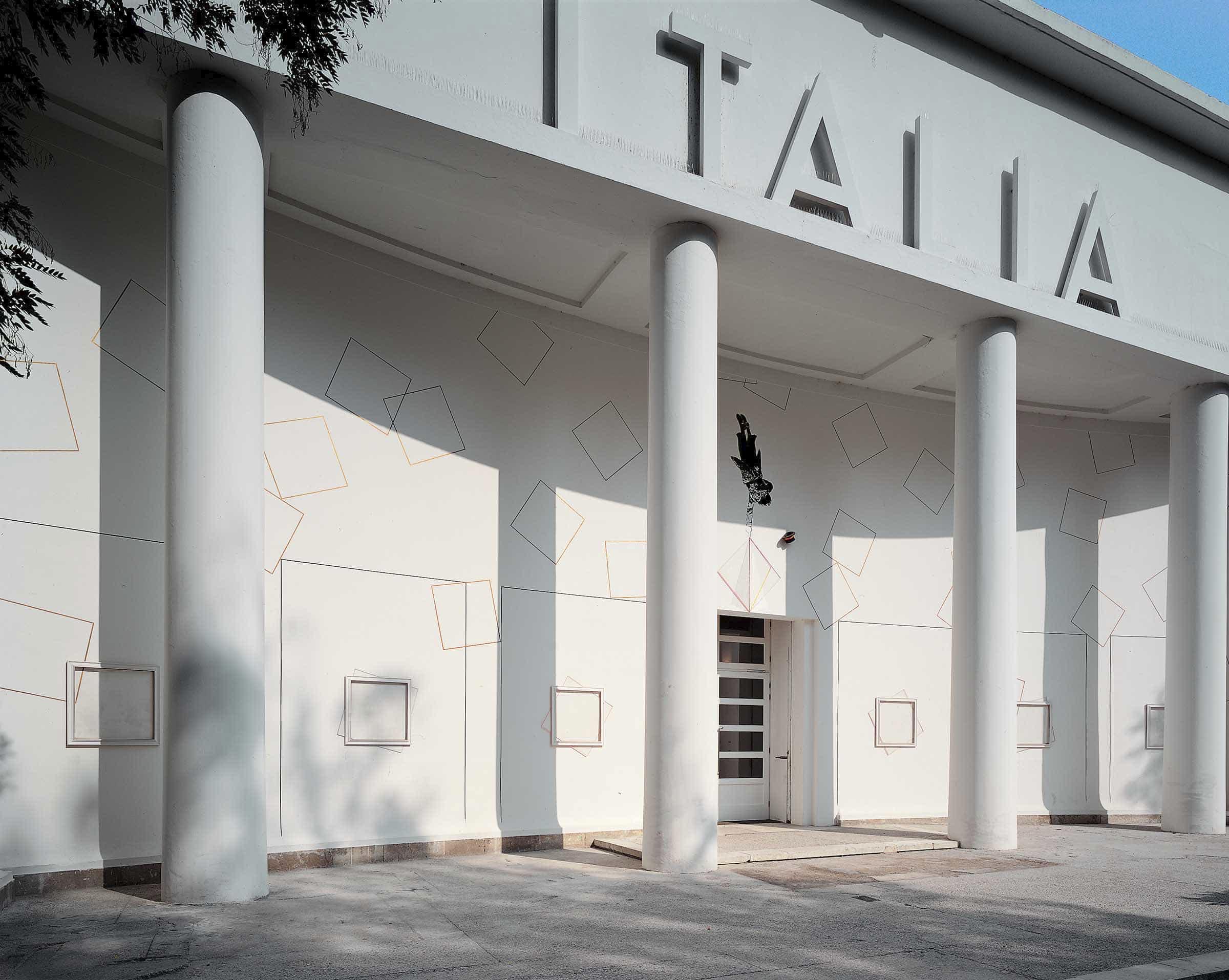
• 1997, Venice, Biennale: the work was installed on the outer wall of the Italian Pavilion.
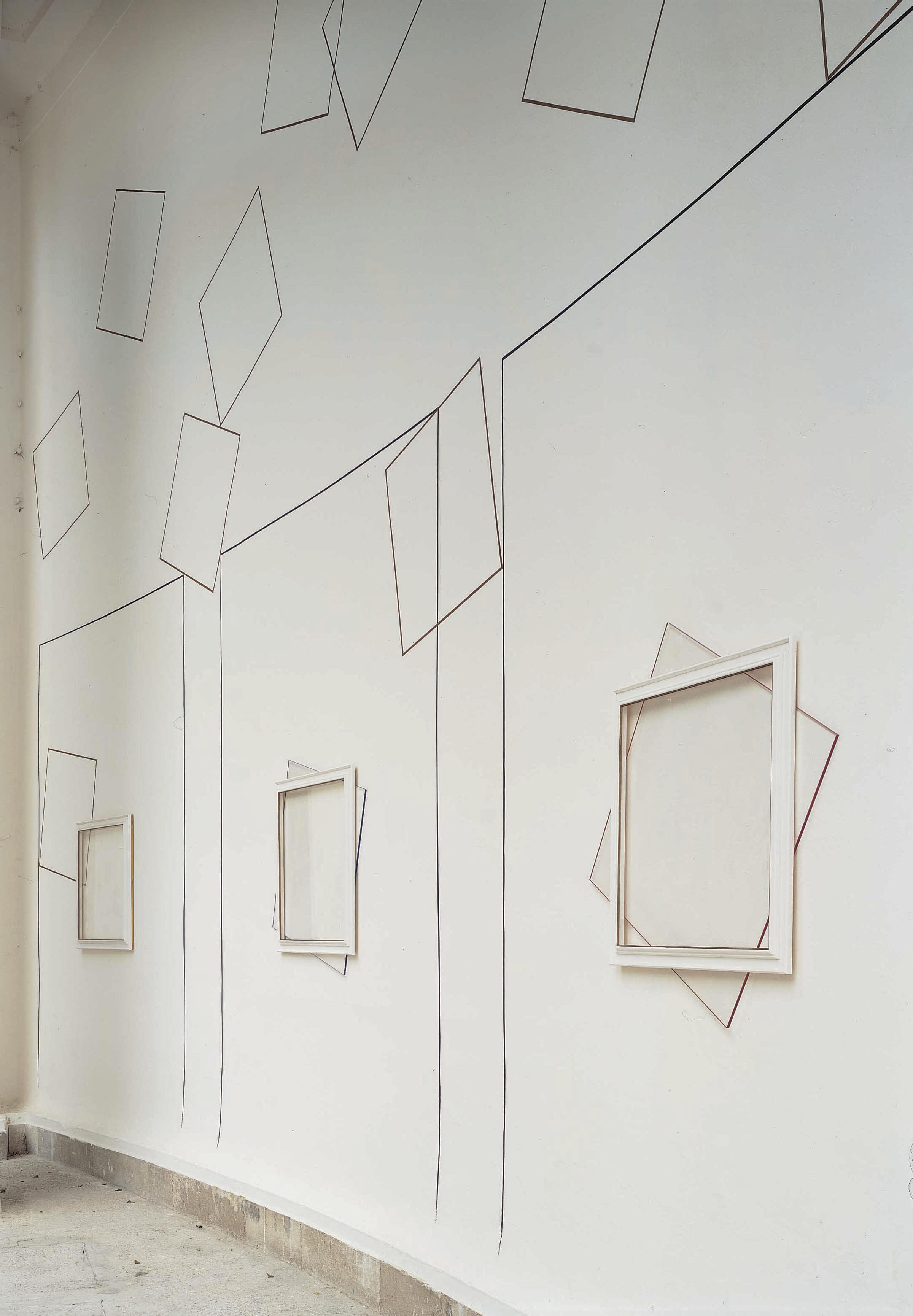
Six "doors" outlined in black enamel are lined up in a regular sequence on a wall interrupted at the centre by a real door, which determines the dimensions of the ones that are drawn. At the centre of each virtual door, a white wooden frame with a golden fillet in the internal profile, contains a plexiglas sheet of the same size, each time slightly rotated (starting from the first element, where it coincides with the frame) and distinguished by a profile of a different colour (from left to right: yellow, blue, red, purple, brown, green). Other squares of the same size are drawn in golden enamel and fall freely in the upper part of the wall, until they are "stopped" by the frames, where they "find residence" as they are captured by the golden fillet. Above the real door, a life-size, upside-down acrobat, painted with black enamel, points his finger, as if to hold himself up, at the corner of a plexiglas element with a coloured profile. This consists of a sheet arranged in a tilted position, in which half of another identical sheet is inserted perpendicularly, thus evoking a rotating object (the thickness of the tilted sheet includes the colours from yellow to purple, while the profile of the perpendicular one ranges from blue to green). Slightly farther away, as if it had slipped from the head of the character balancing, is a top hat with six coloured ribbons placed close together according to the colour spectrum.
The title, which refers to the venue of the Great Exhibition in London in 1851, the famous glass building designed by Joseph Paxton, refers to the transparent elements that as a whole evoke an unlimited number of "paintings". Similarly, the colours of the spectrum refer to a universal summa.
As concerns the Venice Biennale in 1997, for which the work was conceived, the countless squares and paintings scattered across the entrance facade of the Italian Pavilion, alluded, according to the artist, to the "number of works exhibited inside the building, or to the number of past or future editions of this exhibition; or, to other 'doors' that might open, another endless number of times, on this same or other drawing".1
1 G. Paolini in Giulio Paolini. Early Dynastic, exhibition catalogue, Rome, Studio d’Arte Contemporanea Pino Casagrande (Milan: Skira editore, 2001), p. 51.
| 1997 | Venice, Giardini di Castello, Padiglione Italia, Biennale di Venezia: XLVII Esposizione Internazionale d’Arte. Futuro Presente Passato, 15 June - 9 November, cited in the checklist of exhibited works p. 705, not repr. |
| • | G. Paolini, “Crystal Palace”, in Giulio Paolini. Early Dynastic, exhibition catalogue, Rome, Studio d’Arte Contemporanea Pino Casagrande (Milan: Skira editore, 2001), p. 51. |
| • | Giulio Paolini. Von heute bis gestern / Da oggi a ieri, exhibition catalogue, Graz, Neue Galerie im Landesmuseum Joanneum (Ostfildern-Ruit: Cantz Verlag, 1998), col. repr. pp. 332-333 (exhibition view Venice 1997). |
| • | S. Bann, “Giulio Paolini”, in Rewriting Conceptual Art, edited by M. Newman and J. Bird (London: Reaktion Books, 1999), pp. 169-170, not repr. |
| • | Giulio Paolini. Early Dynastic, exhibition catalogue, Rome, Studio d’Arte Contemporanea Pino Casagrande (Milan: Skira editore, 2001), col. repr. pp. 52-53 (exhibition view Venice 1997). |
| • | M. Disch, Giulio Paolini. Catalogo ragionato 1960-1999, vol. 2 (Milan: Skira editore, 2008), cat. no. 786 pp. 802-803 (with incorrect dimensions), col. repr. (exhibition view Venice 1997). |
| • | I. Bernardi, “Il giuoco delle parti”, in Giulio Paolini, exhibition catalogue, Rome, MACRO Museo d'Arte Contemporanea Roma and London, Whitechapel Gallery (Rome: Quodlibet Edizioni, 2014), p. 93, not repr. (repr. of a study p. 93). |
| • | I. Bernardi, “Sulla soglia. Giulio Paolini e la Biennale di Venezia”, in Crocevia Biennale, edited by F. Castellani and E. Charans (Milan: Scalpendi Editore, 2017), p. 243, not repr. |
| • | A. Soldaini, “‘Cos’altro c’è da dire?’”, in Giulio Paolini. A come Accademia, exhibition catalogue, Rome, Accademia Nazionale di San Luca (Rome: Gangemi Editore, 2023), p. 40, not repr. |

