Esposizione universale, 2005
GPO-0904
Universal Exposition
Structure in steel profiles, transparent and reflecting plexiglas sheets, plexiglas cubes, crystal sphere, hourglass, Murano glass fragment, clip-on spotlights
Twenty-four transparent and reflecting plexiglas sheets 135 x 135 cm each, overall dimensions variable
Dismantled work
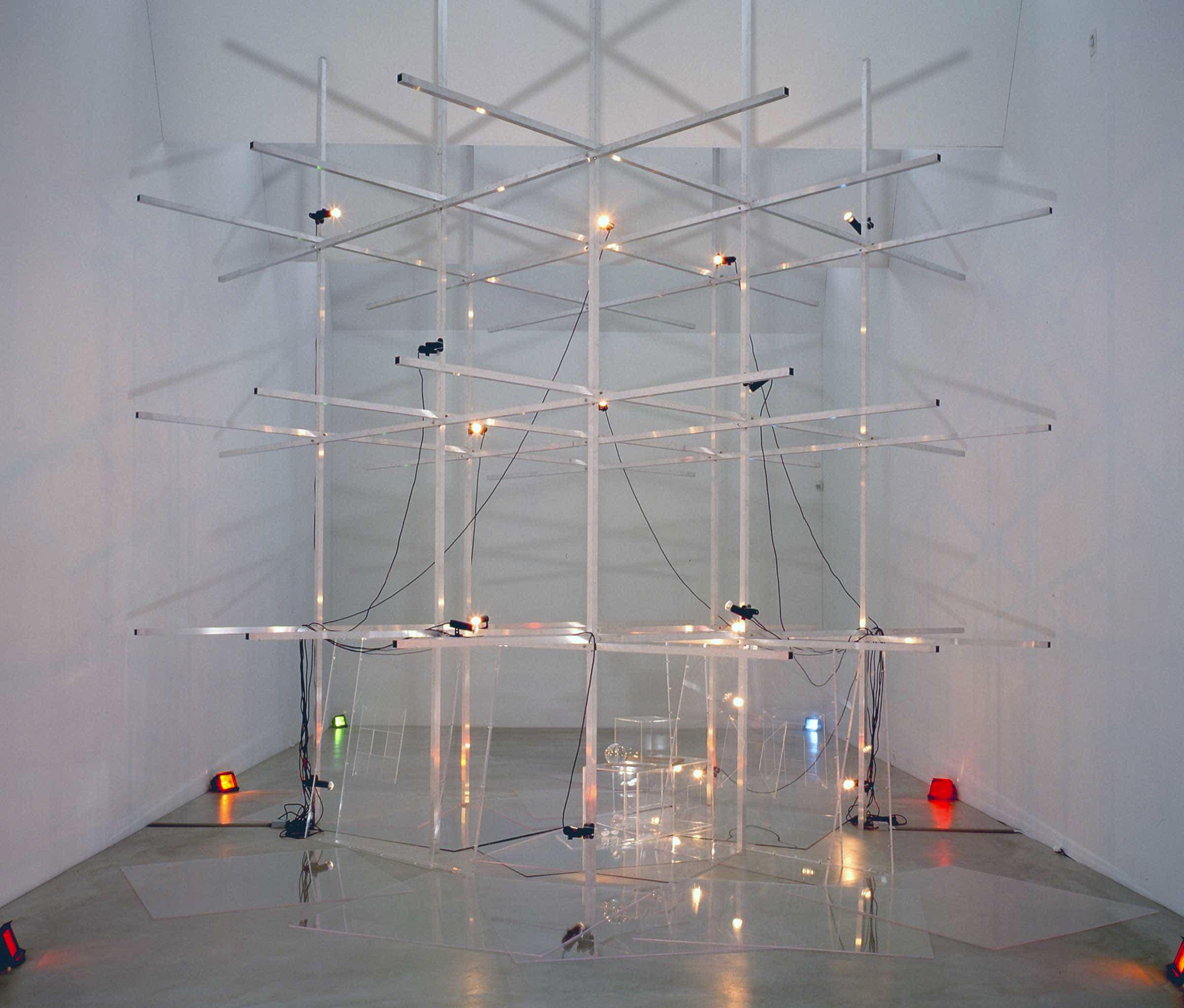
• 2005, Winterthur, Kunstmuseum: the transparent and reflecting plexiglas sheets are fewer than the twenty-four that had originally been planned (some of them were omitted during installation of the work; there are three reflecting sheets). The lights as well, at first meant to be twenty-four, were reduced during the installation of the work. The work included a frieze, developed along the top of the wall of the perimetral exhibition rooms, made up of a pencil drawing and photographs mounted in plexiglas cases (cf. the description in the artist’s statement transcribed in this entry).
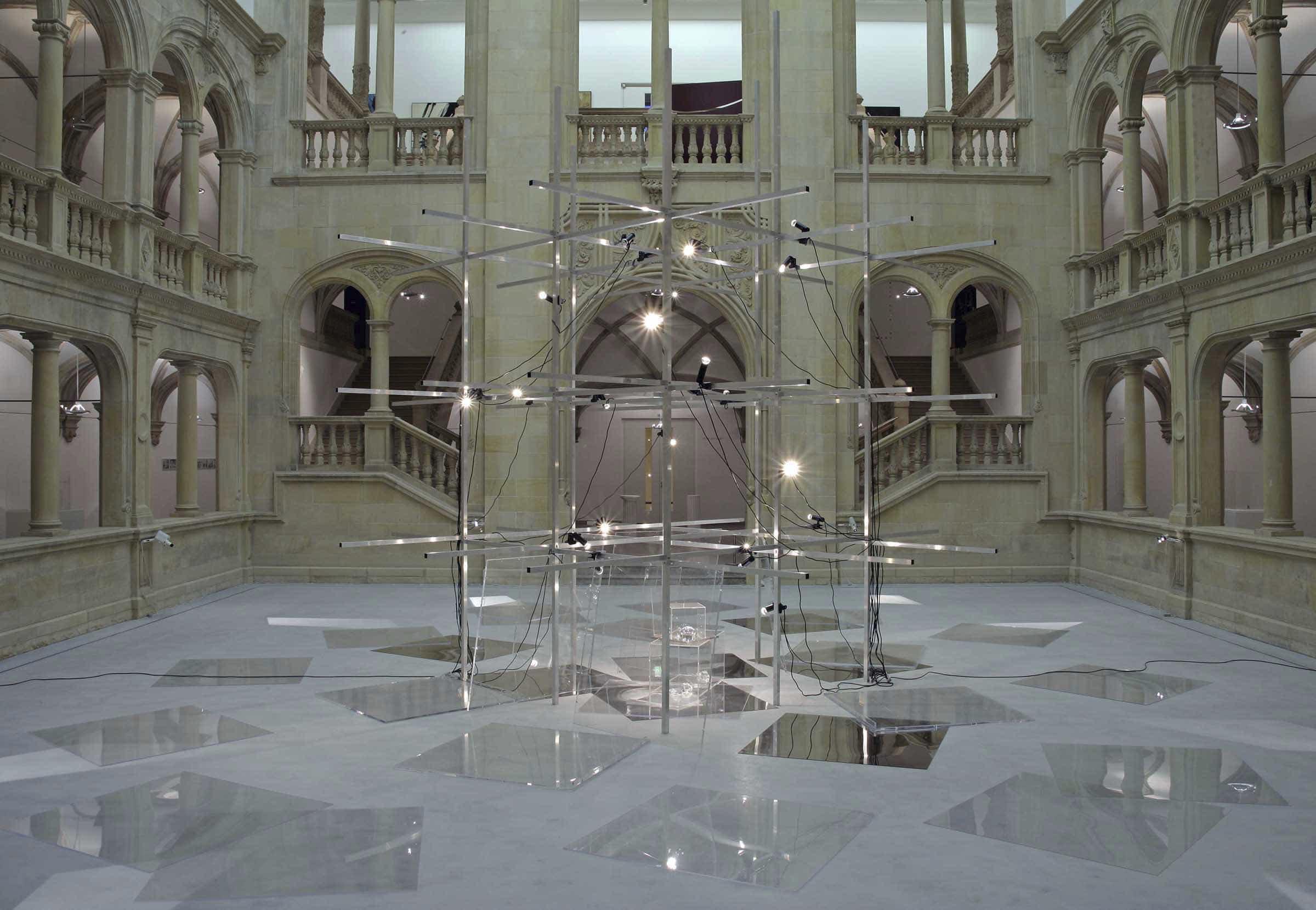
• 2005, Münster Westfälisches Landesmuseum für Kunst und Kulturgeschichte: the plexiglas sheets numbered twenty-four. The coloured lights were replaced by four beam shapers, which projected squares of light onto the floor (the beam shapers were fastened to plexiglas sheets propped up against the wall surrounding the room).
A large orthogonal framework made up of steel profiles features twelve spotlights and is lit by nine coloured halogen lamps, arranged on the ground, at equidistant intervals, along the sides of the room. Several plexiglas sheets are propped up against this framework. The sheets are carved with the drawing of a room in which an empty cube is located on a plinth. Other transparent or reflecting sheets are scattered on the ground. On one of these sheets is a plexiglas cube, topped by several translucid objects: a small empty case, a fragment of Murano glass, an hourglass containing white sand, and a crystal ball, along with several small plexiglas sheets featuring a carved drawing.
A workshop waiting to be fulfilled, the work presents itself as a work in progress: as if the elements scattered around on the ground were waiting to be composed and raised in order to form a volume or a sculpture. In other words, the work calls into question the moment before a work takes shape and therefore the definition of its identity. In a broader sense, Esposizione universale offered the idea itself of the exhibition as the “workshop” for the becoming of a work.
The “universal” dimension – the title recalls the great world exhibitions that have taken place every five years since 1851 – connotes the numerology underlying the elements at play: the twelve spotlights evoke the hours of the day and the months of the year; the nine coloured lamps recall the number of planets and therefore the universe; while the coloured lights evoke the entire colour spectrum.
The work harkens back to the theme of the first version of Esposizione universale, 1992 (GPO-0705), deconstructing its material and semantic components. Emerging from that first version are twelve plexiglas sheets, doubled to twenty-four, as well as some transparent objects arranged on the floor, such as the cube and the sheets featuring a carved drawing.
| 2005 | Winterthur, Kunstmuseum Winterthur, Giulio Paolini. Esposizione universale, 23 April - 24 June, touring to: Münster, Westfälisches Landesmuseum für Kunst und Kulturgeschichte, 1 October 2005 - 8 January 2006, cited in the checklist of exhibited works no. 23 p. 88, col. repr. n. pag. (exhibition view), referred to in the artist’s text pp. 8, 10, 12, referred to in the text by D. Schwarz pp. 15-18; in the Münster visitor’s guide referred to in the text by E. Franz, n. pag. |
| • | G. Paolini in Giulio Paolini. Esposizione universale, exhibition catalogue, Winterthur, Kunstmuseum Winterthur (Düsseldorf: Richter Verlag, 2005), pp. 8, 10, 12 (letters sent by the artist to Dieter Schwarz during the preparation of the solo exhibition at Kunstmuseum in Winterthur, dated respectively May 2003 and October 2004). |
| • | “Giulio Paolini. Esposizione Universale”, photo shoot of the solo exhibition in Winterthur 2005, in Lotus 125 (Milan), September, 2005, col. repr. p. 75. |
| • | B. Schwabsky, Giulio Paolini. Art at room temperature, in Italia, auction catalogue, London, Phillips de Pury & Company, 30 June 2010, col. repr. p. 37 (exhibition view Winterthur 2005). |
| • | Arte povera 2011, edited by G. Celant (Milan: Mondadori Electa, 2011), col. repr. no. 376 p. 461 (exhibition view Münster 2005). |
| • | Giulio Paolini. A come Accademia, exhibition catalogue, Rome, Accademia Nazionale di San Luca (Rome: Gangemi Editore, 2023), col. repr. pp. 241 (exhibition view Winterthur 2005), 245 (exhibition view Münster 2005). |

