
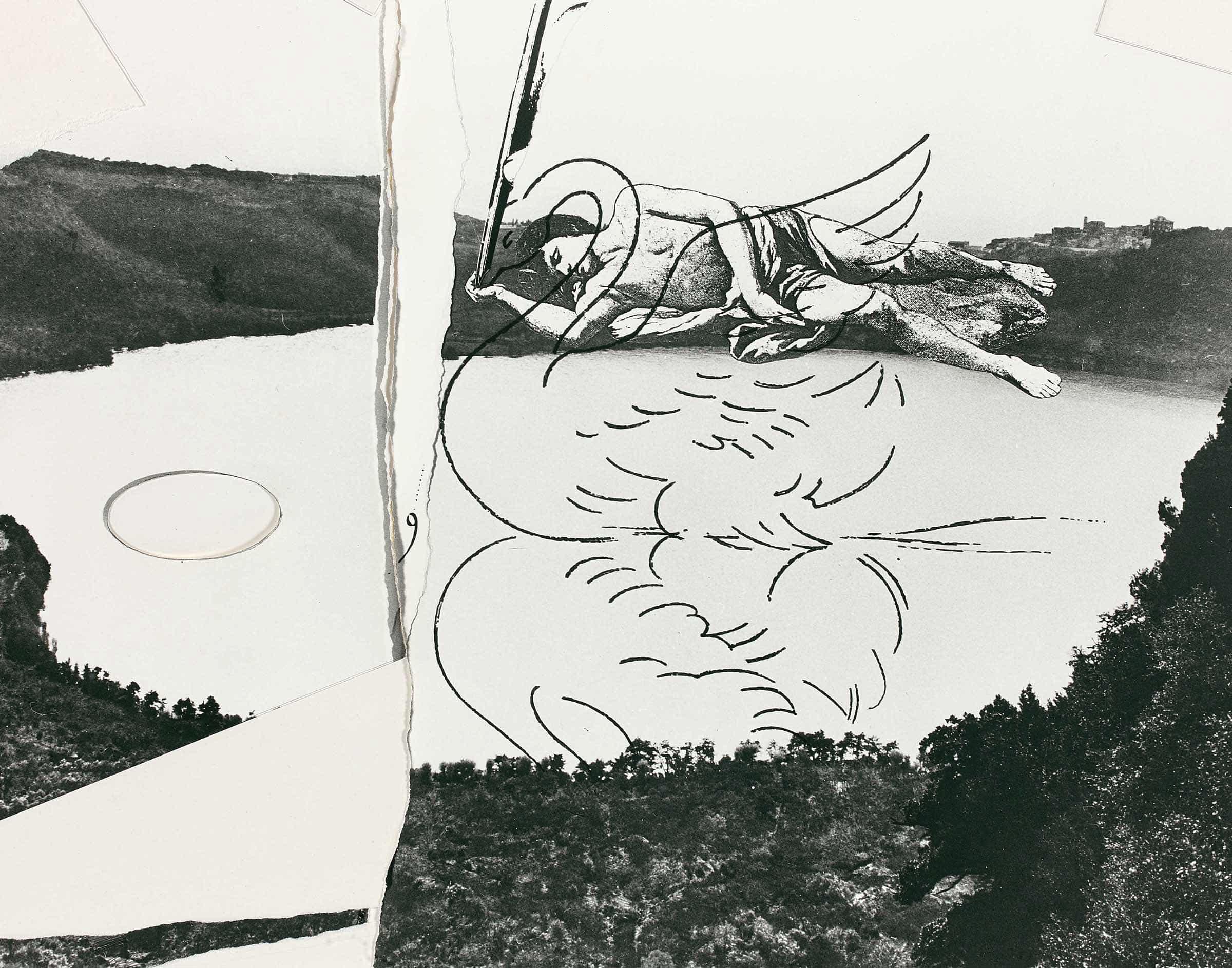
L’exil du cygne, 1983-84
GPO-0915
Collage on paper and on wall
Framed part 72.3 x 102 cm, overall dimensions 164 x 254 cm
Signed, titled, and dated on the verso of the framed element: “Giulio Paolini / L’exil du cygne / 1983-84”
Private collection
The framed photograph torn into two parts that are slightly staggered, portrays Narcissus sleeping on the shore of Lake Nemi, turned into a palette by way of an oval cut-out. On the surface of the lake the drawn profile of a swan is reflected in its specular double. Narcissus's left hand is associated with a feather-pen, which corresponds to the adjacent tear in the form of a feather. Inserted in the tear is the torn detail of the number nine (a reference to the nine Muses and the symbol of completeness).1 Scattered across the photograph and all around the wall are the torn fragments of blank sheets of drawing paper.
The first formulations of the theme of L’Exil du cygne date to 1982 (cf. GPO-0466); the subsequent developments include a variant from the same year (GPO-0514), several versions on paper, and four other versions conceived between 1984 and 1993 (GPO-0513, GPO-0610, GPO-652, GPO-712).
1 Both details – the antique pen as well as the fragment with the number nine – are taken from a reproduction of plate III of D. Diderot and J. D’Alembert’s
Encyclopédie, where the drawing accompanied by nine numbers didactically illustrates the "true way to hold a pen" while writing.
• Fratelli Alinari, Nemi – Prov. di Roma. Panorama del Lago e della piccola borgata di Genzano, c. 1890, photograph, 21 x 27 cm, Archivi Alinari, Florence (ACA-F-006861-0000).
• Sleeping Narcissus: Nicolas Poussin, Echo et Narcisse, c. 1630, oil on canvas, 74 x 100 cm, Musée du Louvre, Paris; reproduction from L’opera completa di Poussin. Classici dell’arte 72 (Milan: Rizzoli, 1974), plate X, no. 49.
• Image of a pen with the number “9” from Denis Diderot, Jean-Baptiste D’Alembert, Encyclopédie, ou Dictionnaire raisonné des sciences, des arts et des métiers. Recueil de planches sur les sciences, les arts libéraux et les arts méchaniques, avec leur explication. Seconde livraison, en deux parties. Première partie 23 (Paris: 1763), plate III (“Art d’Ecrire”).
| 1996 | Brussels, Musée d’Ixelles, Collection Groeninge, 13 June - 28 July, [catalogue whereabouts unknown]. |

