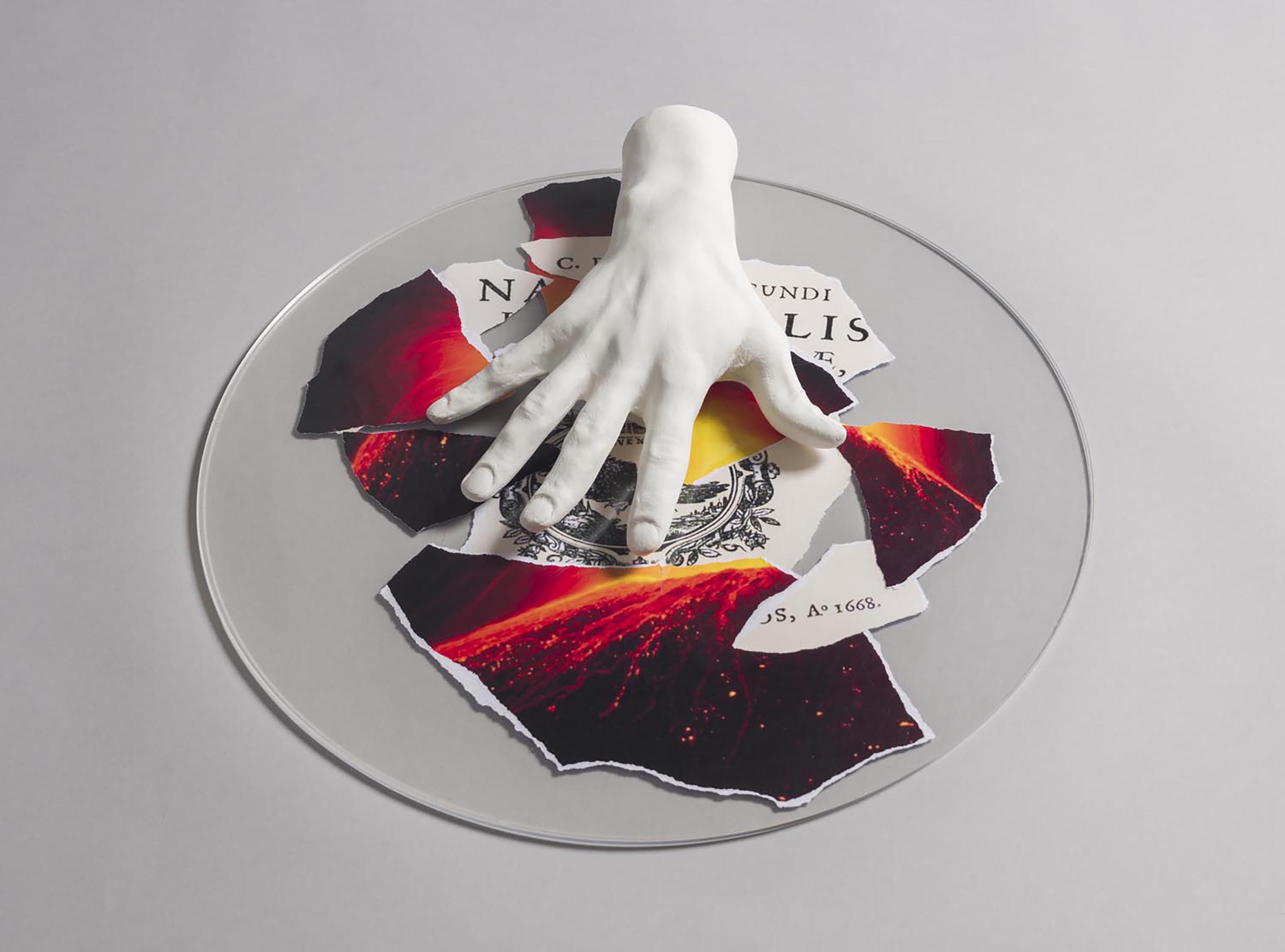
Naturalis historia, 2022
GPO-1140
Plaster cast, plexiglas rounds, fragments of xerox reproductions, white plinth, plexiglas case
Cast 7 x 30 x 23 cm, two rounds Ø 47 cm each, plinth 90 x 50 x 50 cm, case 50 x 50 x 50 cm, overall dimensions 140 x 50 x 50 cm
Private collection
Two round plexiglas sheets placed one atop the other hold down the torn fragments of photographic images of Vesuvius erupting, and of the cover of the treatise Naturalis historia by Pliny the Elder. The plaster cast of a man’s hand, placed on the transparent rounds, seems to prevent the imminent dispersion of the fragments.
While the photographic images evoke the death of the Latin author caused by the toxic fumes from Vesuvius, the details of the ancient book recall the intellectual legacy of the philosopher and naturalist, whose writings still represent a fundamental document that is of essential importance to the patrimony of scientific knowledge in ancient times. The hand recalls Pliny’s curious fate, killed by a natural catastrophe that he himself had studied: a “protomartyr of experimental science”, as Italo Calvino described him.
The title of the work not only pays tribute to the encyclopaedic work of Pliny the Elder, recalling the field of the study of “natural history”, but also, broadly speaking, alludes to “nature’s despotic ways before man”, as the artist informs us.1
The work was conceived as the first edition of a multiple commissioned by the Associazione Amici Musei Civici di Como on the occasion of the two thousandth anniversary of the birth of Pliny the Elder. It was eventually abandoned and replaced by a lithographic version of the same theme (GPE-0153).
1 G. Paolini in conversation with B. Della Casa, 18 May 2022.
Pliny the Elder, Naturalis historia, 77-78 AD; reproduction from C. Plinii Secundi Naturalis historiæ (Rotterdam: Hackios, 1668), title page.
| 2024 | Como, Ex Chiesa di San Pietro in Atrio e Palazzo del Broletto, Il catalogo del mondo: Plinio il Vecchio e la Storia della Natura, 3 May - 31 August. |

