A.R.S. scaenica, 2024
GPO-1178
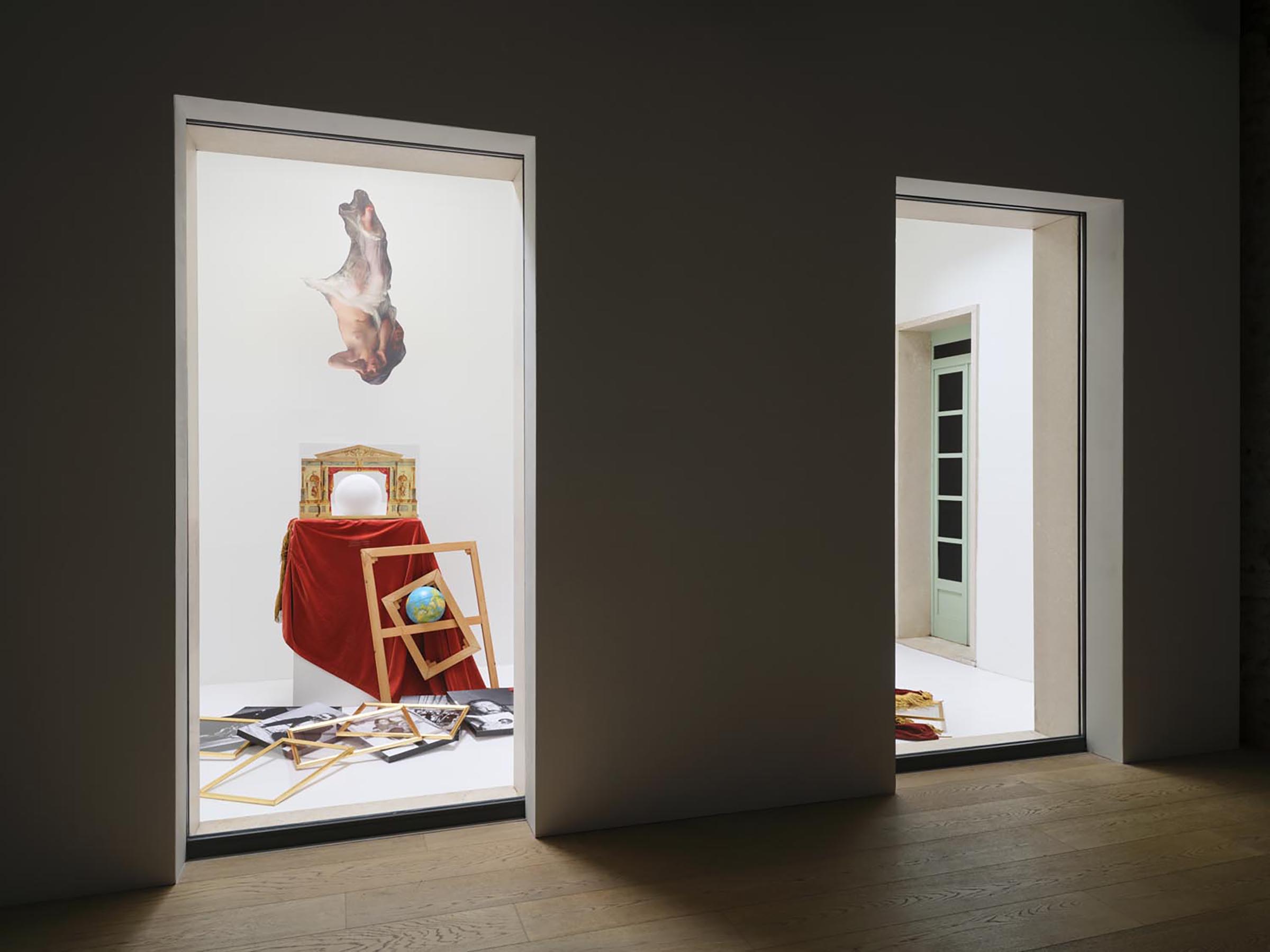
Velvet stage curtain, stretchers, globe, white plinth, plaster sphere, miniature cardboard theatre, plexiglas case, photographic panels, gilt frames, photo prints mounted between plexiglas shapes, steel cables
Two stretchers: 80 x 120 cm, 40 x 60 cm, plinth 120 x 78 x 45 cm, sphere Ø 30 cm, minature theatre 48.5 x 72.5 x 41.5 cm, case 50 x 75 x 42 cm, two photo prints between plexiglas shapes 131.5 x 62 cm each, nine photographic panels 40 x 60 cm each, ten frames 40 x 60 cm each, overall dimensions 446 x 603 x 305 cm
Teatro Franco Parenti, Milan
To conclude the celebrations of the fiftieth anniversary of the Teatro Franco Parenti, Paolini was invited to create a permanent work for the building of the Bagni Misteriosi, adjacent to the historic seat of the Milanese theatre.1
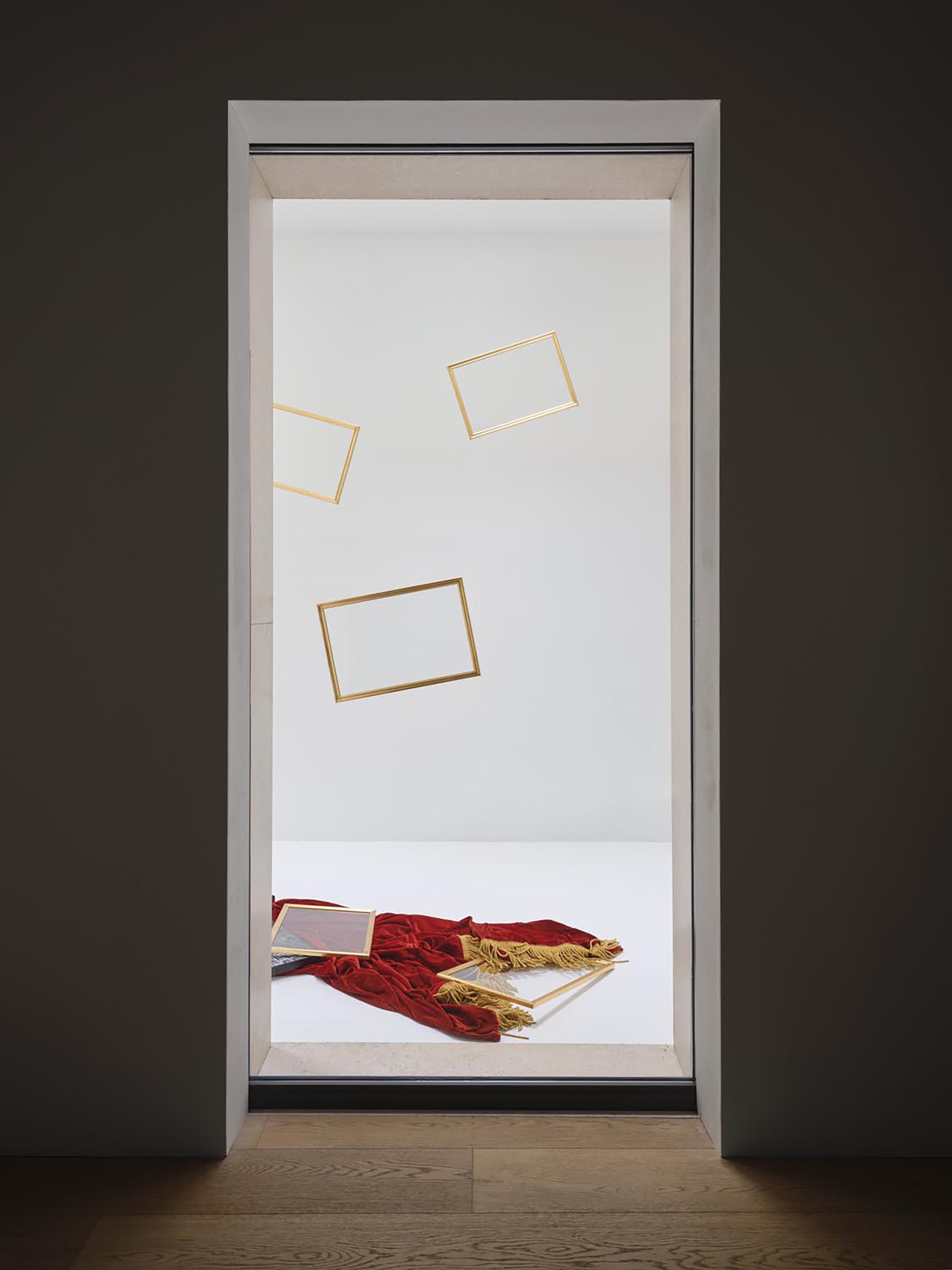
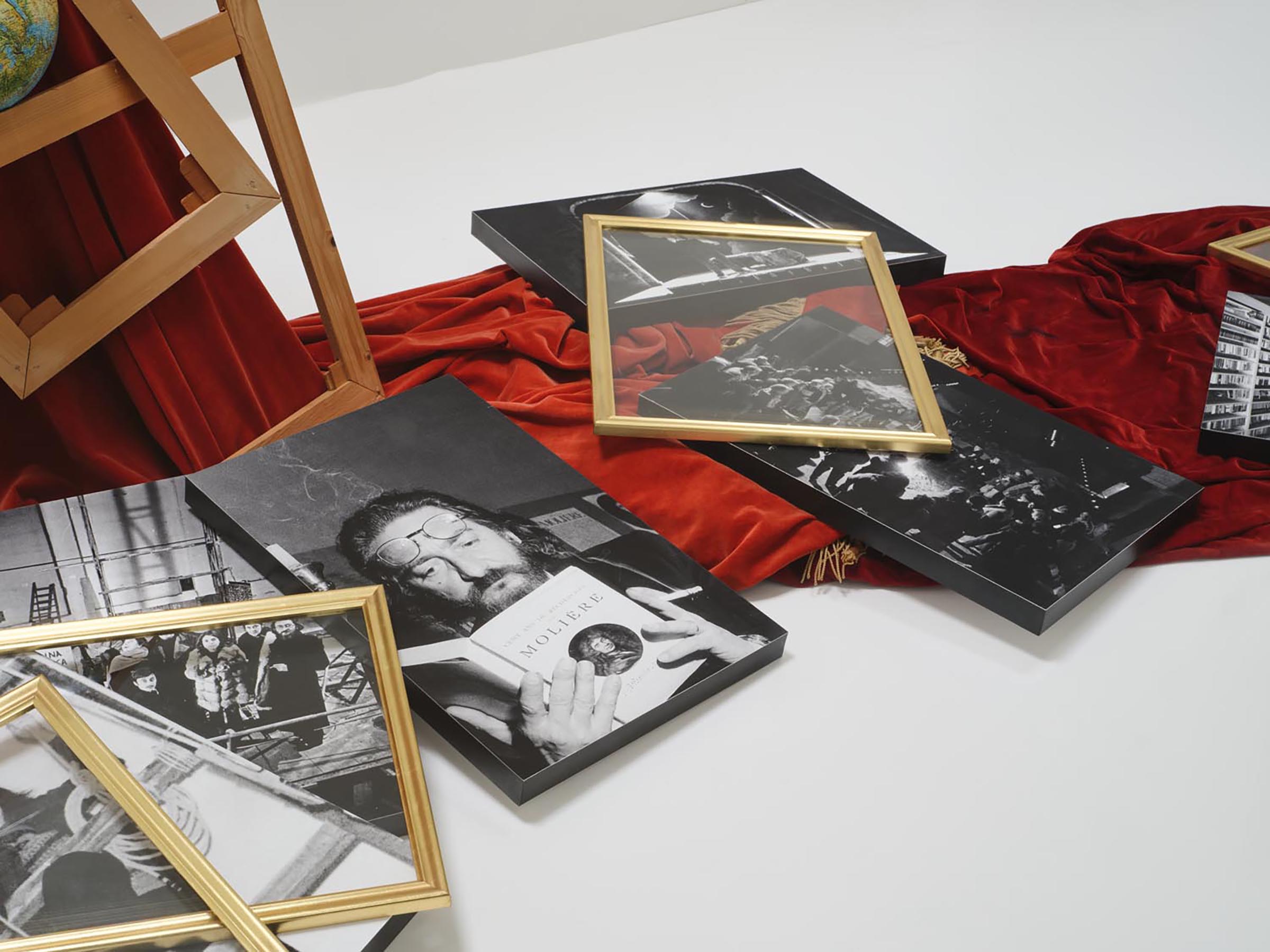
The central core of the composite ensemble is a white plinth, surmounted by a miniature cardboard theatre, in which the area corresponding to the scenic space hosts a plaster sphere. Two stretchers of different sizes that overlap each other lean up against the plinth holding a globe in a precarious balance. A long red stage curtain that falls from the plinth to the floor holds nine photographic panels having to do with the history of the Teatro Franco Parenti, scattered amongst several gilt frames. A photographic reproduction of the nymph Echo – borrowed from a nineteenth-century painting by Alexandre Cabanel and held between two plexiglas shapes – hangs upside-down from the ceiling, as if in the act of falling upon the centre of the representation. Also hanging from the ceiling at various heights are three gilt frames, identical to the ones arranged on the floor.
The key to interpretation lies in the enigmatic white sphere inside the theatre, the fulcrum of the work, which symbolically represents the "absolute truth" of the theatre, that is, the mystery of fiction, and the miracle of representation. At the same time, the immaculate sphere also evokes the ideal completeness (as opposed to the globe as the emblem of contingent reality) that the artist untiringly seeks to set his eyes on and hold onto between one work and another, even though any attempt to make contact is ruinous, as is suggested by the theme of the fall. In the author's own words: "The fall of objects and figures dropping from above onto a virtual stage is a mise-en-scène for the incomparable fiction itself of the idea of theatre. Echo's fate is juxtaposed with that of the Artist, constantly in search of Beauty albeit aware of the vanity of his desire."2 Similarly, the gilt frames evoke the ideal painting, "invoked over and over again, but each time missed – inaccessible, ungraspable, impossible".3 The theatrical dimension thus intersects with the artistic one, the references to the theatrical context are at the same time an allegory of the basic idea that the author reformulates from one work to another, that is, "the ever renewed challenge that is the mise-en-scène of a work of art".4
The title, A.R.S. scaenica, implies a dual homage: on the one hand, to art (via the Latin noun "ars") and to the art of the stage, on the other (via the initials "A.R.S."), to the person commissioning the work, the theatre director Andrée Ruth Shammah, founder, together with her husband, and director of the Teatro Franco Parenti.
Paolini also included four works on paper in the acquisition of the work by the Milanese theatre. The works on paper were specially conceived, and expand the homage to the theatrical dimension, as well as to the history of the Teatro Franco Parenti (cf. GPC-2442, GPC-2443, GPC-2444, GPC-2445).
1 The work commissioned from the artist in the spring of 2024 on the initiative of Andrée Ruth Shammah was inaugurated on 5 November 2024. The space on the ground floor of the Bagni Misteriosi – an air shaft that was completely restored so it could host the artistic intervention – can be accessed by the public upon request.
2 The first sentence is in S. Bucci, "Installazione e collage per un palcoscenico", in La Lettura, supplement of the newspaper Corriere della Sera, 3 November 2024, p. 42; the second sentences was extracted from an unpublished annotation to the work. Elsewhere, Paolini adds the following: "I chose the figure of Echo out of a sense of the inexhaustible repetition of the work that it represents" (S. Chiappori, "L'arte povera di Paolini arriva in teatro", in La Repubblica, 5 November 2024, p. 11).
3 G. Paolini, unpublished annotation to the work.
4 Ibidem.
Alexandre Cabanel, Écho, 1874, oil on canvas, 97.8 x 66.7 cm, The Metropolitan Museum of Art, New York.
| • | G. Paolini, Eccomi. Qui dove sono (Turin: Fondazione Giulio e Anna Paolini, 2025), col. repr. p. 73. |

