Passatempo, 1992
GPO-0706
Pastime
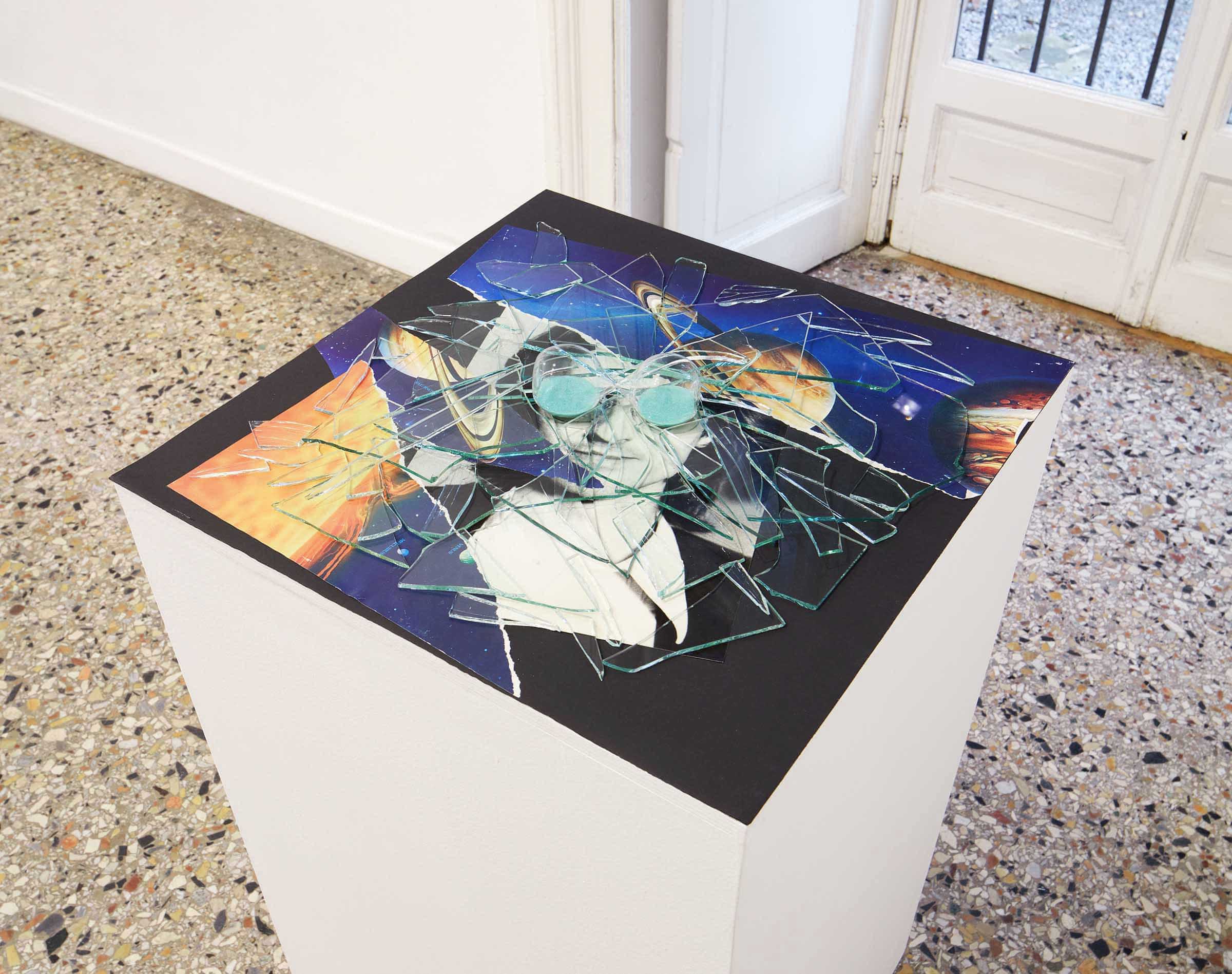
Photo print, torn xerox reproduction, glass fragments, hourglass, plexiglas case, white plinth
155 x 60 x 60 cm
Collection of the artist
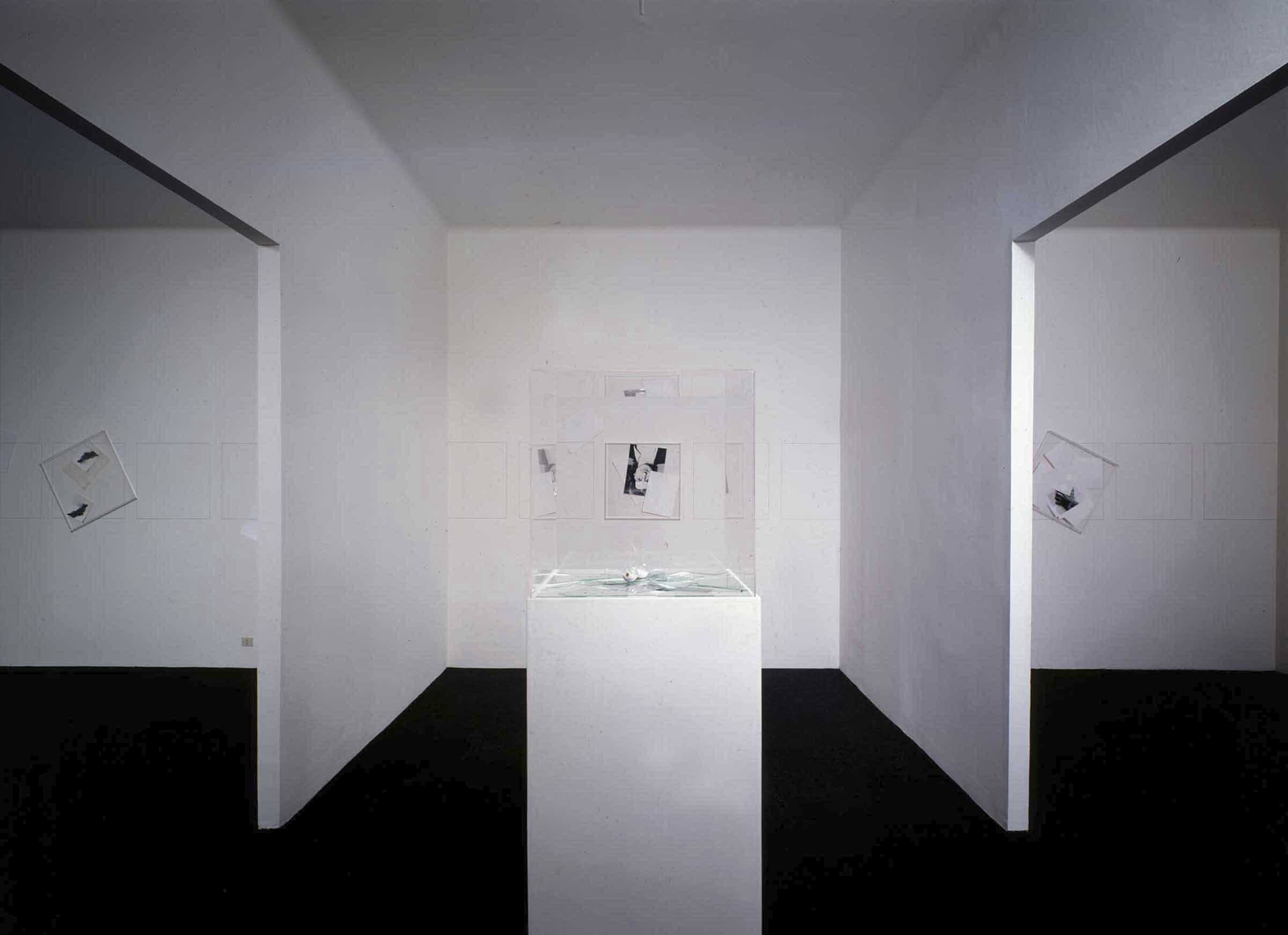
• 1992, Turin, Galleria Christian Stein: on a plinth the artist's portrait is half-hidden by several sheets of blank paper and by glass shards, and it is contained inside a rectangle drawn in pencil on the sheets. The hourglass is placed at the centre of the plinth, in the area corresponding to the eyeglasses in the portrait. On the wall, on the long side of the display area, is a sequence of drawn squares and plexiglas cases. The case in the middle, in line with the plinth, hangs so that it is in a straight position and encloses another copy of the artist's portrait taken by Mussat Sartor. The portrait is upside down. The other cases, which are installed in a tilted position, contain images of the artist's hand as he makes Vedo (la decifrazione del mio campo visivo), 1969, or while holding some sheets. On the opposite wall, in line with the plinth (hence, opposite the overturned portrait), the fourth case, in the middle of the wall, arranged in a tilted position, and overlapping a square drawn in a straight position, is surrounded by squares with different orientations drawn in random order, associated in some cases with other images of the artist's hand in the process of creating Vedo.
• 1992, Paris, Galerie Yvon Lambert: the photographic documentation is missing.
• 1993, Paris, Galerie Yvon Lambert: the photographic documentation is missing.
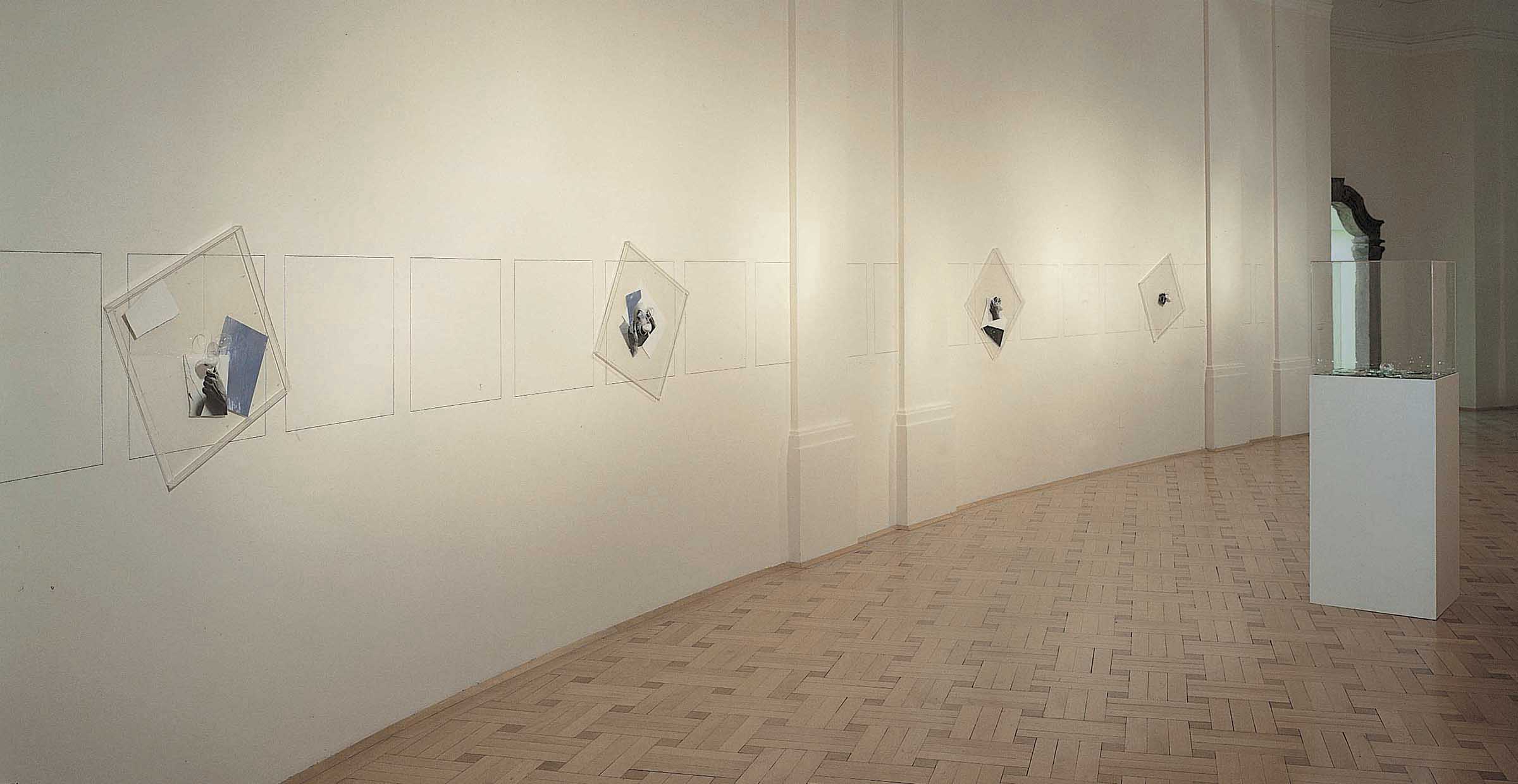
• 1993, Zurich, Galerie Annemarie Verna: the installation resembles the one that was executed originally (Turin 1992), adapted to this exhibition space, however. Here, the fourth case and the squares drawn in random order are located on a narrower wall, perpendicular and adjacent to the longer side with the sequence of plexiglas cases and drawn squares.
• 1994, Genoa, Galleria Locus Locus: the limited exhibition space suggests the presence of just two cases on the wall, with no intervention in pencil. On the plinth, the artist replaces the blank sheets and the drawing with photographic records of some of his other works (Giovane che guarda Lorenzo Lotto, 1967, GPO-0140; Vedo (la decifrazione del mio campo visivo), 1969, GPO-0188; Elegia, 1969, GPO-0196) and of the 1985 solo show at the same Genoese gallery. This time the hourglass lying across the portrait contains green sand.
• 1997, Sabbioneta, Galleria degli Antichi: the entirely frescoed walls of the exhibition space impose the presentation of the work limited to the plinth alone, installed just as it was in Genoa in 1994 (detailed photographic documentation is missing).
• 1998, Graz, Neue Galerie: the artist again reformulates the installation of the portrait on a plinth, this time associated with fragments of colour reproductions of astral motifs (rather than the previous parts of images). The sequence on the wall develops along a single side of the room. The overturned portrait is left out, and the images of the artist's hand now appear to be associated with reproductions of the daytime or night-time sky (in colour) and of the open sea (b/w). In the area corresponding to the central cut-out on the front of each case is an hourglass featuring white sand and turned horizontally. The hourglass hangs down on the wall from a nylon thread.
• 1999, Turin, GAM Galleria Civica d’Arte Moderna e Contemporanea: the installation is the same as the previous one in Graz, adapted to the exhibition space. The sequence of drawn squares and plexiglas cases is developed on two opposite walls. The plinth is installed between the two walls, in a central position.
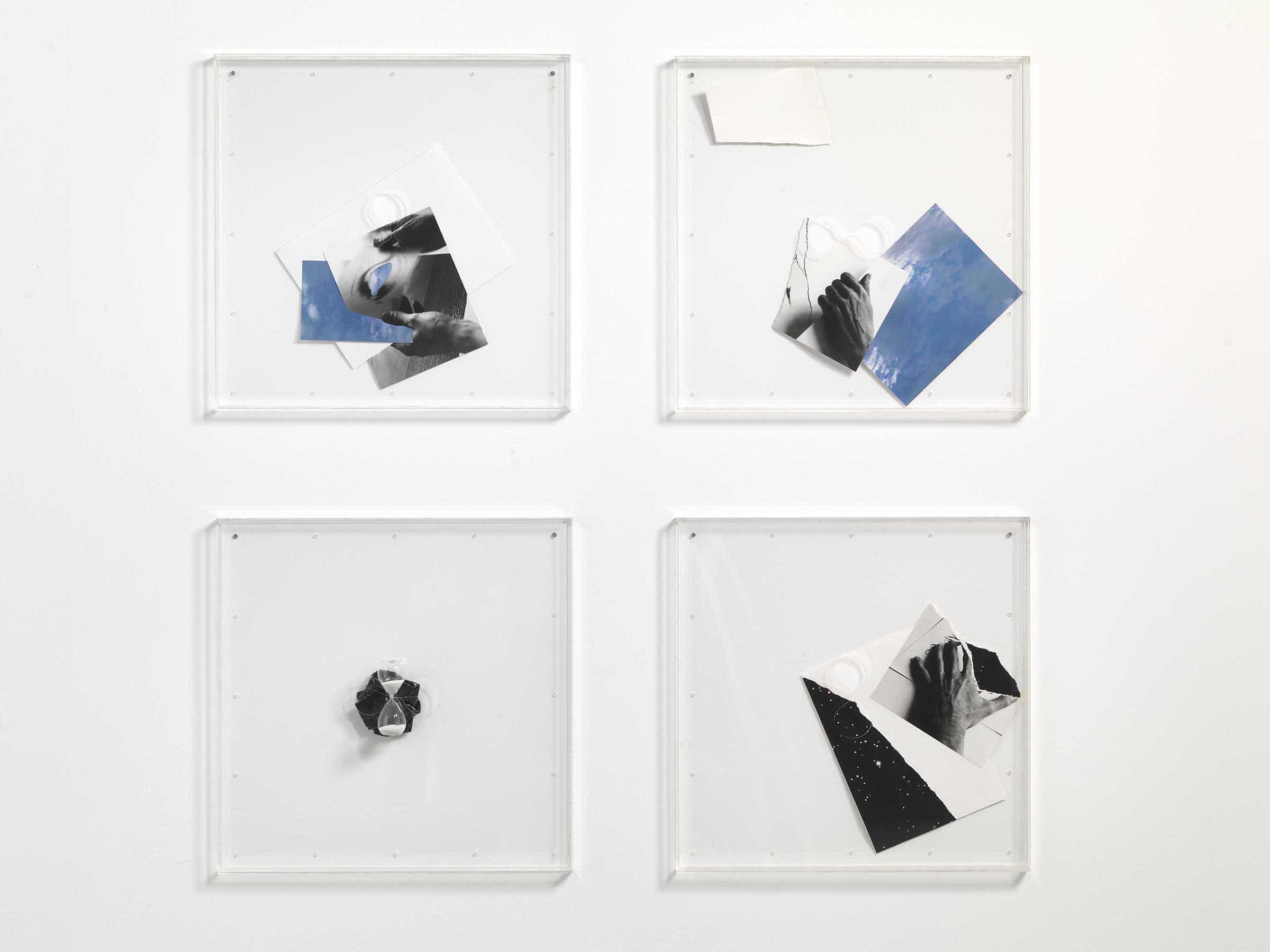
• 2013, Rome, MACRO: the work is only represented by the four cases, hanging from the wall in a straight position, and forming a quartet (2 x 2 units, with an 18-cm interval between them both in height and in width). Only one of the cases contains an hourglass, this one featuring white sand and turned vertically.
• 2020, Milan, Galleria Christian Stein: the installation of the work includes only the part on the base.
Passatempo is a work that was conceived in two parts, at times also presented individually, installed on a plinth and a wall, respectively. It has been reformulated over the course of time with modifications and additions.1
The situation on the plinth offers a photographic portrait of the artist (taken by Paolo Mussat Sartor in 1971) and astral images arranged under a multitude of glass fragments; an hourglass lies across the eyeglasses in the portrait.3 The work on the wall, which is instead of variable length and configuration depending on the display space, is chiefly made up of a series of squares drawn in pencil that are lined up so that they form a horizontal sequence. They are interspaced by several tilted plexiglas cases that contain a collage of photographic cut-outs of blue sky, a black and white image of the open sea, and the torn fragments of reproductions of the starry sky. In the middle of the front, each
case presents a cut-out in the shape of an eyeglass-hourglass (akin to what is installed on the plinth), on which an actual hourglass hanging on the wall from a nylon thread falls in a horizontal position.5
In Passatempo the author looks through time in an attempt to capture what his gaze and his hand cannot help but pursue, between fragments of time (the portrait from 1971) and the clues of an absolute dimension (the celestial and astral iconography): this explains the presence of the hourglass in a phase of immobility, thereby suggesting the desire to withhold the ideal instant in which a fulfilled vision might surface.
1 The variations above all involve the installation of the situation on the plinth (from 1994) and the addition of new images to the intervention on the wall (from 1998).
Portrait of Giulio Paolini taken by Paolo Mussat Sartor, 1971.
| 1992 | Turin, Galleria Christian Stein, Giulio Paolini, from 29 October. |
| 1992 | Paris, Galerie Yvon Lambert, Giulio Paolini, 28 November - 24 December. |
| 1993 | Paris, Galerie Yvon Lambert, Le monde en éclat, l’œuvre en effraction, 16 January - 23 February. |
| 1993 | Zurich, Galerie Annemarie Verna, Giulio Paolini, 4 May - 3 July. |
| 1994 | Genoa, Galleria Locus Solus, Giulio Paolini. Locus Solus, from 28 January, cited in the checklist of exhibited works nos. D2-3 p. 72, col. repr. pp. 29, 31 (exhibition views); installation limited to the part on the plinth. |
| 1997 | Sabbioneta, Galleria degli Antichi, Giulio Paolini. Esposizione Universale, 25 May - 29 June, repr. p. 17, referred to in the text by L. Cherubini p. 38; installation limited to the part on the plinth. |
| 1998 | Graz, Neue Galerie im Landesmuseum Joanneum, Giulio Paolini. Von heute bis gestern / Da oggi a ieri, 4 April - 31 May, cited in the checklist of exhibited works nos. 9-10 p. 181 (erroneously cited as two distinct works), repr. pp. 304 (installation Genoa 1994, detail), 305 (installation Turin 1992, detail). |
| 1999 | Turin, GAM Galleria Civica d’Arte Moderna e Contemporanea, Giulio Paolini. Da oggi a ieri, 8 May - 25 July, cited in the checklist of exhibited works nos. 2-3 p. 37 (erroneously cited as two distinct works), repr. pp. 73, 94 (exhibition views Graz 1998, with detail), 103 (exhibition view, detail). |
| 2013-14 | Rome, MACRO Museo d'arte contemporanea Roma, Giulio Paolini. Essere o non essere, 29 November 2013 - 9 March 2014, cited in the checklist of exhibited works p. 154, repr. p. 95 (exhibition view), referred to in the text by I. Bernardi p. 93 and in the entry by M. Disch p. 129; in the exhibition guide repr. p. 33 (exhibition view Graz 1998); installation limited to the four cases on the wall. |
| 2020-21 | Milan, Galleria Christian Stein, Giulio Paolini. Qui dove sono, 30 September 2020 - 30 January 2021; installation limited to the part on the plinth. |
| • | G. Odoni, “Spazi d’arte. Giulio Paolini in interni”, in Casa Vogue 248, February, 1993, col. repr. p. 95 (exhibition view Turin 1992). |
| • | R. Denizot, “Le monde en éclats, l’œuvre en effraction”, in Temporale. Rivista d’arte e di cultura 8, no. 31 (Lugano), 1993, repr. pp. 28-29 (exhibition view Paris 1993). |
| • | F. Pasini, “Giulio Paolini. Una mostra lunga un anno”, in Flash Art 184 (Milan, Italian edition), May, 1994, repr. p. 23 (exhibition view Genoa 1994, detail). |
| • | M. Disch, “Giulio Paolini. Hors-d’oeuvre”, in Giulio Paolini. La voce del pittore – Scritti e interviste 1965-1995, edited by Id. (Lugano: ADV Publishing House, 1995), pp. 106-107, repr. nos. 26-27 (exhibition view Turin 1992, details). |
| • | Kounellis, Paladino, Paolini, Bianchi, exhibition catalogue, [Rome], Associazione Culturale Dogana, [1996], col. repr. n. pag. (exhibition view Genoa 1994, detail). |
| • | M. Disch, Giulio Paolini. Catalogo ragionato 1960-1999, vol. 2 (Milan: Skira editore, 2008), cat. no. 706 pp. 720-721, repr. and col. repr. (details and exhibition view Graz 1998). |

