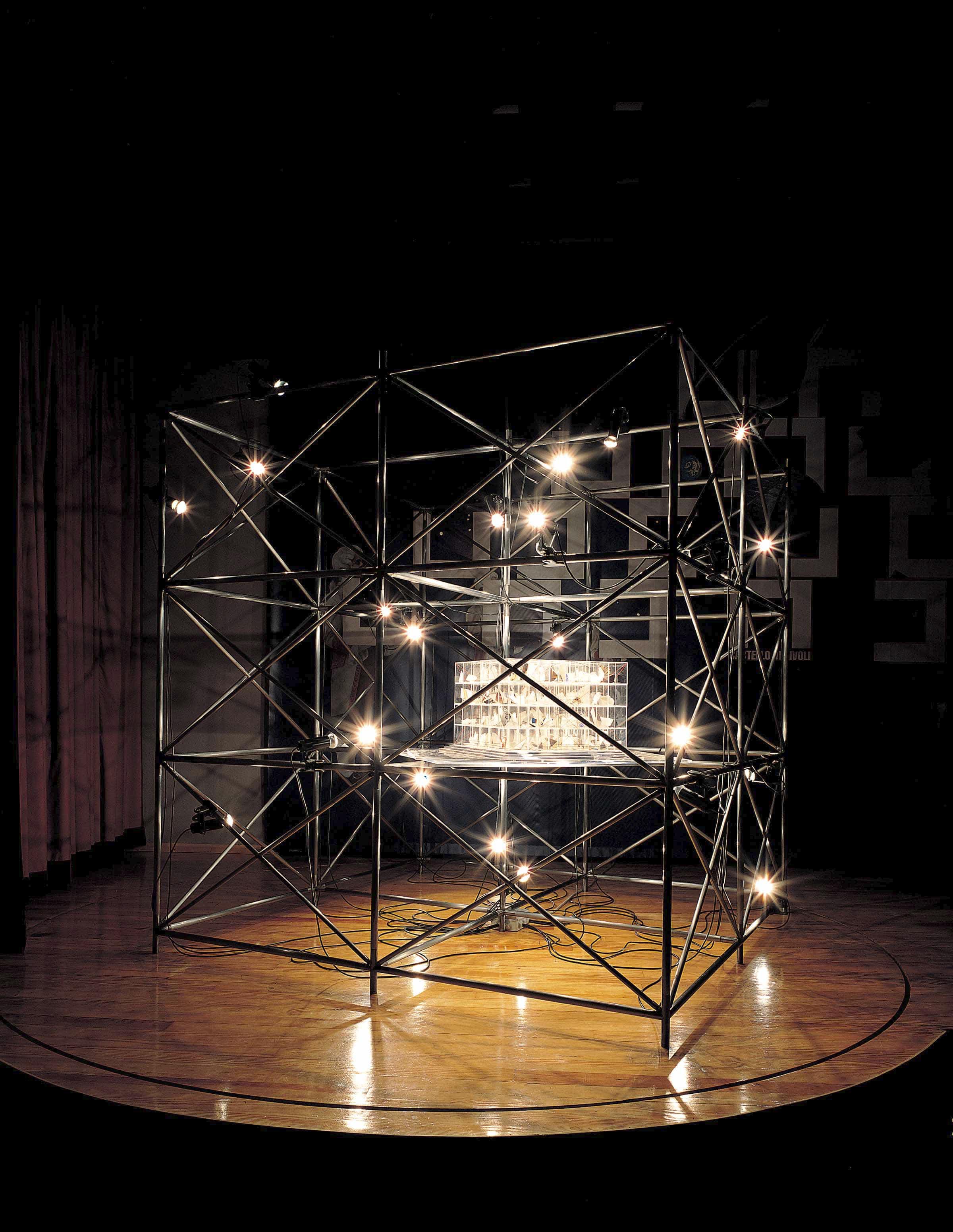
Padiglione dell’Aurora, 1998-99
GPO-0832
Aurora Pavilion
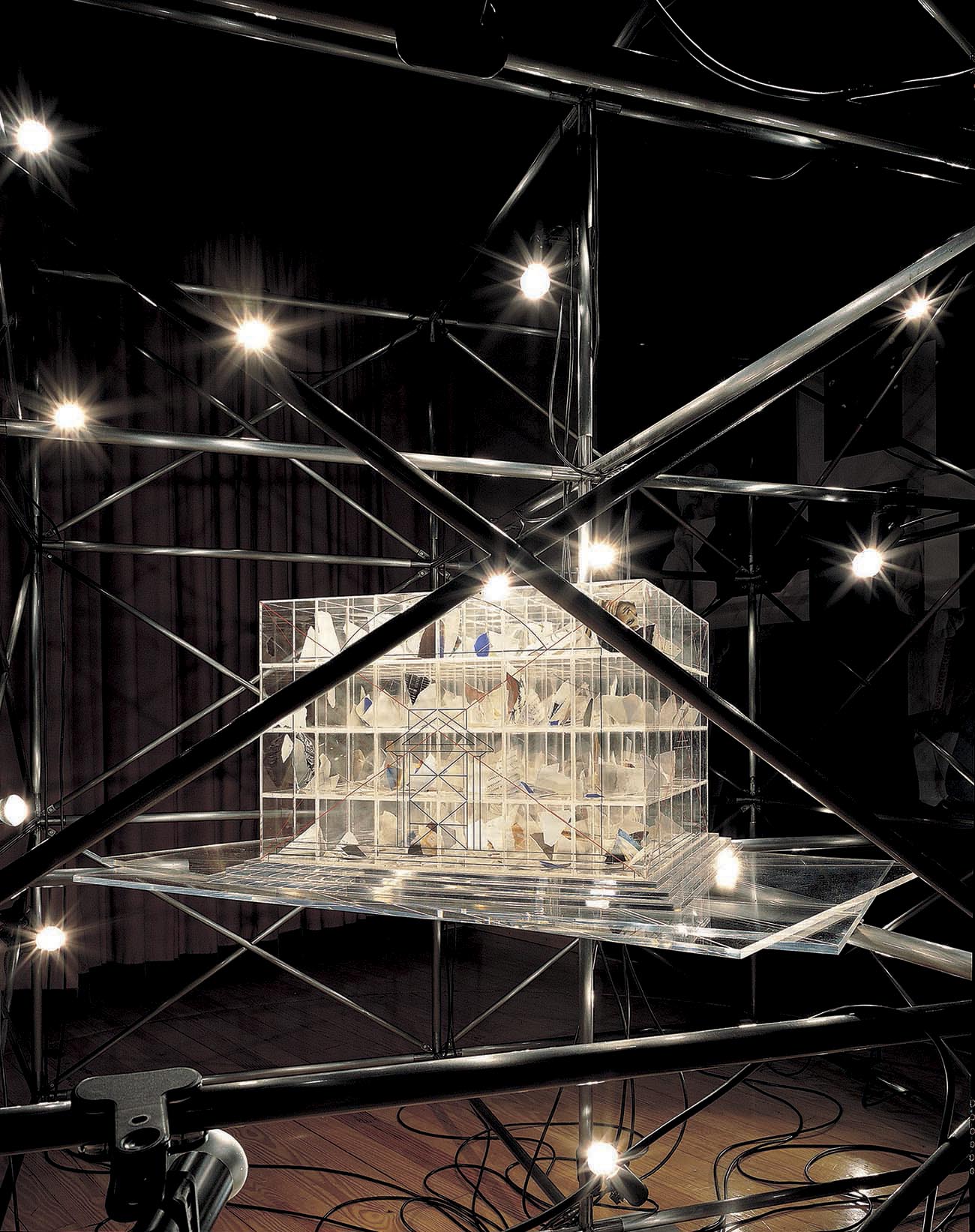
Metal tubular structure, plexiglas sheets, plexiglas cubes with engraved drawing, fragments of xerox reproductions, spotlights and soundtrack connected to an electronic programming device
One hundred forty-four cubes 10 x 10 x 10 cm each pulled together to form a 40 x 60 x 60 cm parallelepipedon, overall dimensions 280 x 240 x 240 cm
Collection of the artist
Padiglione dell’Aurora is made up of one hundred forty-four small plexiglas cubes arranged so that they form a parallelepiped, whose sides containing 4 x 6 units reiterate the proportional parameter of the artist’s first painting, Disegno geometrico (1960, GPO-0001). The cubes that make up the facades of this volume-building are carved in red and black, so that overall each side of the parallelepiped features the diagonals in red and the drawing of an architectural facade in black. Each single cube includes six torn fragments – one per side – of writings, drawings, figures. Akin to an ancient temple, the parallelepiped is set down on three plexiglas sheets that serve as a platform, in turn set down on two larger sheets that overlap so that they are staggered, and are carved with the diagonals.
The entire “pavilion-temple” is set down on the median horizontal plane of a scenographic metal structure, it too consisting of the multiplication of the measurements of Disegno geometrico. At the top, the four vertices of the structure are interrupted, indicating the hypothetical continuity. Twenty-four spotlights are attached to the structure. The spotlights whose brightness varies are turned in various directions, and are connected to a programmed device: “the lights are added up and subtracted the one from the other 24 times, they mark the succession of hours in the day and in the night: 24 hours in 24 minutes, from a vague, uncertain light to an increasingly intense luminosity, a blinding one… and vice versa”.1 The same device also defines the varying of the volume of a soundtrack made up of music by various composers on the theme of Orpheus and Eurydice, closely linked to the gaze and the auroral apparition in the darkness of the night.2
The title harkens back to the name of a pavilion located in the garden of the castle of Sceaux, near Paris.
1 G. Paolini in Giulio Paolini. Padiglione dell’Aurora, exhibition catalogue, Rivoli, Castello di Rivoli Museo d’Arte Contemporanea (Milan: Edizioni Charta, 1999), p. 26.
2 The musical pieces are from M.A. Charpentier, C.W. Gluck, C. Monteverdi, and J. Peri. The volume of the sound increases and decreases simultaneously and according to the varying of the intensity of the lights.
Title from the image of a theatre reproduced in L’avventura del Sipario. Figurazione e metafora di una macchina teatrale, edited by Valerio Morpurg (Milan: Ubulibri, 1984), p. 146, n. 118 (“Münchner Künstler-Theater: Proscenium (1908)”).
| 1999 | Rivoli, Teatro Castello di Rivoli Museo d’Arte Contemporanea, Giulio Paolini. Padiglione dell’Aurora, from 7 May, repr. on cover, text by G. Verzotti pp. 30-36. |
| • | G. Paolini in Giulio Paolini. Padiglione dell’Aurora, exhibition catalogue, Rivoli, Castello di Rivoli Museo d’Arte Contemporanea (Milan: Edizioni Charta, 1999), pp. 6-28. |
| • | P.G. Castagnoli, “Qui e altrove”, in Giulio Paolini. Da oggi a ieri, exhibition catalogue, Turin, GAM Galleria Civica d’Arte Moderna e Contemporanea (Turin: Hopefulmonster, 1999), p. 18, repr. p. 19 (exhibition view Rivoli 1999). |
| • | M. Bandini, “Arte che parla dell’arte”, in Ars 8 (Milan), August, 1999, col. repr. p. 100 (exhibition view Rivoli 1999). |
| • | Arte all’arte. IV edizione: 1999, exhibition catalogue, San Gimignano, Arte Continua, 1999, repr. p. 197 (exhibition view Rivoli 1999). |
| • | Belvedere dell’arte. Orizzonti, exhibition catalogue, Florence, Forte Belvedere (Milan: Skira editore, 2003), col. repr. p. 119 (exhibition view Rivoli 1999). |
| • | L. Cherubini, “Pasolini e noi”, in Pasolini e noi. Relazioni tra arte e cinema, exhibition catalogue, Turin, Archivio di Stato (Cinisello Balsamo: Silvana Editoriale, 2005), p. 45, not repr. |
| • | G. Paolini, Quattro passi. Nel museo senza muse (Turin: Giulio Einaudi editore, 2006), plate no. XI (exhibition view Rivoli 1999). |
| • | M. Disch, Giulio Paolini. Catalogo ragionato 1960-1999, vol. 2 (Milan: Skira editore, 2008), cat. no. 831 pp. 856-857, col. repr. (exhibition view Rivoli 1999). |

